The storm is raging at the summit. The wind is howling and freezing fog is coating everything with ice. The webcam images are mostly blocked as ice covers the camera windows, but I can still see out of one side of MastCam towards the Keck 2 dome.
Just received word that our day crew will not attempt the summit, they are leaving HP and headed home. The rangers report snow drifts on the road at fairly low elevations and the snow plow crews will not attempt to clear the roads until the storm abates. Looks like we will lose cooling on some of the instruments as the liquid nitrogen runs out.
Freezing fog forms ice on the weather mast on March 9th, 2015
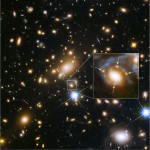
Astronomers have for the first time spotted four images of a distant exploding star, arranged in a cross-shape pattern by a powerful gravitational lens. In addition to being a unique sighting, the discovery will provide insight into the distribution of dark matter. The findings will appear March 6 in a special issue of the journal Science, celebrating the centenary of Albert Einstein’s Theory of General Relativity.
This image shows the light of a supernova split into four images by a foreground elliptical galaxy embedded in a giant cluster of galaxies. The four images were spotted on Nov. 11, 2014. Credit: NASA/ESATwo teams spent a week analyzing the object’s light, confirming it was the signature of a supernova, then turned to the W. M. Keck Observatory on Mauna Kea, in Hawaii, to gather critical measurements including determining the distance to the supernova’s host galaxy 9.3 billion light-years from Earth.
To explain the unique, four-up projection, the scientists determined a galaxy cluster and one of its massive elliptical members are gravitationally bending and magnifying the light from the supernova behind it, through an effect called gravitational lensing. First predicted by Albert Einstein, this effect is similar to a glass lens bending light to magnify and distort the image of an object behind it. The multiple images, arranged around the massive elliptical galaxy, form an Einstein Cross, a name originally given to a multiple-lensed quasar that appear as a cross.
Although astronomers have discovered dozens of multiply imaged galaxies and quasars, they have never seen a stellar explosion resolved into several images. “It really threw me for a loop when I spotted the four images surrounding the galaxy – it was a complete surprise,” said Patrick Kelly of the University of California, Berkeley, lead author of the paper and a member of the Grism Lens Amplified Survey from Space (GLASS) collaboration. The GLASS group is working with the FrontierSN team to analyze the supernova.
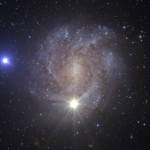
Scientists using the W. M. Keck Observatory and Pan-STARRS1 telescopes on Hawaii have discovered a star that breaks the galactic speed record, traveling with a velocity of about 1,200 kilometers per second or 2.7 million miles per hour. This velocity is so high, the star will escape the gravity of our galaxy. In contrast to the other known unbound stars, the team showed that this compact star was ejected from an extremely tight binary by a thermonuclear supernova explosion. These results will be published in the March 6 issue of Science.
An artist impression of the mass-transfer phase followed by a double-detonation supernova that leads to the ejection of US 708. Credit: ESA/Hubble, NASA, S. GeierStars like the Sun are bound to our Galaxy and orbit its center with moderate velocities. Only a few so-called hypervelocity stars are known to travel with velocities so high that they are unbound, meaning they will not orbit the galaxy, but instead will escape its gravity to wander intergalactic space.
A close encounter with the supermassive black hole at the centre of the Milky Way is typically presumed the most plausible mechanism for kicking these stars out of the galaxy.
A team of astronomers led by Stephan Geier (European Southern Observatory, Garching) observed the known high-velocity star know as US 708 with the Echellette Spectrograph and Imager instrument on the 10-meter, Keck II telescope to measure its distance and velocity along our line of sight. By carefully combining position measurements from digital archives with newer positions measured from images taken during the course of the Pan-STARRS1 survey, they were able to derive the tangential component of the star’s velocity (across our line of sight).
Putting the measurements together, the team determined the star is moving at about 1,200 kilometers per second – much higher than the velocities of previously known stars in the Milky Way galaxy. More importantly, the trajectory of US 708 means the supermassive black hole at the galactic center could not be the source of US 708’s extreme velocity.
A primitive ocean on Mars once held more water than Earth’s Arctic Ocean, according to NASA scientists who measured signatures of water in the planet’s atmosphere using the most powerful telescopes on Earth including the W. M. Keck Observatory in Hawaii. The results are being published in the journal Science on March 6, 2015.
NASA scientists have determined that a primitive ocean on Mars held more water than Earth’s Arctic Ocean and that the Red Planet has lost 87 percent of that water to space. Credit: NASA/GSFCThe young planet would have had enough water to cover the entire surface in a liquid layer about 450 feet (137 meters) deep. More likely, the water would have formed an ocean occupying almost half of Mars’ northern hemisphere, in some regions reaching depths greater than a mile (1.6 kilometers).
“Our study provides a solid estimate of how much water Mars once had, by determining how much water was lost to space,” said Geronimo Villanueva, first author of the paper and scientist at NASA’s Goddard Space Flight Center in Greenbelt, Maryland. “With this work, we can better understand the history of water on Mars.”
The new estimate is based on detailed observations of two slightly different forms of water in Mars’ atmosphere. One is the familiar H2O, made with two hydrogens and one oxygen. The other is HDO, a naturally occurring variation in which one hydrogen is replaced by a heavier form, called deuterium.
It snowed much of yesterday and well into the night. The result? Probably about a foot total at the summit, the Mauna Kea rangers report drifts of up to two feet in places. I am scheduled up top tomorrow, maybe some more photos?
A MastCam view peeking through the ice at the Keck 1 dome
It is snowing pretty hard on the summit of Mauna Kea right now. There were a few inches from the previous days, looks like quite a bit more by tomorrow…
Snow falling around the IRTF telescope on the afternoon of March 3, 2015
With the start of March the observatory known as JAC is no more. The Joint Astronomy Center ran two telescopes, the United Kingdom Infrared Telescope (UKIRT) and the James Clerk Maxwell Telescope (JCMT). Both telescopes have been transferred to new management and will continue to pursue science.
You can get more details on Tom Kerr’s blog A Pacific View.
I would also suggest you take a few minutes and enjoy some beautiful time-lapse to celebrate the achievements of the JAC…
NASA’s Dawn spacecraft has returned new images captured on approach to its historic orbit insertion at the dwarf planet Ceres. Dawn will be the first mission to successfully visit a dwarf planet when it enters orbit around Ceres on Friday, March 6.
This image was taken by NASA’s Dawn spacecraft of dwarf planet Ceres on Feb. 19 from a distance of nearly 29,000 miles (46,000 kilometers). Credit: NASA/JPL-Caltech/UCLA/MPS/ DLR/IDA“Dawn is about to make history,” said Robert Mase, project manager for the Dawn mission at NASA’s Jet Propulsion Laboratory in Pasadena, California. “Our team is ready and eager to find out what Ceres has in store for us.”
Recent images show numerous craters and unusual bright spots that scientists believe tell how Ceres, the first object discovered in our solar system’s asteroid belt, formed and whether its surface is changing. As the spacecraft spirals into closer and closer orbits around the dwarf planet, researchers will be looking for signs that these strange features are changing, which would suggest current geological activity.
“Studying Ceres allows us to do historical research in space, opening a window into the earliest chapter in the history of our solar system,” said Jim Green, director of NASA’s Planetary Science Division at the agency’s Headquarters in Washington. “Data returned from Dawn could contribute significant breakthroughs in our understanding of how the solar system formed.”
Dawn began its final approach phase toward Ceres in December. The spacecraft has taken several optical navigation images and made two rotation characterizations, allowing Ceres to be observed through its full nine-hour rotation. Since Jan. 25, Dawn has been delivering the highest-resolution images of Ceres ever captured, and they will continue to improve in quality as the spacecraft approaches.