Asteroid 2004 BL86 is not small, it is large enough for astronomers to take notice as it passed near the earth yesterday at a close, but safe distance of 745,000 miles. Numerous telescopes were trained on this object as it passed by, including a deep space radar at Goldstone that confirmed that the asteroid is about 1,100 feet in diameter. They did get a surprise as well, 2004 BL86 has a small moon.
Close approach was earlier in the day, thus it was some hours after that I was able to photograph the asteroid from Hawaii. The most difficult part in taking the photo is locating the object. An asteroid this close by will move across the sky very quickly. To locate the asteroid I used a high precision ephemeris generated by the JPL Horizons Database with time intervals of every half hour. This was necessary as the asteroid was moving several degrees each hour. If I used coordinates even an hour off it would have been out of the frame. It took half an hour of hunting, comparing frames taken a couple minutes apart.
Below is the streak created as the asteroid moves over the course of an eight minute exposure…
Asteroid 2004 BL86 just after close approach on January 26, 2015
Sunday night I shot a wide-field image of the comet as it passed near the Pleiades star cluster. I am somewhat disappointed by the image. The skies over Waikoloa are just not conducive to wide-field imaging. And with a couple scheduled mountain days I did not have the option to take the gear up to where conditions are better. Not and get any sleep. Still, it is not a total disaster…
Comet C/2014 Q2 Lovejoy passing by the Pleiades star cluster
The first good night for comet imaging since the moonlight has departed the evening sky. If is wasn’t clouds it was heavy haze and vog. With a good Saturday night I set up the ‘scope in the driveway and shot for a couple hours on comet C/2014 Q2 Lovejoy.
This is not a properly processed shot, rather just a quick stack of the longer exposures. The real image will be a few days before I can get about to processing it. Still, a lot of interesting detail in the tail…
Comet C/2014 Q2 Lovejoy, a rough processing job on 30 x 4min exposures taken with a Canon 6D and a TV-76mm ‘scope
A team of scientists recently discovered a system of three planets, each just larger than Earth, orbiting a nearby star called EPIC 201367065. The three planets are 1.5-2 times the size of Earth. The outermost planet orbits on the edge of the so-called “habitable zone,” where the temperature may be just right for liquid water, believed necessary to support life, on the planet’s surface. The paper, “A Nearby M Star with Three Transiting Super-Earths Discovered by K2,” was submitted to the Astrophysical Journal today and is available here.
This whimsical cartoon shows the three newly discovered extrasolar planets (right) casting shadows on their host star that can been seen as eclipses, or transits, at Earth (left). Credit: K. Teramura, UH IFA“The compositions of these newfound planets are unknown, but, there is a very real possibility the outer planet is rocky like Earth,” said Erik Petigura, a University of California, Berkeley graduate student who spent a year visiting the UH Institute for Astronomy. “If so, this planet could have the right temperature to support liquid water oceans.”
The planets were confirmed by the NASA Infrared Telescope Facility (IRTF) and the W. M. Keck Observatory in Hawaii as well as telescopes in California and Chile.
“Keck’s contribution to this discovery was vital,” said Andrew Howard, a University of Hawaii astronomer on the team. “The adaptive optics image from NIRC2 showed the star hosting these three planets is a single star, not a binary. It showed that the planets are real and not an artifact of some masquerading multi-star system.”
Due to the competitive state of planet finding, and the fact that time on the twin Keck telescopes are scheduled months in advance, the team asked UC Berkeley Astronomer, Imke de Pater to gather some data during her scheduled run.
Today Mercury will be at maximum eastern elongation, as high in the evening sky as it will appear for this current apparition. After today the planet will slide back into the sunset, passing through inferior conjunction on January 30th and reappearing in the dawn during the first weeks of February.
Some parts of the job are simply fun. Installing the various upgrades to the weather system has been just that. The latest piece of kit being more fun than usual.
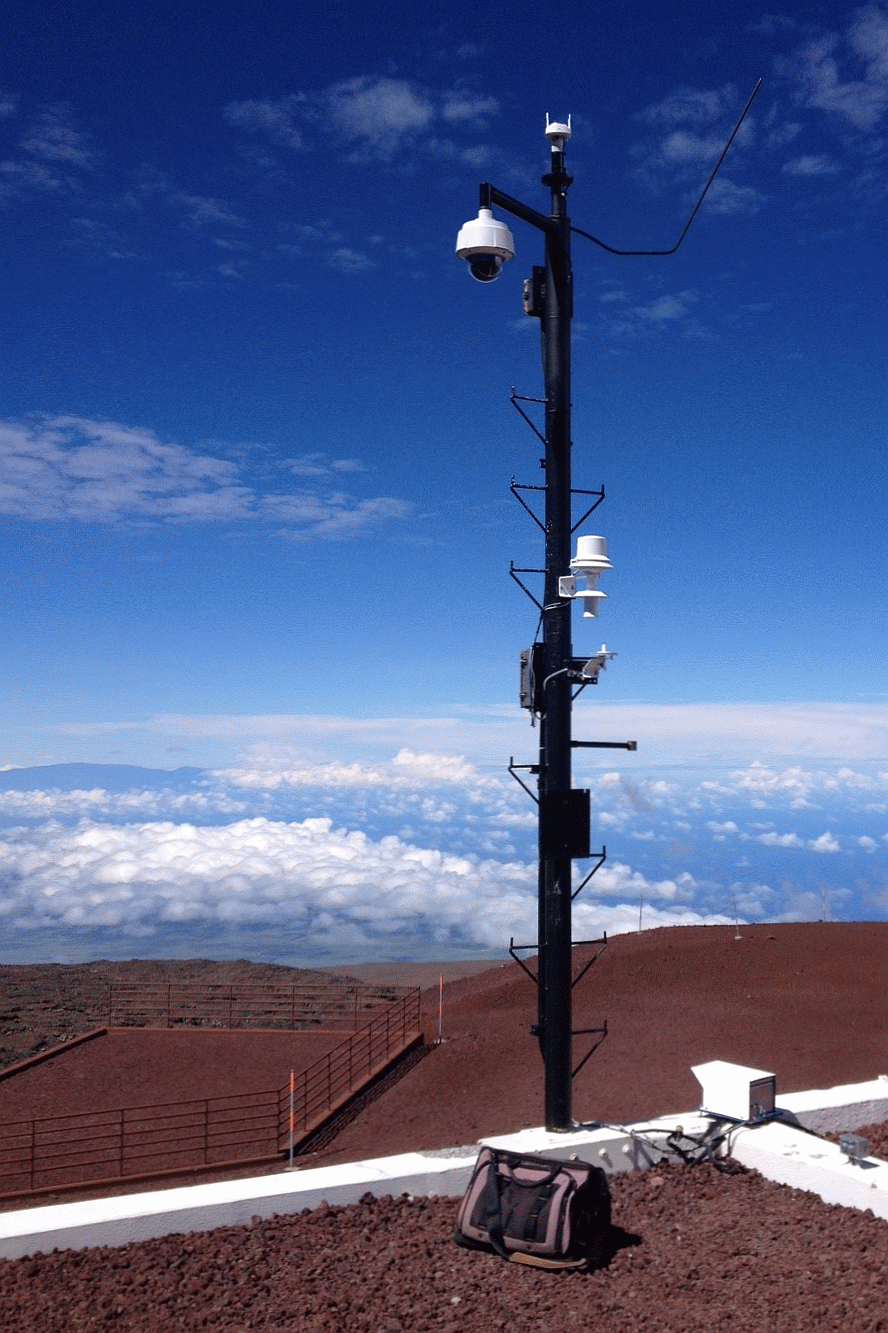
The Keck weather mast with a sonic anemometer at top, MastCam, and the housings for the temperature, humidity and barometric pressure sensors.We are installing a number of new cameras throughout the facility. Replacing an ancient CCTV system that still uses composite video and black and white monitors. Yeah, that ancient. The system is quite useful, it allows visibility of the telescopes from the operator stations and the manual control panels when you are driving the telescope.
Even that is topped by the camera I installed this fall. The latest camera is a new pan-tilt-zoom camera attached to the weather mast.
The camera does have more prosaic reasons to justify the effort of installing it. With the camera the operators can observe the weather conditions around the telescope, observing supervisors can view the ice and snow on the domes from Waimea, the day crew can check the weather conditions before driving to the summit, and more. The camera does have enough sensitivity to see the brighter stars and the banks of fog that roll over the summit. In full dark and at full gain the image is noisy and faint, not all that great. Given just a little moonlight the performance is much better, allowing visibility of oncoming clouds.
Hanging ice blocks the view of MastCam after a severe winter storm on January 4th, 2015Weather conditions can be extreme on the summit. Last week’s storm being a good example… 100mph sustained winds, 135mph gusts, more than a foot of ice coating any vertical surface and several inches on the ground. The camera is rated to survive such conditions, and has now survived its first major winter storm. Electronic operation is guaranteed by the manufacturer for -40°C, and there is a heater and blower inside the camera dome to remove ice. It was able to melt its way clear, at least partially on the first day, while it took a week to clear the domes for operation.
Even more fun! On Christmas Eve I was contacted by Hawaii News Now for photos of the storm, they were eager to do something about a white Christmas for the evening news. As I had not been to the summit and no one on our crew was up, I simply grabbed some MastCam images and forwarded them. The images were aired in the first couple minutes of the Honolulu evening news!
The camera is not available to the public, it would be too much wear and tear to the pan-tilt mechanism and a huge hog of bandwidth. You have to be inside the Keck network to use, from there it is available to anyone on staff. It has proven quite popular, with many folks using the imagery to check on mountain conditions in the latest bad weather.
Next up, yet more cameras in the dome and even a couple on top of the domes. there is also a precipitation sensor and more in the works for the weather station.
OK, enough fun, back to revising the Keck 2 dome schematics.
Mercury and Venus will be in a close conjunction this evening. While the pair has been drawing closer for the last week, tonight will see them at their closest, about 38′ separation.
Look for the bright planet Venus low in the sunset. Mercury will slightly down and to the north of Venus. A separation of 38′ is just a bit more that the width of the full Moon. Both objects are fairly bright, with Venus shining at -3.9 magnitude and Mercury at -0.7. Bright enough to be quite obvious, the pair will be 17° above the horizon at sunset.
Over the coming week the pair will slightly separate. Mercury will be at maximum elongation on January 14th, after which it will begin its slide back into the sunset.
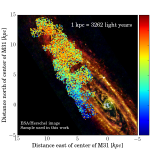
Dots show locations of stars in the Keck Observatory spectroscopic survey superimposed on an image of Andromeda. Credit: Claire Dorman/ESAA detailed study of the motions of different stellar populations in Andromeda galaxy by UC Santa Cruz scientists using W. M. Keck Observatory data has found striking differences from our own Milky Way, suggesting a more violent history of mergers with smaller galaxies in Andromeda’s recent past. The findings are being presented on Thursday, January 8, at the winter meeting of the American Astronomical Society in Seattle.
The structure and internal motions of the stellar disk of a spiral galaxy hold important keys to understanding the galaxy’s formation history. The Andromeda galaxy, also called M31, is the closest spiral galaxy to the Milky Way and the largest in the local group of galaxies.
“In the Andromeda galaxy we have the unique combination of a global yet detailed view of a galaxy similar to our own. We have lots of detail in our own Milky Way, but not the global, external perspective,” said Puragra Guhathakurta, professor of astronomy and astrophysics at the University of California, Santa Cruz.
The new study, led by UC Santa Cruz graduate student Claire Dorman and Guhathakurta, combined data from two large surveys of stars in Andromeda conducted at the Keck Observatory in Hawaii as well as data from the Hubble Space Telescope.
The storm that deposited a heavy layer of ice on Mauna Kea has kept Keck Observatory shuttered for a week now. The last night we observed was New Year’s Day. Despite clear skies, there was just too much ice on the domes that could come crashing in on the telescope if we attempted to open. For a few days the Keck II dome was frozen in place by a pile of solid ice against the lower skirt.
We just got word that day crew, with a little solar help, has cleared the worst of the ice from the domes and we will be observing tonight.
Ice on the Keck 2 dome ladders after the New Year’s storm of 2015