This photo is getting a little comment, no surprise, it is hilarious. When I stopped at park two to look around I had no idea and when I saw it I broke out laughing. Alone on the side of an ice covered mountain, laughing loudly with no one to hear but the wind…
Over the next week Mercury and Venus will rendezvous in the sunset. This evening will see the two separated by 48′, well under one degree. This will close to about 38′ on the evening of January 10th, just a little over the width of a full Moon apart. Both objects are fairly bright, with Venus shining at -3.9 magnitude and Mercury at -0.7. Bright enough to be quite obvious, the pair will be 17° above the horizon at sunset.
The instruments were warming up. Liquid nitrogen exhausted, cooling interrupted by loss of power, the cryogenic dewars had begun to warm. Recovering instruments takes many days of vacuum pumps and re-cooling to restore function if cooling has been loss. Other problems caused by the storm and power outages plagued the summit, some systems not responding to remote queries.
Keck Observatory covered in heavy iceOn Friday, the crew had abandoned early in the day in the face of deteriorating weather conditions. With the storm raging, no one had made it to the summit on Saturday. We all watched as remote weather instruments reported sustained winds of over 100mph and gusts as high as 134mph. With the wind came freezing fog, a thick coating of ice forming on every surface. The snowplow crews did not even try Saturday, it was just too dangerous.
Sunday offered at least a hope of making it to the summit. The storm had abated and beautiful sunny skies appeared over the summit. We readied for an attempt at the summit of Mauna Kea. As the engineer on call I would join the support techs at the summit. Maybe we could salvage something from the chaos.
Today the Earth is closest to the Sun, a point called perihelion. We will be about 147,099,000km (91,403,000miles) from the Sun. Compare this to the 152,096,000km (94,508,000miles) we will be at aphelion on July 6th, a difference of about 4,996,000km (3,104,000miles) occurs throughout one orbit.
It may seem odd that we are actually at the closest for the middle of northern winter, you just have to remember that proximity to the Sun is not the cause of the seasons. The seasons are caused by the axial tilt of the Earth, creating short and long days throughout the year, with a resulting change in the angle and intensity of the sunlight.
The first meteor shower of 2015 is the annual Quadrantid meteor shower. The Quadrantids are a reliable shower, producing 60-120 ZHR, one to two meteors per minute. The Quadrantids are named for the obsolete constellation Quadrans Muralis, now part of the constellation Boötes.
A pair of Leonid meteors streak through OrionUnlike other showers where activity can occur for days or even weeks, the Quadrantids have a sharp peak, activity falls off rapidly on the preceding and following nights, or even a few hours away from the peak. Thus it is important to observe the Quadrantids quite near the peak prediction. For 2015 the peak is predicted for January 4th around 02:00UT, or January 3rd at 16:00HST on this side of the globe, mid-afternoon. The shower radiant in Boötes does not rise until around 2am local time. Combine the light of a full moon and poor timing and you quickly see that observing conditions are less than ideal for observing this year’s shower.
Back on August 17th, Australian amateur astronomer Terry Lovejoy disocvered a very nice Christmas gift for us all to enjoy… A bright comet that we have now unwrapped and are able to enjoy through the new year.
Comet C/2014 Q2 Lovejoy is currently passing through perihelion. While closest to the Sun and the Earth it will be at its brightest during the first couple weeks of January. For northern hemisphere observers the comet is currently low in the southern sky and getting brighter each day.
Comet C/2014 Q2 Lovejoy as it appeared on the night of 20Dec2104, 28 x 4min with a Canon 6D and a TV-76mm ‘scopeYou can not simply call this comet Lovejoy. Terry Lovejoy has been quite successful in catching comets, with five discoveries to his credit. As a result there are five comets that bear the name Lovejoy. To properly identify which comet you are referring to you should use the full designation, C/2014 Q2 Lovejoy, as clumsy as that is in conversation.
The comet passes through perihelion on January 30th of 2015. For earthbound observers it will be at its brightest during the first weeks of January, reaching near 4th magnitude. It is currently visible around 5th magnitude in the faint constellation of Columba south of Orion. It has been visible without optical aid for a few weeks, as long as you have access to a dark sky and know where to look. As it brightens it will be easily visible, even rather obvious. With binoculars the view will be even better, a bright fuzzball with a wispy tail.
The current position and orbital path of comet C/2014 Q2 Lovejoy from the JPL Horizons systemOne of the best parts is that this comet will be well placed for observing through its perihelion passage. Longtime comet observers are used to looking for comets in the sunset or in the dawn sky as they near perihelion. Comet C/2014 Q2 has a perihelion that is just outside of the Earth’s orbit, and happens to pass by just as our planet reaches that part of it’s orbit. This puts the comet high in the midnight sky. No trying to catch the comet in bright twilight before the Sun comes up.
The next thing you may note about the orbital diagram is that the comet has a high inclination to the ecliptic. Currently approaching from underneath the plane of the solar system, the comet will exit north of our Sun. The practical side of this, is that over the next few weeks the comet will move northwards across the sky, rising higher each night. While our friends down south have been enjoying nice views of the comet approaching perihelion, it is northern hemisphere observers that will be able to best view the comet after perihelion.
The apparent path of comet C/2104 Q2 Lovejoy against the starsThe path of comet Lovejoy is shown in the diagram included here. The comet is plotted for today, December 28th at 0:00h. There is also a tick mark for January 11th near the top of the chart. A sweep with binoculars along this path will quickly locate the comet. There are no deep sky objects along this path that are bright enough to be confused with the comet. See a bright fuzzball? You found it.
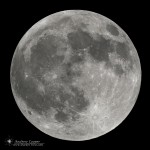
One issue will be the bright Moon. Currently a waxing half phase, the Moon will be full on January 4th. This will make spotting the comet much more difficult and completely drown out the faint tail. By 9th or 10th the Moon will have waned enough to make comet viewing much more successful.
As January fades, so will comet C/2014 Q2. By the end of the month the comet will slip below unaided eye visibility, while staying within reach of binoculars through April or so. Sky watchers will be able to follow the comet for months betond that with the aid of a telescope. Enjoy the comet while you can, 8,000 years will pass before this comet returns to the inner solar system.