
Tonight the Moon and Jupiter will be close. The Moon will rise first, followed by Jupiter rising about 22:19HST. The Moon will be about 78% illuminated and about 9° from the bright planet. Tomorrow night the Moon will have moved to the other side of Jupiter and be a bit closer, about 7° separation.
Category: Astronomy
Exploring the cosmos
Mercury at Superior Conjunction
Today Mercury passes through superior conjunction, passing behind the Sun as seen from the Earth. The planet will appear in the sunset in ten days or so, reaching maximum elongation on January 14th.
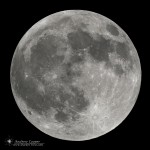
Full Moon
Scientists Accurately Quantify Dust Around Planets in Search for Life
W. M. Keck Observatory press release…
A new study from the Keck Interferometer, a former NASA project that combined the power of the twin W. M. Keck Observatory telescopes atop Mauna Kea, Hawaii, has brought exciting news to planet hunters. After surveying nearly 50 stars from 2008 to 2011, scientists have been able to determine with remarkable precision how much dust is around distant stars – a big step closer into finding planets than might harbor life. The discovery is being published in the Astrophysical Journal online, on December 8th.

The Keck Interferometer was built to seek out this dust, and to ultimately help select targets for future NASA Earth-like planet-finding missions.
Like planets, dust near a star is hard to see. Interferometry is a high-resolution imaging technique that can be used to block out a star’s light, making the region easier to observe. Light waves from the precise location of a star, collected separately by the twin 10-meter Keck Observatory telescopes, are combined and canceled out in a process called nulling.
“If you don’t turn off the star, you are blinded and can’t see dust or planets,” said co-author Rafael Millan-Gabet of NASA’s exoplanet Science Institute at the California Institute of Technology in Pasadena, California, who led the Keck Interferometer’s science operations system.
Continue reading “Scientists Accurately Quantify Dust Around Planets in Search for Life”
Venus Appears in the Sunset

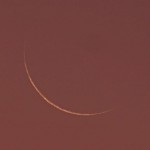
On the 22nd Venus will joined by a thin crescent Moon. Only 1.8% illuminated the Moon will be a beautiful pair with the planet, only 6° away.
New Moon
Evicted? Possible Black Hole Found 2,600 Light Years from Home
W. M. Keck Observatory press release…
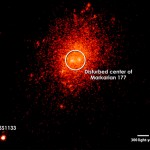
The mystery object is part of the dwarf galaxy Markarian 177, located in the bowl of the Big Dipper, a well-known star pattern within the constellation Ursa Major. Although supermassive black holes usually occupy galactic centers, SDSS1133 is located at least 2,600 light-years from its host galaxy’s core. The team was able to detect it in astronomical surveys dating back more than 60 years.
In June 2013, the researchers obtained high-resolution near-infrared images of the object using the 10-meter Keck II telescope at Keck Observatory. “When we analyzed the Keck data, we found the emitting region of SDSS1133 is less than 40 light-years across, and that the center of Markarian 177 shows evidence of intense star formation and other features indicating a recent disturbance that matched what we expected for a recoiling black hole,” said Chao-Ling Hung, a UH Manoa graduate student performing the analysis of the Keck Observatory imaging in the study.
Continue reading “Evicted? Possible Black Hole Found 2,600 Light Years from Home”
The Sky Is Falling
Yes… The sky is falling… Literally.
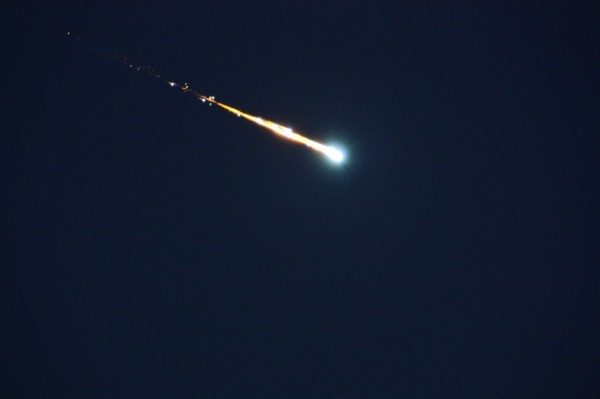
Anyone who spends a good amount of time observing the night sky is well aware of how common meteors are. On any given night you will see five to ten meteors an hour is you observe carefully from a dark site. This rate goes up dramatically during a meteor shower. Most of the meteors you will see are quite small, ranging from dust grains to smallish sand sized bits. Anything large can be quite spectacular. Something the size of a pebble will create a bright meteor, a bright fireball that streaks across the sky.

Estimates vary widely, but something like 50,000 tons of meteoric material rains down on the Earth every year. The process that allowed our planet to form continues to this day.
Occasionally a larger object enters the atmosphere. Something big enough to reach the ground intact. Or even something big enough to cause damage from the impact. How often this occurs would be a surprise to most of our fellow citizens who pay little attention to the the natural world around them.
The Chelyabinsk event got the world’s attention. A medium sized object exploded in the atmosphere directly over a mid-sized city causing modest damage. Due to the prevalence of camera gear in modern Russia we were treated to an unprecedented view of this event. With historical events like Tunguska, all we have is eyewitness accounts and a few grainy black and white photographs of the damage taken years after the impact. Now we get dozens of videos of the event that detail how it occurred from dozens of viewpoints.
While this event is unusual, it was not unprecedented, objects of this size will continue to impact our planet. Meanwhile the event fades from public awareness, at least until it happens again… Which it will.
To drive home this point researchers at NASA’s Near Earth Object (NEO) Program have released a map of impacts over the last few years. Using atmospheric sensors that detect the pressure wave of the airburst they were able to locate and estimate the size of the larger events. For further details you can read the press release.
The Chelyabinsk meteor can be seen as a large dot over southern Russia. That event may be the largest dot on the map, but it is not alone. It is the number of other dots that may surprise some people. Our planet is impacted regularly.
The Moon and Jupiter
Tonight the Moon and Jupiter will be close. The Moon will rise first, followed by Jupiter a few minutes after midnight. The Moon will be about 59% illuminated and about 12° from the bright planet. Tomorrow night the Moon will have moved to the other side of Jupiter and be much closer, about 5° separation.
Astronomers Thrilled by Extreme Storms on Uranus
W. M. Keck Observatory press release…
The normally bland face of Uranus has become increasingly stormy, with enormous cloud systems so bright that for the first time ever, amateur astronomers are able to see details in the planet’s hazy blue-green atmosphere.
“The weather on Uranus is incredibly active,” said Imke de Pater, professor and chair of astronomy at the University of California, Berkeley, and leader of the team that first noticed the activity when observing the planet with adaptive optics on the W. M. Keck Observatory in Hawaii.

In all, de Pater, Hammel and their team detected eight large storms on Uranus’s northern hemisphere when observing the planet with the Keck Observatory on August 5 and 6. One was the brightest storm ever seen on Uranus at 2.2 microns, a wavelength that senses clouds just below the tropopause, where the pressure ranges from about 300 to 500 mbar, or half the pressure at Earth’s surface. The storm accounted for 30 percent of all light reflected by the rest of the planet at this wavelength.
When amateur astronomers heard about the activity, they turned their telescopes on the planet and were amazed to see a bright blotch on the surface of a normally boring blue dot.
‘I got it!’
French amateur astronomer Marc Delcroix processed the amateur images and confirmed the discovery of a bright spot on an image by French amateur Régis De-Bénedictis, then in others taken by fellow amateurs in September and October. He had his own chance on Oct. 3 and 4 to photograph it with the Pic du Midi one-meter telescope, where on the second night, “I caught the feature when it was transiting, and I thought, ‘Yes, I got it!’” said Delcroix.
Continue reading “Astronomers Thrilled by Extreme Storms on Uranus”