The Leonids are one of the better known annual meteor showers. Some years see high Leonid activity, with amazing numbers of meteors. This shower has occasionally created true meteor storms. Unfortunately 2014 is not predicted to be one of those years, with very modest numbers expected.
A pair of Leonid meteors streak through OrionThe shower will peak on November 17 around 22:00UT, with an expected ZHR of around 15 meteors per hour. While this occurs in the middle of the day for the islands, the Leonids exhibit a broad peak allowing viewing for days before and after maximum. Moonlight should not be a problem with a thin waning crescent in the sky.
Due to the gravitational influence of Jupiter, the Leonids are not expected to produce any exceptional showers for some decades. We are unlikely to see any repeats of the early 21st century storms anytime soon.
Living in Hawaiʻi you pick up a few additions to your vocabulary. For centuries the islands have been a stew of languages, each borrowing words from one another. Hawaiian, Portuguese, Chinese, Japanese, English, Spanish and more have all added to the flavor of these islands. Everyone uses a few words from other languages in everyday conversation. Then there are local folks who grew up speaking the full mixture, a pidgin unique to the islands.
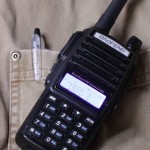
A handheld radio used at Keck for daily communication.Working with a bunch of island guys you need to learn a bit of pidgin simply to understand the conversations around you. To an English speaker, such as myself, the syntax seems mixed about. The words are mostly English and Hawaiian, with a clear context and a little exposure you begin to pick it up. After a while it seems natural to hear pidgin around you.
Some of the words that Hawaiian supplies seem much better than the English equivalents, it is understandable that they are used in preference to the English words. Some are simply more appropriate on an island… Mauka and Makai make perfect sense where everything is either towards the mountain or towards the sea. Puʻu us the perfect name for the numerous volcanic hills that dot the island. Puka, for small hole, just sounds right.
My favorite is Pau, meaning finished or done, a word that is commonly heard on the Keck radio channels. “How are you guys doing up there?” might go the radio chatter, “We all pau!” Something about the word just works, the sound and the meaning in agreement.
I expect these words will stay in my vocabulary, alongside British expressions I picked up living in England decades ago. Language is a fluid and dynamic thing, part of the richness of our lives.
The mystery about a thin, bizarre object in the center of the Milky Way headed toward our galaxy’s enormous black hole has been solved by UCLA astronomers using the W. M. Keck Observatory, home of the two largest telescopes on Earth. The scientists studied the object, known as G2, during its closest approach to the black hole this summer, and found the black hole did not dine on it. The research is published today in the journal Astrophysical Journal Letters.
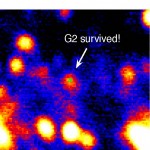
An image from W. M. Keck Observatory near infrared data shows that G2 survived its closest approach to the black hole. Credit Andrea Ghez/Gunther Witzel/UCLA Galactic Center Group/W. M. Keck ObservatoryWhile some scientists believed the object was a cloud of hydrogen gas that would be torn apart in a fiery show, Ghez and her team proved it was much more interesting.
“G2 survived and continues happily on its orbit; a gas cloud would not do that,” said Andrea Ghez, UCLA professor of physics and astronomy who holds the Lauren B. Leichtman and Arthur E. Levine Chair in Astrophysics, and directs the UCLA Galactic Center Group. “G2 was completely unaffected by the black hole; no fireworks.”
Instead, the team has demonstrated it is a pair of binary stars that had been orbiting the black hole in tandem and merged together into an extremely large star, cloaked in gas and dust, and choreographed by the black hole’s powerful gravitational field.
“G2 is not alone,” said Ghez, who uses Keck Observatory to study thousands of stars in the neighborhood of the supermassive black hole. “We’re seeing a new class of stars near the black hole, and as a consequence of the black hole.”
Ghez and her colleagues — who include lead author Gunther Witzel, a UCLA postdoctoral scholar in Ghez’s research group, and Mark Morris, a UCLA professor of physics and astronomy — studied the event with both of the 10-meter telescopes at Keck Observatory.
Today Mercury reaches maximum elongation, the furthest point it will reach from the Sun in the sky and the highest it will be above the sunrise for this morning apparition. The planet is easily visible as a bright, starlike object about 19° above the rising Sun as the twilight begins. Over the next couple weeks Mercury will slide back into the sunrise, heading for superior conjunction on December 7th.
Today, at 20:55HST, Venus will pass superior conjunction, passing around the far side of the Sun as seen from Earth. The planet will begin to rise into the evening sky in early December, arriving at maximum elongation June 6th, 2015.
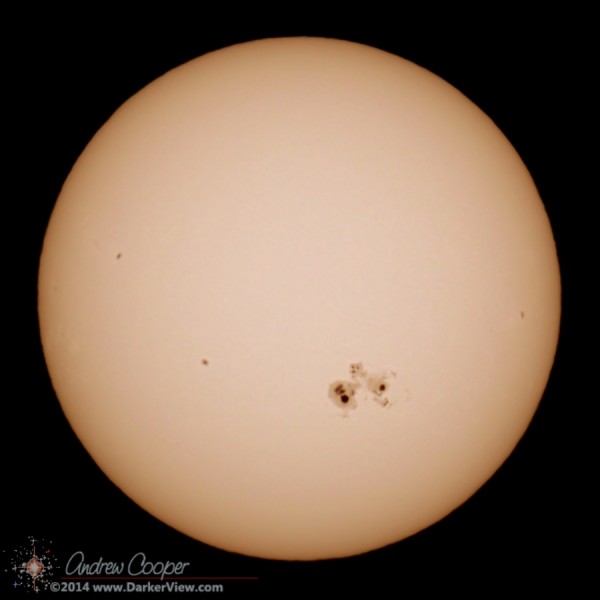
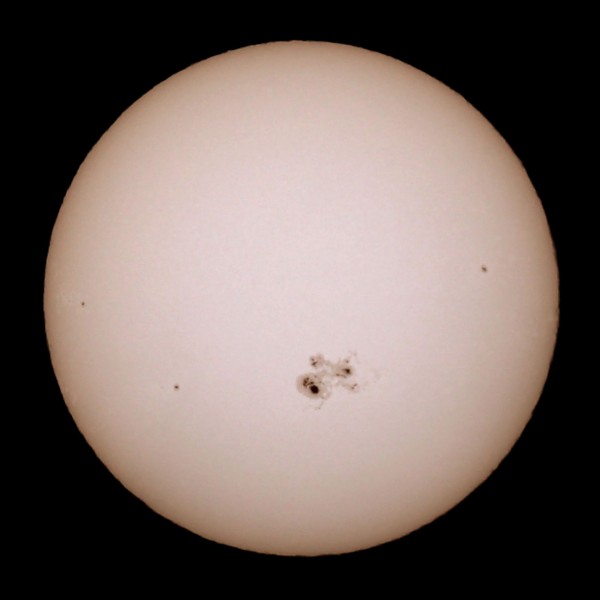
Sunspot complex AR2192 is the largest I have seen in a long time. Easily visible without a telescope, simply using appropriate eye protection. It is quite large, more than ten times the diameter of the Earth. There are reports of it being noticed at sunset.
I photographed the sunspot during lunch fron Waimea, setting up a little telescope next to my vehicle in the Keck parking lot. The photo was taken using a TV-76mm telescope, the EOS-M camera and a Baader solar film filter, the same setup I viewed the Venus transit with.
Of course there was a partial solar eclipse today, visible across western North America. Photos of this enormous sunspot and the eclipse are now being posted across the web. Unfortunately this eclipse was not visible from Hawai’i. If you have not taken a look, I urge you to step outside with your solar viewing glasses and take a quick look. You do have solar viewing glasses handy… Right?
Sunspot complex AR2192 on 23 October, 2014, Canon EOS-M and TV-76mm telescope
A very young moon over Waikoloa, this is only 26 hours after new, visible to the unaided eye as a sliver in the fading glow of sunsetNew Moon will occur today at 11:57HST.
A partial solar eclipse will sweep across western North America today, from Alaska to Mexico. For those in the best possible place the Moon will cover about 80% of the Sun. The eclipse will be visible for some distance out into the Pacific, but will not be visible in Hawai’i.