Here we go with hurricane two for the season. The forecast continues to put the island of Hawaiʻi directly in the path of the storm. If anything the news is a little worse, with the storm tracking up the west side of the island.
I suspect we will need to take this storm even more seriously than Iselle. Time to put the patio furniture away again, and check around the house for anything loose that may be an issue. Pick a few of my ripe grapefruits as well.
The observatory is reactivating the response plan we had a chance to refine and put into action for hurricane Iselle. Time to batten down the hatches, somewhat literally in the case of the summit facility. We are working on the Keck 1 shutter today, checking the seals and resetting the fully closed position to deal with some leaks.
The predicted path for hurricane Ana from the Pacific Hurricane Center
I usually have a list of things that need done on the summit. Mostly manini things, stuff that takes a few minutes, or maybe an hour. Not enough to justify a day on the summit, this stuff can usually wait for a week or two, until I find time. When a more serious issue takes me to the summit, something that must be done, it may take an hour, or half a day. When the main thing is done I always have the list to fill in the remainder of the day.
The list of things to do on the summit.There were three things on the list, one that had to get done. No problem, I will be on the summit tomorrow. A phone call added another item to the list. A co-worker stopping by my desk with a favor to ask… One more item added. When the end of the day was finally upon me, the list had grown to ten items. It usually works that way.
A small yellow-lined piece of paper pulled from a pad, a scrap that would rule my day on the summit. I slip the list into my left breast pocket beside a black ball-point pen.
Attach a data logger to the K2 shutter drive controllers and move the top shutters. The data looks… Ummm… interesting. That will wait for another day to analyse. The shutters have been faulting out a bit lately, there is something wrong with the VFD drives, but I am not sure what. Hopefully the answer is in the data. Much of the morning is consumed with getting the test done.
Align the WYKO interferometer under the AO bench… No problem, takes five minutes… After I gown up to enter the AO enclosure. I can replace the wave front camera controller while I am in there, just swapping the unit with the controller from the development lab at headquarters. Alignment complete, nice fringes on the video monitor… Sam will be happy with that.
Time for lunch and a game of cribbage, a busy day makes this break all that much more enjoyable, It is a fun game, even if we do lose. We do not keep score, we play for fun and bragging rights for the day. All is forgotten a day later, with years of experience the skill level is pretty even and everyone takes a turn winning or losing.
A tour at 1pm, some family friends from Portland getting a tour of the telescope, always fun. A meeting at 3pm… I forget what for now… It must have been terribly important. The day was just a mite hectic, hurrying from task to task. Slowly the list dwindled as I cross off items.
As we headed down the mountain, I pulled the now well tattered list from my pocket. Not complete, a couple items will wait for another day. But still… A sense of satisfaction, of accomplishment. None of these tasks were of major importance, none would stop the telescope from going on-sky that night, just the routine minutiae of keeping the telescopes operating.
It is currently snowing on the summit. Not just a dusting this time, but a real blanket of white on the mountain. Poliʻahu has returned to the summit. The forecast is calling for up to three inches of white before tomorrow morning.
We just got word that the Keck summit crew is abandoning the summit. They are leaving before the conditions get worse.
A photo from a UKIRT webcam is below. I would post one from our Keck cameras, but the camera windows are covered with blown snow and ice. I have a new all-weather webcam, a full pan-tilt-zoom unit to install, but it is still sitting in a box at the summit. Personally I am not planning being up until Wednesday, I wonder if the snow will still be there, fresh snow on the mountain is always pretty.
The first winter storm on Mauna Kea for the 2014-2015 season blankets the summit in white.
Our new CloudCam is undergoing testing. It assembles a video each night, just like the original CFHT CloudCam. The website is not quite public yet, but I had to share this one…
Heather mentioned at breakfast that she had been watching thunderstorms on CloudCam as she ran the telescope through the night. Thanks to the new camera we can all enjoy the spectacle.
The University of California has appointed Claire Max, professor of astronomy and astrophysics at UC Santa Cruz, to serve as director of UC Observatories on an interim basis while an international search is conducted to appoint a permanent director. Max succeeds Sandra Faber, whose two-year appointment as interim director ended in June.
Claire Max, credit: University of CaliforniaMax is internationally known for her research in plasma physics, astronomy, and astronomical instrumentation. A pioneer in the field of adaptive optics, she has served as director of the Center for Adaptive Optics at UC Santa Cruz. Max is a member of the National Academy of Sciences and a fellow of the American Academy of Arts and Sciences, the American Physical Society, and the American Association for the Advancement of Science. She received the U.S. Department of Energy’s E. O. Lawrence Award in Physics in 2004.
UC Observatories (UCO) is a multicampus research unit headquartered on the UC Santa Cruz campus. UCO operates the Lick Observatory on Mount Hamilton and the UCO Technical Labs at UC Santa Cruz and UCLA, and is a managing partner of the W. M. Keck Observatory in Hawaii. UCO is also the center for UC’s participation in the Thirty-Meter Telescope (TMT) project.
The board of the W. M. Keck Observatory is pleased to announce that Hilton Lewis has been appointed Director of Keck Observatory, effective immediately. He has served as the Interim Director since May.
Hilton Lewis, Director, W. M. Keck Observatory, credit Ethan Tweedie“The board is delighted that Hilton has agreed to take on this substantial responsibility,” said Ed Stolper, Chairman of the California Association for Research in Astronomy board, which manages Keck Observatory. “In his many years of service at Keck Observatory, and in the past four months as its Interim Director, Hilton has demonstrated his technical, managerial and leadership skills, and his commitment to the observatory. We are pleased that we have been able to attract such an outstanding and experienced leader to serve as our next Director”.
“We are delighted to welcome Hilton Lewis as the new Director of Keck Observatory. Hilton has a deep understanding of the opportunities and challenges that lie ahead for the observatory, a thorough knowledge of its workings, and the strategic vision to keep Keck Observatory at the forefront of astronomical research,” said UC Santa Cruz Chancellor George Blumenthal, who also serves as the vice chair of the Keck Observatory board.
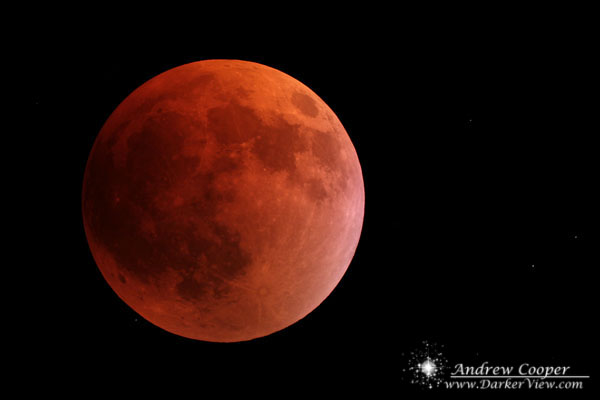
A total lunar eclipse will occur on the next full Moon, Oct 8th. The eclipse will be visible across much of the western hemisphere, including the west coast of North America and across the Pacific. This is an excellent eclipse for observers here in Hawai’i, the entire eclipse will be visible from start to end.
Total lunar eclipse, photo is a 8sec exposure with a Canon 20Da on a 90mm f/12 APOSome references note that this eclipse will occur on the 8th, and so it will for much of the world. For Hawai’i this will start late on the 7th when considering the time zone correction.
The Moon will be thoroughly submerged in the umbra, the darkest part of the Earth’s shadow, with an umbral magnitude of 1.16. The Moon will not pass directly through the umbra, but rather through the northern section, thus the north pole of the Moon will remain somewhat brighter, even at maximum. The eclipse occurs at the Moon’s descending node in southern Pisces, two days after perigee (October 06 at 09:41 UT). This means that the Moon will appear 5.3% larger than it did during the April 15 eclipse (32.7 vs. 31.3 arc-minutes).
Observing a total lunar eclipse requires no special equipment, simply the desire to look up. The most useful piece of equipment will be a reclining chair or some other method of staying comfortable while watching the sky. A pair of binoculars or small telescope can provide beautiful views of the Moon during an eclipse. Photography is somewhat more challenging, but not that difficult. Focal lengths of around 1000mm will fill the field of most DSLR cameras allowing photos like that shown here.
Penumbral Eclipse Begins
22:15:33 HST
08:15:33 UT
Partial Eclipse Begins
23:14:48 HST
09:14:48 UT
Total Eclipse Begins
00:25:10 HST
10:25:10 UT
Greatest Eclipse
00:54:36 HST
10:54:36 UT
Total Eclipse Ends
01:24:00 HST
11:24:00 UT
Partial Eclipse Ends
02:34:21 HST
12:34:21 UT
Penumbral Eclipse Ends
03:33:43 HST
13:33:43 UT
Timing for the 7Oct2013 total lunar eclipse
The entire eclipse will be visible during the night, quite convenient for amateur and casual sky-watchers. This is an excellent eclipse to publicize and use for outreach purposes.
Over the next few days the planet Mars will pass the bright star Antares. The two appear so similar in color and magnitude that the star’s name derives from Mars… The name Antares is from Anti-Ares or opposite of Mars. Recalling that the Greek name for the god of war Mars was Ares.
These two will appear close for several days, passing closest on the September 27th at a distance of 3.1°. Mars will be shining brightly at magnitude 0.8 while Antares will be very slightly dimmer at 1.1, almost too close to differentiate. The coloration is also quite close, a ruddy orange, making the two almost indistinguishable. Mars will be the one to the west. Both will be easily visible in the south after sunset.