Comet C/2014 E2 Jacques

A bright comet is always a good reason to drag the telescope out of the garage. In this case it is comet C/2014 E2 Jacques, currently about magnitude 7 in Cepheus. The comet is rising over the house about 9pm and available for shooting from my usual driveway setup location.

Setup went pretty smoothly, I have not changed anything in the basic configuration for a while. Shooting the Canon 6D on the TV-76mm scope. I did have some issues getting the autoguider to calibrate. The low magnification and high latitude meant the the calibration moves are just too small. Realizing that this also meant that any potential guide errors would also be small, I just shut the autoguider off. No guiding errors are visible in the four minute exposures.

C/2014 E2 Jacques
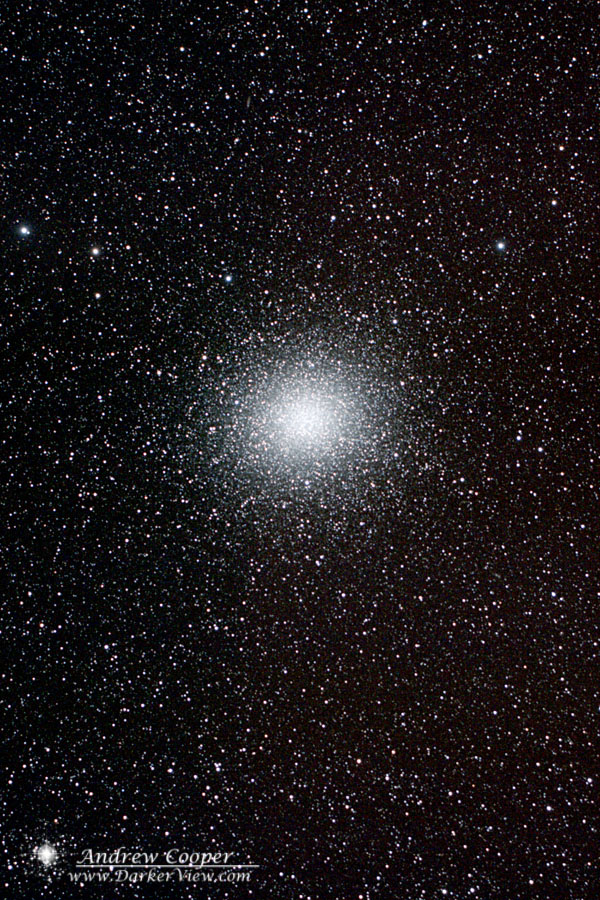
Comet C/2014 E2 Jacques on the evening of 27Aug2014, single 240s exposure with a Canon 6D and a TV-76mm telescope

Yes, the shot looks pretty bad… The frame is a quick process of a single sub-frame, just a white balance and curve adjustment in Photoshop. As I write this there are 13 completed exposures with another 17 to go. I do not think I will complete the sequence, I do need to go to bed sometime soon, I have to head to Hilo early tomorrow morning for a conference at Gemini.

Given a couple dozen good exposures I should be able to produce a much better image than is seen here. So far all of the sub-frames look good indeed, nice signal to noise, a bit of nebulae showing near the comet, and maybe a trace of the wispy ion tail. It will be a few days before I have a chance to properly process the image.

Merging Galaxies in the Distant Universe Through a Gravitational Lens

ESA/Hubble press release

H-ATLAS J142935.3-002836
Galaxy H-ATLAS J142935.3-002836 seen in a composite of Hubble and Keck 2 data, credit NASA/ESA/ESO/W. M. Keck Observatory
The NASA/ESA Hubble Space Telescope and many other telescopes on the ground and in space have been used to obtain the best view yet of a collision that took place between two galaxies when the Universe was only half its current age. The astronomers enlisted the help of a galaxy-sized magnifying glass to reveal otherwise invisible detail.

These new studies of the galaxy have shown that this complex and distant object looks surprisingly like the well-known local galaxy collision, the Antennae Galaxies.

In this picture, which combines views from Hubble and the Keck-II telescope on Hawaii (using adaptive optics), you can see a foreground galaxy that is acting as the gravitational lens. The galaxy resembles how our home galaxy, the Milky Way, would appear if seen edge-on. But around this galaxy there is an almost complete ring — the smeared out image of a star-forming galaxy merger far beyond.

Postcard from the Summit – From the Top

The view from the top of the dome is dramatic. It has been a couple years since I had cause to climb to the top of the dome. In one week I ended up going top the top twice for different reasons. The ladders, stairways and full climbing gear do not prevent me from taking the full size DSLR…

From the Top
The view from the top of the Keck 1 dome

The Keck CloudCam

It works! We now have a CloudCam at Keck. It is not quite ready for full active service, but it is alive and taking images. I got the network connection running yesterday, after mounting the camera and running the various cables over the last couple weeks. A little time for commissioning and getting the software setup and the camera will be available to everyone.

Keck CloudCam
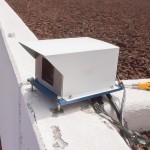
The housing for the Keck CloudCam ready for the worst in Mauna Kea weather.

Our camera was built by Kanoa over at the Canada France Hawaii Telescope. Kanoa built the first CloudCam that has served CFHT so well. In service for a couple years now, the CFHT CloudCam gives our telescope operators an unparalleled view of the weather. This is critically important as heavy fog, rain or snow can damage the telescope optical coatings.

Post Update… The Keck CloudCam Link!
Video Archive

To secure and protect the enclosure Kanoa built I fabricated a solid mount. A heavy machined plate and an aluminum cover should shield the camera from the worst that Mauna Kea Weather can dish out. The camera electronics warm the box nicely and a heater is installed to warm and deice the window. We shall see how it fares, the summit weather can be amazing.

With the original CloudCam pointing east, over Hilo, our CloudCam points west, a complementary view of the weather approaching the summit from either direction. The imagery will be closely monitored by all of the telescope operators on the summit during marginal weather.

The imagery will be available to the public as well. Expect live images as well as compiled movies of each night. The first CloudCam has quite a following, quite a few people check the camera constantly. This includes quite a few UFO consipracists. If anything odd shows up on the camera the video quickly shows up on YouTube and linked to postings on the UFO sites.

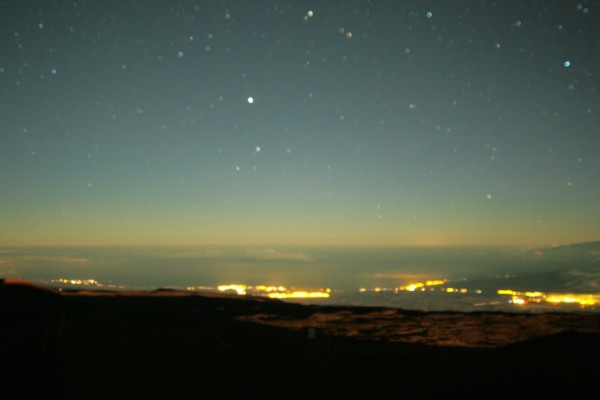
Yes, the focus needs to be adjusted (I expected that), but the scene covers a nice range from the Waikoloa resorts on the left, past Kawaihae, to Waimea on the right.

CloudCam at Keck
A test image from the Keck CloudCam

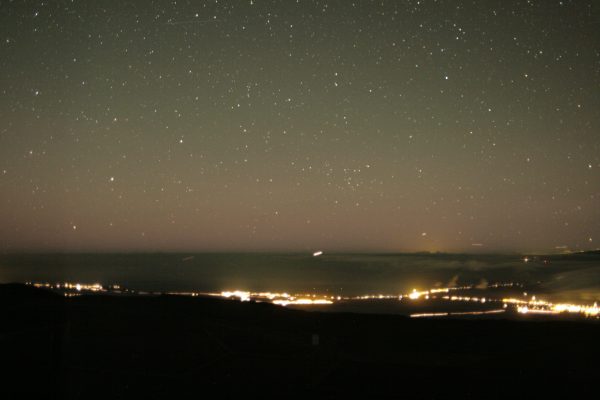
And after focus adjustment we get much nicer stars…

CloudCam Image
A CloudCam image showing the lights of Waikoloa, Waimea, and a lot of evening inter-island air traffic.

Venus and Jupiter

Back in April and May we saw Venus pass Uranus and Neptune making for badly mismatched conjunctions. This week it will be Jupiter, the only planet able to shine brightly enough to make a good pairing for Venus.

Today the pair are drawing close, currently separated by 5.5°. Close approach will occur on the 17th when the pair will rise in the dawn separated by only 35′. The closest approach will happen well after sunrise in the islands, about 18:06HST at a separation of a mere 12′, easily close enough to fit in the same telescopic field. The major challenge here is that the conjunction will occur only 17° from the Sun.

Venus will outshine Jupiter by over a magnitude, -3.9 compared to Jupiter’s -1.8 magnitude. The sizes will be comparable as well. Venus will be smaller at only 10.3″ compared to Jupiter’s 31.6″ across at the equator.

In an odd twist, this conjunction will occur on the edge of the Beehive cluster, M44. The cluster is not likely to be very visible given the advent of dawn, but it will be there.