Previous forecasts showed the hurricane passing well north of the island, following the same track as the last two storms. Then this evening’s forecast came out.
I can only hope it changes again…

When you want to see the stars, find someplace dark

Previous forecasts showed the hurricane passing well north of the island, following the same track as the last two storms. Then this evening’s forecast came out.
I can only hope it changes again…
On May 9th, 2016 Mercury will transit the Sun. While transits of Mercury are not rare, they are not all that common either. The last transit was almost a decade ago in November of 2006. On average there are fourteen transits of Mercury each century or one every seven years. If you wish to observe one the situation is much better than transits of Venus which occur in pairs over a century apart.
This particular transit will favor observers in Europe and North America where the entire transit will be visible. Unfortunately for observers in the islands only the final three hours of the transit will be visible having begun well before local dawn. Sunrise will occur around 05:48 for the island of Hawaiʻi, with the transit ending at 08:42 in the morning.
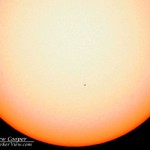
| Mercury Transit May 9th, 2016
|
||||
|---|---|---|---|---|
| UT (geo) | HST | HST (offset) | ||
| First Contact | 11:12 | 01:12 | –:–:– | |
| Second Contact | 11:15 | 01:15 | –:–:– | |
| Greatest | 14:57 | 04:57 | –:–:– | |
| Third Contact | 18:39 | 08:39 | 08:39:58 | |
| Fourth Contact | 18:42 | 08:42 | 08:43:10 | |
| Source: NASA Eclipse website | ||||
First contact is simply the first moment that the disk of Mercury begins to impinge on the disk of the Sun. Second contact will be the moment when Mercury is entirely in front of the Sun. Third and fourth contacts are a reverse of first and second with fourth contact as the end of the event.
Observing a planetary transit of the Sun requires proper eye protection. If you can not look safely, do not look! The Sun can cause permanent eye damage if viewed without proper protection. As Mercury is quite small some magnification will be useful in observing this event, a telescope of binoculars with a solar filter. A pinhole camera can be made out of things lying around in your kitchen that provides a very good image. Read my Guide to Safe Solar Viewing for a lot more information on viewing the Sun safely.
The next transit of Mercury will occur November 11, 2019 at 15:20UT (mid-transit). This next transit also favors Europe and eastern North America where the entire transit will be visible.
Boat dives are always a treat. We generally shore dive, where the only costs are the tank fills and a little gas to drive to the site. Many sites along the Kohala Coast are easily reached from shore. There are a number of great sites that are more difficult to reach, sites for which a boat provides a nice alternative. When going with a dive boat you also have the crew to assist in rigging gear and getting in and out. They also provide drinks, snacks and friendly conversation while you wait through a surface interval between dives. A holiday treat? A mutual Christmas gift? Whatever you want to call it, we booked a dive with Denise and Dave from Blue Wilderness for a day of diving.

There were several divers beside Deb and myself. Ben, from London, had left his girlfriend back at the resort for a morning of diving. A family from Saskatchewan was escaping the winter with a couple weeks in Hawai’i and a morning of diving. The wife and daughter were simply snorkeling. The father, an ex-navy diver, was introducing his son Brett to the sport.