A tricky shot, taking very precise timing and navigation. I can not claim credit, Sean Goebel did the planning. I just supplied scouting information and came along for the ride.
The Moon rising directly behind the telescopes on the summit as seen from near WaikoloaSean has been after this photo opportunity for some time. For months he has messaged me to check on the weather over the Waikoloa area each time a full Moon is available. As he has to drive across island to reach the correct locations, a look ahead at the weather can save a great deal of wasted time.
Given that this only involved a fifteen minute drive from the house for me… Why not? Give it a try. Besides, I already had a suitable telescope loaded in the vehicle.
Telescope clock drives from the 1980’s or earlier often used AC synchronous motors. These commonly available AC motors are used to power timeclocks, record player turntables, and telescopes, anyplace a motor needed to run at a very accurate speed.
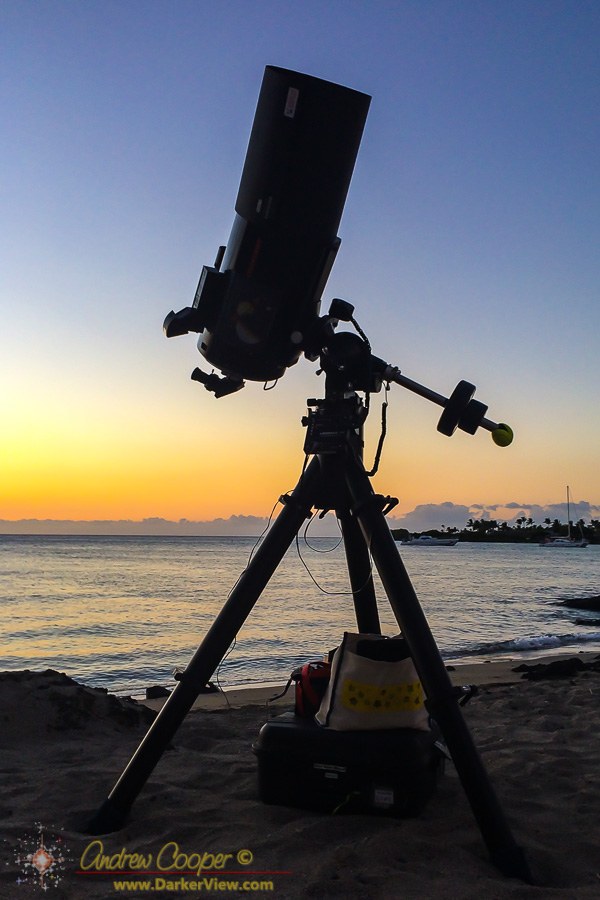
A Celestron telescope drive configured as a sidereal rate tracking camera platform
The speed of a synchronous motor is set by the frequency of the powerline, in North America and many other places this is 60Hz. As the frequency must be synchronized for every power station on the grid the frequency is quite accurate, a feature exploited by clockmakers and telescope builders. Once found everywhere these motors are less common, but are still around.
Drive Correctors
It was the common use of these motors in telescope drives that led to the invention of the drive corrector, a device that was once a required piece of kit for serious amateur astronomers. Drive correctors like this were needed when operating from a battery at some remote location, generating AC from a 12Vdc car battery.
You also needed a drive corrector for guiding while doing astrophotography. The corrector could speed up or slow down the telescope drive a bit to correct the telescope drive speed and stay on target, something not possible with the fixed 60Hz of the mains supply. Thus the term drive corrector.
It was a last minute request. OK, not actually the last minute, but two days is not much lead time to plan a public outreach event.
Fortunately there was not much to arrange, a single solar telescope and the standard table setup we keep packed and ready to go, all we had to do was show up. Drive up to the Pōhakuloa Training Area to join in their Earth Day events. There would be several hundred students from local schools, tables and displays from other organizations, a good outreach opportunity.
A solar telescope set up at Pōhakuloa Training Area for Earth Day.In ten years of driving past the front gates of PTA, I had never been inside. Why not, just an easy drive from Waikoloa, and I have a telescope that will do the job perfectly.
It seems odd that a military base would celebrate Earth Day. What do attack helicopters, live munitions, and troops have to do with the environment? The answer should not be that surprising… Military bases are often large effective nature reserves.
Large areas of land, much of which sits unused and undisturbed, are closed to public access. An active range needs huge safety and buffer zones around the firing ranges. Of the 133,000 acres that makes up PTA, only a small percentage is directly impacted by the training activities. The rest is home to a endemic and endangered species, closed to any activity that can disturb the land.
Where do you go to show a bunch of students from Hawaii Preparatory Academy the stars? Located in Waimea the school has a very nice campus, that is usually under heavy clouds every afternoon and evening. After looking around we settled on Mauna Kea Recreation Area in the saddle between Mauna Loa and Mauna Kea. At 6,700ft elevation the site can offer very good skies for stargazing. This area in the saddle at Pōhakuloa is often cloud free, a curious hole in the clouds between the mauna that tower on either side.
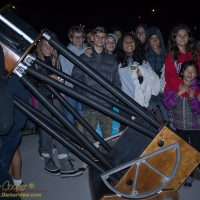
Students and chaperones from HPA enjoy dark skies with the 20″ obsession telescopeThe recreation area has recently been undergoing a 10 million dollar renovation. While the renovated cabins are not open yet, the new bathrooms and playground have proven immensely popular to travellers crossing the saddle from Hilo to Kona.
With the opportunity for a reasonably dark sky I brought the 20″ obsession. Tony and Maureen brought 12″ dobs. Tony’s friend Steve brough the 8″ he had just bought from Tony, a first night out with a new ‘scope. Cliff brought his 6″ imaging system set up to show objects on the screen. We had a lot of glass available, good telescopes, and surprisingly good skies.