The little taco stand in Waikoloa is a decent place for a late night dinner…

When you want to see the stars, find someplace dark

The little taco stand in Waikoloa is a decent place for a late night dinner…

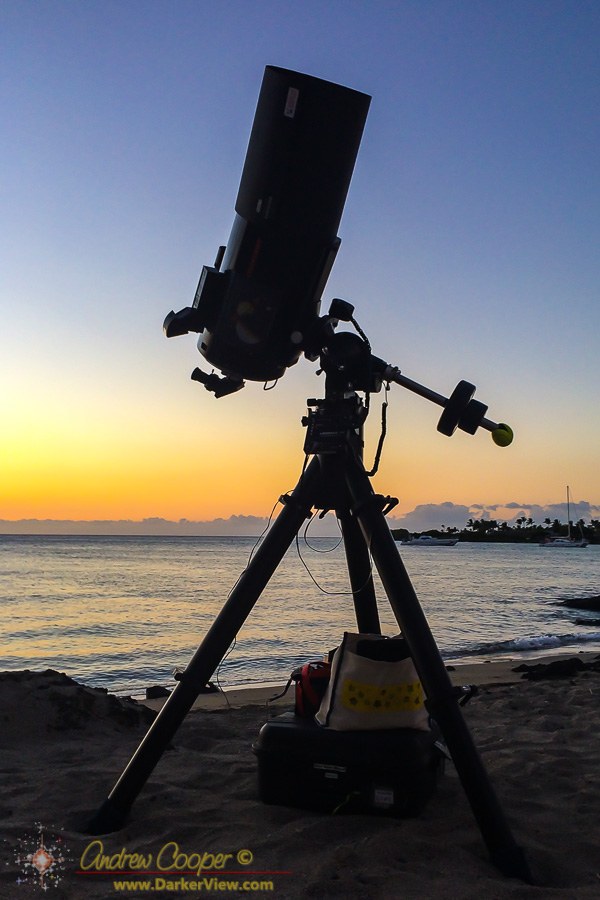
Yes, it is a telescope on a beach…
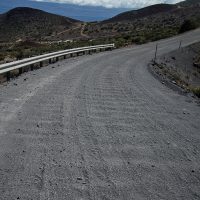
It has long been policy on the Mauna Kea summit road to use four wheel drive while ascending the mountain. One of the reasons given is to slow the formation of washboard, the annoying ripples that inevitably form on gravel roads.

On Mauna Kea an oft cited mantra is that the use of four wheel drive when ascending the mountain reduces the formation of washboard. I have always suspected this is a mountain myth with no substance. Where does this belief come from? Is there any real information on this?
There are a great many references that detail the practical details of maintaining gravel roads. Generations of highway engineers have spent a lot of time studying and writing about how to best maintain gravel roads at the least cost.
The US Department of Transportation highway Administration has published a lengthy guide to the problems and solutions of gravel roads. This guide dedicates a dozen pages to the issue of corrugation or washboarding. While multiple factors in the formation and prevention of washboarding are discussed there is no mention of 4WD vehicles being a factor.















Today the Earth is furthest from the Sun, a point called apehelion. We will be about 152,096,000km (94,508,000miles) from the Sun. Compare this to the 147,099,000km (91,403,000miles) we were at perihelion on January 4th, a difference of about 4,996,000km (3,104,000miles) occurring throughout one orbit.
It may seem odd that we are actually at the furthest for the middle of northern summer, you just have to remember that proximity to the Sun is not the cause of the seasons. The seasons are caused by the axial tilt of the Earth, creating short and long days throughout the year, with a resulting change in the angle and intensity of the sunlight.
| 2017 Solstices and Equinoxes | ||||
|---|---|---|---|---|
| UT | HST | |||
| Perihelion | Jan 4 | 14:18UT | Jan 4 | 04:18HST |
| Vernal Equinox | Mar 20 | 10:29UT | Mar 20 | 00:29HST |
| Summer Solstice | Jun 21 | 04:24UT | Jun 20 | 18:24HST |
| Apehelion | Jul 3 | 20:11UT | Jul 3 | 10:11HST |
| Autumnal Equinox | Sep 22 | 20:02UT | Sep 22 | 10:02HST |
| Winter Solstice | Dec 21 | 16:28UT | Dec 21 | 06:28HST |
| Source: USNO data Services | ||||

I was looking at some photos and realizing how much perfboard I have used in recent years. I routinely find myself building small circuits, and that process almost always begins with grabbing a bit of perfboard from the supply stash.

The holes are usually about 0.042″ and will accommodate a wide range of electronic components without modification. Cheap perfboard will have no copper pads or traces, good perfboard will have a pattern of copper traces and pads to which you can solder your components. Better yet is perfboard with plated-thru holes and pads on both sides.