
Misty Morning
When you want to see the stars, find someplace dark

Telescope clock drives from the 1980’s or earlier often used AC synchronous motors. These commonly available AC motors are used to power timeclocks, record player turntables, and telescopes, anyplace a motor needed to run at a very accurate speed.
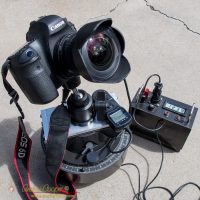
The speed of a synchronous motor is set by the frequency of the powerline, in North America and many other places this is 60Hz. As the frequency must be synchronized for every power station on the grid the frequency is quite accurate, a feature exploited by clockmakers and telescope builders. Once found everywhere these motors are less common, but are still around.
It was the common use of these motors in telescope drives that led to the invention of the drive corrector, a device that was once a required piece of kit for serious amateur astronomers. Drive correctors like this were needed when operating from a battery at some remote location, generating AC from a 12Vdc car battery.
You also needed a drive corrector for guiding while doing astrophotography. The corrector could speed up or slow down the telescope drive a bit to correct the telescope drive speed and stay on target, something not possible with the fixed 60Hz of the mains supply. Thus the term drive corrector.
Continue reading “Old School Drive Corrector”
A minor code revision as I slowly get everything working properly. I am adding new modules as I need them for other projects.
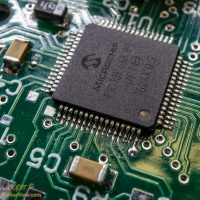
In the process I added support for the service connectors including parallel and simple serial modules to the GenPIC code base, may as well release it. Thus you get code release 0.2…
Along with the new modules I removed the copyright notices that I had left in the code, replacing them with a Creative Commons Attribution-ShareAlike 4.0 (CC BY-SA 4.0) license, just something I overlooked when releasing everything as open source.
Next up will probably be SD card support, I have a project that needs to be finished requiring some reasonable data storage. Just ordered a few micro-SD card breakout boards from SparkFun
W. M. Keck Observatory press release…
Since the mid-1990s, when the first planet around another sun-like star was discovered, astronomers have amassed an ever-expanding collection of nearly 3,500 confirmed exoplanets.

“This is a major new division in the family tree of planets, analogous to discovering that mammals and lizards are distinct branches on the tree of life,” says Andrew Howard, professor of astronomy at Caltech and a principal investigator of the new research.
The lead author of the new study, to be published in The Astronomical Journal, is Benjamin J. (B. J.) Fulton, a graduate student in Howard’s group.
In essence, their research shows that our galaxy has a strong preference for either rocky planets up to 1.75 times the size of Earth or gas-enshrouded mini-Neptune worlds, which are from 2 to 3.5 times the size of Earth (or somewhat smaller than Neptune). Our galaxy rarely makes planets with sizes in between these two groups.
“Astronomers like to put things in buckets,” says Fulton. “In this case, we have found two very distinct buckets for the majority of the Kepler planets.”
Continue reading “Unexpected Classification of Exoplanets Discovered”
Today Mercury will be at superior conjunction. After today the planet will reappear in the evening sky, rising high enough from the Sun’s glow to be seen early next month.
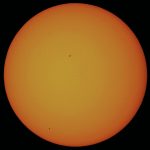
As Mercury is on an orbit inside that of Earth’s it will see both inferior and superior conjunctions as it passes from the evening sky to the dawn sky and back again.
Summer solstice occurs today at 18:24HST. Today the Sun will occupy the most northerly position in the sky of the year. The term solstice comes from the latin terms Sol (the Sun) and sistere (to stand still). On this day the Sun seems to stand still as it stops moving northwards each day and begins move to the south. This is the first day of summer as marked by many cultures in the northern hemisphere. Alternately this is the first day of winter for those living south of the equator.
This year many calendars will mark September 21st as the summer solstice, and so it is for much of the world. Here in Hawaiʻi the solstice actually occurs on the 20th when considering the time zone differences.
| 2017 Solstices and Equinoxes | ||||
|---|---|---|---|---|
| UT | HST | |||
| Perihelion | Jan 4 | 14:18UT | Jan 4 | 04:18HST |
| Vernal Equinox | Mar 20 | 10:29UT | Mar 20 | 00:29HST |
| Summer Solstice | Jun 21 | 04:24UT | Jun 20 | 18:24HST |
| Apehelion | Jul 3 | 20:11UT | Jul 3 | 10:11HST |
| Autumnal Equinox | Sep 22 | 20:02UT | Sep 22 | 10:02HST |
| Winter Solstice | Dec 21 | 16:28UT | Dec 21 | 06:28HST |
| Source: USNO data Services | ||||
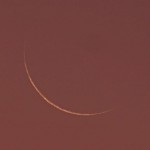
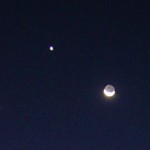
Tomorrow morning, June 20th, a pretty crescent Moon will be located close to a brilliant Venus. The Moon will be a slim 18% crescent a little under 6° from Venus shining at -4.2 magnitude. The pair will rise about three hours before sunrise at about 2am, look for the two above the brightening glow of dawn.
W. M. Keck Observatory press release…
Astronomers have shown what separates real stars from the wannabes. Not in Hollywood, but out in the universe.
“When we look up and see the stars shining at night, we are seeing only part of the story,” said Trent Dupuy of the University of Texas at Austin and a graduate of the Institute for Astronomy at the University of Hawaii at Manoa. “Not everything that could be a star ‘makes it,’ and figuring out why this process sometimes fails is just as important as understanding when it succeeds.”
Dupuy is the lead author of the study and is presenting his research today in a news conference at the semi-annual meeting of the American Astronomical Society in Austin.
He and co-author Michael Liu of the University of Hawaii have found that an object must weigh at least 70 times the mass of Jupiter in order to start hydrogen fusion and achieve star-status. If it weighs less, the star does not ignite and becomes a brown dwarf instead.
How did they reach that conclusion? The two studied 31 faint brown dwarf binaries (pairs of these objects that orbit each other) using W. M. Keck Observatory’s laser guide star adaptive optics system (LGS AO) to collect ultra-sharp images of them, and track their orbital motions using high-precision observations.
“We have been working on this since Keck Observatory’s LGS AO first revolutionized ground-based astronomy a decade ago,” said Dupuy. “Keck is the only observatory that has been doing this consistently for over 10 years. That long-running, high-quality data from the laser system is at the core of this project.”
Continue reading “Astronomers Prove What Separates True Stars from Wannabes”