Jacked
When you want to see the stars, find someplace dark

How many engineers does it take to change a light bulb?

This is one of those times. A nightlog coded as critical, the Keck 2 adaptive optics system has a slight problem, no output from the white light source, no calibrations, no science. Waiting until after 9am I call the support crew on the summit… Do you know how? No. I wrestle with the thought for a few moments. No avoiding it, I need to drive to the summit.
So how many engineers does it take to change a light bulb?
The Keck Adaptive Optics systems are workhorse scientific instruments. Equipment that has resulted in so many great astronomical discoveries. The AO systems have also seen a great deal of improvements and upgrades through the years. New computers, a new wave-front controller, guide star lasers added, new cameras, different science instruments, and much more.
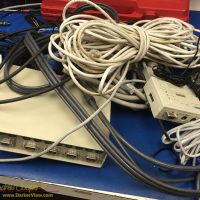
Eventually I just get fed up with it and insist we spend some time getting rid of it. With no AO use scheduled for a while there is a chance to spend a couple days ripping out this pile of cruft. Identifying and removing unused boxes. Following cables to nowhere, wire cutters in hand to snip away the multitude of nylon zip-ties.
We remove three large armloads of cables and other gear, carring the pile down to the electronics lab for sorting through and disposal. Most of it is horribly obsolete, things like KVM’s for PS/2 style mice and keyboards, or cables for old Sun computers. Most of it will simply be thrown out. It feels so good to get it out of AO and to clean up the place a little.
I called this pile of junk cruft, a word that drew funny looks from my co-workers. You don’t know what cruft is? What sort of nerds are you? Sorry, cruft is what I have always called leftover technical junk.
Cruft is jargon for anything that is left over, redundant and getting in the way. It is used particularly for superseded and unused technical and electronic hardware and useless, superfluous or dysfunctional elements in computer software. – Wikipedia
It turns out that the word has a long history in engineering and computer science with a heritage that includes MIT and Harvard. It is indeed the proper word for the detritus that had been accumulating in the AO vault.

W. M. Keck Observatory press release…
Using the world’s most powerful telescopes, an international team of astronomers has discovered a massive galaxy that consists almost entirely of Dark Matter. Using the W. M. Keck Observatory and the Gemini North telescope – both on Maunakea, Hawaii – the team found a galaxy whose mass is almost entirely Dark Matter. The findings are being published in The Astrophysical Journal Letters today.

To determine the amount of Dark Matter in Dragonfly 44, astronomers used the DEIMOS instrument installed on Keck II to measure the velocities of stars for 33.5 hours over a period of six nights so they could determine the galaxy’s mass. The team then used the Gemini Multi-Object Spectrograph (GMOS) on the 8-meter Gemini North telescope on Maunakea in Hawaii to reveal a halo of spherical clusters of stars around the galaxy’s core, similar to the halo that surrounds our Milky Way Galaxy.
Continue reading “Scientists Discover Massive Galaxy Made of 99.99 Percent Dark Matter”
W. M. Keck Observatory press release…

“We looked at how the properties of galaxies in these clusters differed from galaxies found in more typical environments with fewer close neighbors,” said lead author Julie Nantais, an assistant professor at the Andres Bello University in Chile. “It has long been known that when a galaxy falls into a cluster, interactions with other cluster galaxies and with hot gas accelerate the shut off of its star formation relative to that of a similar galaxy in the field, in a process known as environmental quenching. The SpARCS team have developed new techniques using Spitzer Space Telescope infrared observations to identify hundreds of previously-undiscovered clusters of galaxies in the distant Universe.”
Continue reading “Cosmic Neighbors Inhibit Star Formation, Even in the Early-Universe”
W. M. Keck Observatory press release…
UCLA astronomers have used the W. M. Keck Observatory on Maunakea, Hawaii to make the first accurate measurement of the abundance of oxygen in a distant galaxy. Oxygen, the third-most abundant chemical element in the Universe, is created inside stars and released into interstellar gas when stars die. Quantifying the amount of oxygen is key to understanding how matter cycles in and out of galaxies. This research is published online in the Astrophysical Journal Letters.

Credit: Ryan Sandres and the CANDELS Team
Knowing the abundance of oxygen in the galaxy called COSMOS-1908 is an important stepping stone toward allowing astronomers to better understand the population of faint, distant galaxies observed when the Universe was only a few billion years old, Shapley said.
COSMOS-1908 contains approximately one billion stars. In contrast, the Milky Way contains approximately 100 billion stars. Furthermore, COSMOS-1908 contains approximately only 20 percent the abundance of oxygen that is observed in the Sun.
W. M. Keck Observatory press release…
An international team of astronomers have discovered and confirmed a treasure trove of new worlds. The researchers achieved this extraordinary discovery of exoplanets by combining NASA’s K2 mission data with follow-up observations by Earth-based telescopes including the W. M. Keck Observatory on Maunakea, the twin Gemini telescopes on Maunakea and in Chile, the Automated Planet Finder of the University of California Observatories and the Large Binocular Telescope operated by the University of Arizona. The team confirmed more than 100 planets, including the first planetary system comprising four planets potentially similar to Earth. The discoveries are published online in The Astrophysical Journal Supplement Series.

In its initial mission, Kepler surveyed a specific patch of sky in the northern hemisphere, measuring the frequency with which planets whose sizes and temperatures are similar to Earth occur around stars like our sun. But when it lost its ability to precisely stare at its original target area in 2013, engineers created a second life for the telescope that is proving remarkably fruitful.
Continue reading “More Than 100 Planets Confirmed in Single Trove”

I have previously covered the importance of warping, tuning the Keck primary mirror segments for optimum optical performance. Warping has been my responsibility for some years now. Reading out the settings of the thirty strain gauges on the back of each segment is performed by a test fixture, a computer and a sensitive data acquisition system. Over the last year I have designed, built, and programmed a new test fixture.
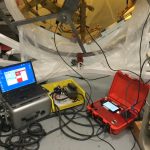
As this is the third generation warping test fixture the name of the software is obvious… Warp3