
Pohoiki Stars
When you want to see the stars, find someplace dark



A dark night under the stars! It has been too long… Why not?
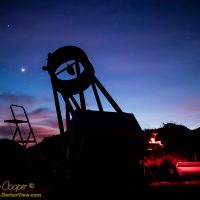
After all the work restoring the 20″ Obsession it was time to get it out under the stars for a decent observing run. During the many hours of work I had looked forward to simply using this telescope for a bit. While it would eventually be stored at the observatory and used for outreach, it seemed a shame not to spend a night or two under the stars with this instrument. Not like I need a 20″ telescope, my 18″ is just fine, but I loaded it up just the same, leaving Deep Violet in the garage.
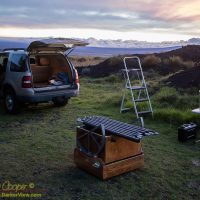
My favorite close by site is KaʻOhe, taking only a twenty minute drive from home to reach. At 5,700 feet on the side of Mauna Kea nearby home does not mean second rate. I really like this spot, the view is spectacular with the coastline below and the Mauna Loa and Hualālai volcanoes dominating the horizon. The entire southern horizon is unobstructed, allowing observations of southern objects right down to the horizon.
Better yet, recent rains meant green grass and a spot near the road maintenance gravel pile was hard packed rock, no dust! The area had even been mown recently! I sometimes have a few uncharitable words to describe DLNR, but not this evening.

Heartbeat stars, discovered in large numbers by NASA’s Kepler space telescope, are binary stars (systems of two stars orbiting each other) that got their name because if you were to map out their brightness over time, the result would look like an electrocardiogram, a graph of the electrical activity of the heart. Scientists are interested in them because they are binary systems in elongated elliptical orbits. This makes them natural laboratories for studying the gravitational effects of stars on each other.
In a heartbeat star system, the distance between the two stars varies drastically as they orbit each other. Heartbeat stars can get as close as a few stellar radii to each other, and as far as 10 times that distance during the course of one orbit.
The film has not even been released yet and local commentators are complaining… Loudly.

I find it somewhat questionable that such accusations can be made without even seeing the film. Editorials written not on the content of the film, but on the author’s perceived version of it based on a two minute trailer. The film simply becomes a convenient vessel into which can be poured all of the author’s pre-conceived grievances. The accusation really have nothing to do with the film, but simply become a screed against whatever they want to rail against.

Using near-infrared adaptive optics on two of the world’s largest telescopes — the 10-meter Keck II and the 8-meter Gemini North, both located near the summit of the dormant volcano Maunakea in Hawaii — UC Berkeley astronomers tracked 48 volcanic hot spots on the surface over a period of 29 months from August 2013 through the end of 2015.
“On a given night, we may see half a dozen or more different hot spots,” said Katherine de Kleer, a UC Berkeley graduate student who led the observations. “Of Io’s hundreds of active volcanoes, we have been able to track the 50 that were the most powerful over the past few years.”
Continue reading “Long-term, hi-res tracking of eruptions on Jupiter’s moon Io”

The same morning Deb and I rode one of the lava tour boats to the ocean entry, photographer Mick Kalber chartered a Paradise Helicopter photo tour of the volcano. It was a great morning, with excellent photographic conditions where the lava meets the sea.
Mick has posted some video of that flight, fun to see the same conditions from a very different point of view. And while we photographed the helicopter maneuvering overhead, he photographed the boats below. Deb and I can be seen in the red and white boat at 2:05 in the video.