Securing the Segment
When you want to see the stars, find someplace dark


Occasionally we get phone calls. People have an astronomy question and decide to call an observatory to get an answer. I would caution that this is generally not the best way to get an answer, Googling the question or looking it up on Wikipedia is much more likely to result in a usable answer. Usually our front desk will politely defer the caller to some other source, Shelly is very good at doing this.

Shelly is also a very nice lady who occasionally takes pity on some caller. Or the caller is very polite and asks very nicely. Often she forwards the call to me, knowing that I can usually answer these sort of questions.
What sort of telescope can be used to view the ISS?
At least the question did not involve aliens or NASA cover-ups, those question would have gotten the polite brush off from Shelly.
For someone who is inexperienced in using telescopes this not the easy place to start. Most of us who have been using telescopes for decades usually do not even try to do this. The space station is quite small and would require higher magnification to see well. It is also moving quite quickly across the sky. The combination of these two factors makes viewing the ISS a real challenge, to put it politely!
Fall equinox occurs today at 04:21HST. Today there will be little difference between the length of the night compared to number of daylight hours. This is the first day of fall as marked by many cultures in the northern hemisphere.
This year many calendars will mark September 23rd as the beginning of fall, and so it is for much of the world. Here in Hawaiʻi the equinox actually occurs on the 22nd when considering the time zone differences.
| 2016 Solstices and Equinoxes | ||||
|---|---|---|---|---|
| UT | HST | |||
| Perihelion | Jan 2 | 22:49UT | Jan 2 | 12:49HST |
| Vernal Equinox | Mar 20 | 04:30UT | Mar 19 | 18:30HST |
| Summer Solstice | Jun 20 | 22:34UT | Jun 20 | 12:34HST |
| Apehelion | Jul 4 | 16:24UT | Jul 4 | 06:24HST |
| Autumnal Equinox | Sep 22 | 14:21UT | Sep 22 | 04:21HST |
| Winter Solstice | Dec 21 | 10:44UT | Dec 21 | 00:44HST |
| Source: USNO data Services | ||||
This weeks news that human remains had been placed within the TMT construction site was a surprise to many. Apparently a well known protester, Palikapu Dedman, had placed an iwi, human remains, into an ahu constructed last year on the site. He did this twice! Apparently the first set of remains had vanished, so he replaced them with a second set.

While much of the local community was quick to express disapproval of this action, notable TMT opponents do not appear to have condemned this outrageous action. Indeed I have yet to see any condemnation for the act on any of the opposition sites or Facebook pages. Yes, I have looked. They link the article, but there are no comments. Even more telling, it appears that many in the local Hawaiian community were aware of this for some time now, but have been silent on the issue.
In addition to the recent revelations in the papers concerning the iwi in the TMT site ahu. There is a claim of another burial in a contested case filing. Dated Sept 2nd, we have document 252 “Fergerstrom Notice of Family Burial Claim Under the Proposed TMT Site” filed by Harry Fergerstrom claiming that a family burial is located “on the access road to the TMT”. The filing is accompanied by a DLNR Burial registration form application.
It seems to be a common belief that the summit is a burial ground. it is certainly an idea that those protesting the TMT are trying to push, they have made this claim in the past. The most recent push may be an attempt to capitalize on the Standing Rock DAPL pipeline controversy that has so much media attention.
It’s important to remember that Mauna Kea is a burial ground – Kealoha Pisciotta quoted in Civil Beat
Mauna Kea is site of mass burial of iwi for centuries. – Pohaku Keaau comment on the Hilo Tribune website
The problem with this argument is that the summit does not appear to have ever been a significant burial ground. There are only a handful of confirmed burials on the mountain and a couple dozen suspected burials, mostly at lower elevations (below 10,000 feet) and none within a mile of the TMT site.

The TMT site itself is mostly solid rock outcropping, there is scant place to hide a burial. The TMT site has been repeatedly examined for burials by various parties, none has been found, at least nothing historical, discounting these recent planted burials. And while the proposed access road to the TMT does cross the lower edge of a cinder cone, this particular path has been previously disturbed by an older road and is unlikely to hide anything.
What a lot of people do not realize is how much the cinder moves about, slowly slumping down the sides of the pu’u under the power of frost heaving and solifluction. If there were “mass burials” of iwi secreted on the summit over the centuries they would not be a secret any longer. We would have beautifully preserved bones appearing out of the cinders on a routine basis. In my decade on the summit I have never seen or heard of such an event.
No doubt the burial ground argument will have traction with those inclined to believe despite the lack of any evidence to the contrary. We will be hearing more on this issue, a new and utterly disgraceful maneuver by TMT opponents.
One of the advantages of a mirrorless camera, like the EOS-M, is the very shallow backfocus requirement. The distance from the lens mount to the sensor is quite small, allowing use of just about any series of lenses on the market. All that is needed is the correct adapter, a need that several specialty manufacturers have addressed with products. The result is that the camera is useful in a wide range of photographic experiments and projects.

I have had fun simply shooting with these old primes and the EOS-M camera. Sometimes I will grab a single lens and just go someplace to play with the camera for half an hour, sort of a self imposed creative exercise. Using one of these manual focus lenses brings back memories of my first years of film photography, before the days of auto-focus.
Combine these old lenses with an extension tube, and the rig becomes a macro-photography setup capable of fairly high magnification.
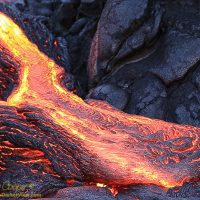
After this latest trip to see the lave I was recalling all of my previous effort to photograph the lava. It has resulted in quite a few beautiful photographs, many of which have appeared here on DarkerView…


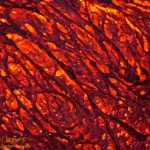






Note: This is an editorial that I wrote a while back. It was originally published in Civil Beat on August 18th, 2016. It appears here in the original form (pre-editor) and with far better photos…

While many frame the argument as one between science and culture, others frame it as one of development versus culture. Their premise is that somehow building another telescope is destroying local culture. They overlook the opportunity the telescopes represent, that the right economic development can support a community, preserve a culture.
Supporters of TMT highlight the jobs that the telescope will bring… “It is not about the jobs!” is the reply from opponents. Of course it is. You cannot maintain a culture in poverty. You cannot maintain a culture when your keiki leave to seek opportunity elsewhere. Leave the island behind… Leave the culture behind. Economic struggle is the greatest single threat to a local culture, a threat that cannot be overstated.
The lack of economic opportunity has an enormous impact on a local community. The stress of struggling for a living, of getting by on a low paying service industry job can be destructive to families and individuals. Drugs use, family abuse, all of the social ills so often identified in low income areas are as destructive to the culture as they are to the person. The statistics tell the story… Hawai’i Island routinely tops rest of the state in numbers that are not good…. Lowest per capita income, highest number of children living in poverty, unemployment and more.