Cherry Blossom Festival Sidewalk Astronomy
It was a perfect day to do an astronomy outreach event. Of course as it was a daytime event, only one star is available for viewing in the telescopes… The Sun. Set up a few solar telescopes for an astro outreach event.

The festival guarantees a huge crowd of people for an outreach event, no advertising needed. The main part of the festival takes place along church row where the cherry trees are, next door to Keck headquarters. Much of the available parking is at the shopping centers on the other side of headquarters. There is a steady stream of hundreds of people right through our lawn. All we needed to do was to set up and be ready for a crowd.
A few friendly looking telescopes, a couple signs with the prominent word “free”… We had a crowd! As one would expect they came in surges, for four hours it varied between a few people at each telescope to a good sized line at every telescope, with up to fifty people gathered around at at time. We had three telescopes operating, two eight inch telescopes with white light filters and the Coronado PST providing a hydrogen alpha view.
Continue reading “Cherry Blossom Festival Sidewalk Astronomy”
Day Gecko

Icy Morning

The Moon, Mercury, and Venus
Tomorrow morning a beautiful trio of two planets and the Moon will rise in the dawn. Venus will rise first at 5:02HST, followed shortly thereafter by the Moon and Mercury nearly together. The trio will form a neat triangle about 6° across. The planets will rise an hour before the light of dawn spreads across the sky and nearly two hours before sunrise.
Modern and Traditional
What is modern? What is traditional? What is different about these two words and what they mean? Is there any real difference? I would argue that there is not and never has been any real difference, except in the minds of those who want to see it. A sort of golden age idealism, that somehow things were better back whenever.

We are human, ancient humans were far more modern than many seem to envision. Many think of the past and see some cartoon version of people who are somehow less than we are today. A view of the past created by so many movies, so many bad historical melodramas.
If one were able to stroll down a street in ancient Rome you would see a city every bit as complex as a modern metropolis. All of the people you would meet completely recognizable in their roles. No cars or electric lights, but there are police and politicians, barbers and butchers, a world quite similar to our own.
Keck Panorama

Dear Keck Staff
We have a lot of fun when the kids come to visit. We regularly offer tours of Keck to local school groups. When they come we lay in a schedule of activities… Solar telescopes, an IR camera demonstration, tours of our remote operations, the activities can vary depending on the grade level.
After the last tour we got a packet of thank you letters from one of the classes. These are just fun to read, it is great to see what the kids remember from their visit. A drawing of telescopes set up in the lawn caught my eye, I was responsible for running the solar telescope activity!

NYPL Digital Collections Online
The New York Public Library has just published 187 thousand digital images online. The collection is staggering in its volume, a collection of images that ranges across the spectrum of American and even world history. One could publish an interesting blog simply mining this huge collection for the historical tidbits it contains. World events to restaurant menus, there is just so much there.
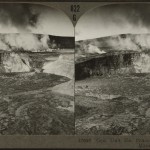
In addition to the images there is a great deal of other material. Old engravings and illustrations, maps, even menus from restaurants dating back a century. I will have to refer to this collection when looking for illustrations in the future, there is a treasure trove of material here.
Most of the interesting images I found were stereoscopic pairs. Stereoscopic pairs were incredibly popular in the late 19th and early 20th centuries. While many might be familiar with the View-Master style stereo viewers of the 1950’s and 1970’s, the original version of this used a side-by-side print in place of a transparency.
Old School Circuitry
I am no stranger to point-to-point wiring. I routinely use the technique to build small circuit boards. Well done point-to-point is a permanent and reliable way to build a complex electronic device.
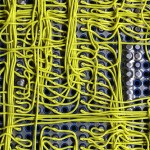
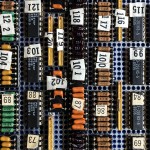
But then there is this circuit board assembly I came across… At first glance it looks like a wire wrap board. But there are no posts, the wires are flush to the board. Neither is it traditional point-to-point wiring, the wires are not terminated to solder pads beside the pins being connected. I had never seen a construction technique like this.
The board is an old PCB assembly found in a storage cabinet while clearing out the old junk that has accumulated about the observatory. No idea where it came from or what it was used for, the only clue is some writing on the box… “Keck level shifter”, Perhaps a piece of a detector controller? Someone clearly put a lot of work into the board at one time, now it sits in my office as unknown junk. It is the odd construction technique that caught my eye and led me to hang on to the board, at least temporarily. What is this?
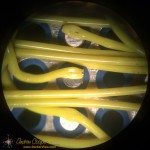
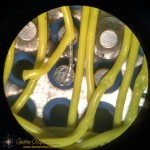
A closer look under a microscope shows a connection clearly made by some sort of spot welder. There is a neat little hole through the insulation at each connection. Stripping back the insulation reveals a very neatly welded wire. Each wire is welded to the flat bottom of each pin socket. Every component pin is socketed, this includes all passives, which are mounted to headers and plugged in alongside the IC’s.
There are a number of advantages to this wiring method… The connections should be very reliable and robust, the weld is a nearly ideal electrical connection. As no connection pads are needed beside each socket the density is much higher using less circuit board real estate per component, you can cram more on the board. Interestingly the connection technique can be used without terminating the wire, daisy chaining to the next connection point.
There are disadvantages as well… The method clearly requires some sort of welding equipment with perhaps an automatic wire feeder and cutter, a built-in microscope for positioning the weld, and more. Clearly an expensive piece of kit. No components can be present during welding as they may suffer damage from the high electrical currents needed for spot welding, thus everything must be socketed. All those little sockets are expensive! Rework or repair would need to be done with more traditional soldering techniques.
I would love to see the machine that did this board assembly. Maybe even a chance to use it. More information on the process seems difficult to find on the web without a trade name or other keyword that would clearly identify the process.
Not that these welded wires would be of much use today. The technique is clearly ideal for complex digital circuits of the style and speed that was common through the 1980’s to around 2000 or so. After that the prevalence of surface mount technology and the abandonment of the DIP package would doom the method. Modern high speed circuits benefit greatly from the more controlled traces of a printed circuit board and would not fare well on a welded wire board. In these days of easy computer layout and cheap printed circuit boards welding would not be my fabrication method of choice.