A Precipitation Sensor

Getting rain or snow on the primary mirrors is bad.

Open Dome
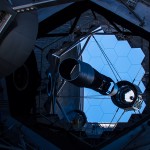
The Keck 2 primary mirror
The normal method of detecting conditions that might lead to rain or snow is by monitoring the humidity or dew point. If the dew point approaches the current temperature, to within a few degrees the operators must close the domes. This is much the same thing as the humidity approaching 100%. Thus I have installed several new humidity/dew point/temperature sensors over the last few years. These replaced some old and troublesome equipment that had been in place for over a decade.

The problem… You can have both rain and snow occur with low humidity. Moist air above the telescope can produce rain or snow which falls into drier air at the summit level. This can catch the operators by surprise, a situation we have observed on a number of occasions.

To help detect this you can deploy a precipitation sensor, something some of the neighboring telescopes have done. The engineers over at CFHT were kind enough to show me the units they had installed during their remote operation project.

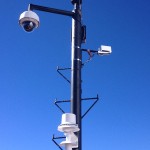
Keck Weather Mast
Various instruments atop the Keck Observatory weather mast
Yes, I just went out and bought one. Not just any old unit either… The best precipitation sensor I could locate on the market, a Vaisala DRD11A. The sensor uses a capacitive detection method. Moisture on the top of a plate will change the capacitance and trigger the sensor. The plate is tilted to allow rain to run off and heated to melt snowflakes and sleet. testing on my work bench showed this to be pretty effective and quite sensitive. Yes, you can visualize me sitting at the bench dripping water on a sensor… It worked.

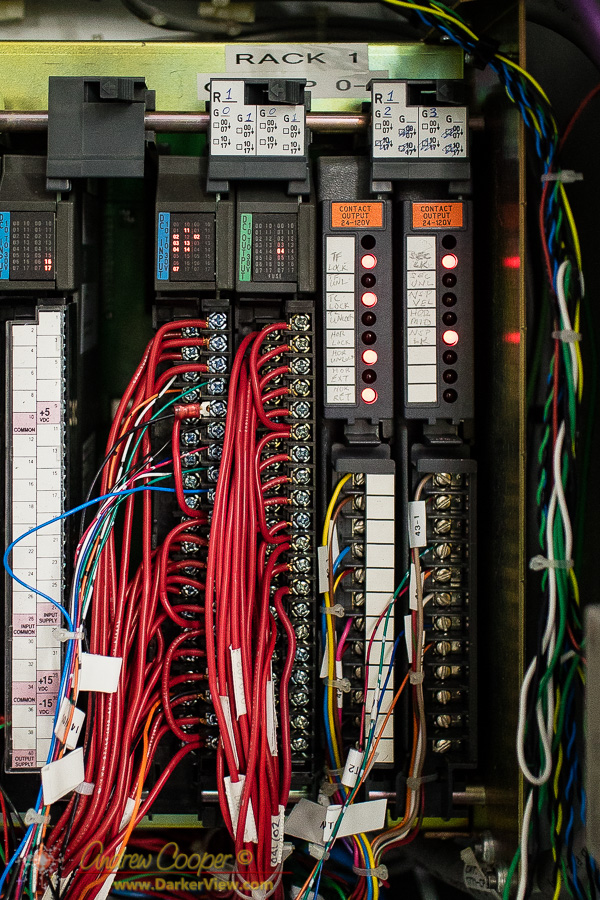
Not that the project was finished there… The new sensor does not come with any sort of network interface. Rather surprising given that just about everything else Vaisala sells has either a serial interface or an ethernet interface. This sensor has just a couple simple outputs… A logic level indication of precipitation, an analog output representing roughly how much, and a frequency output representing the same thing. I needed to interface this unit to the network. As I have installed a terminal server in the rack below the weather mast, at the minimum I needed a serial port.

While I was at it there are a couple other little devices I want to install on the weather mast. These need a network interface as well. May as well put together another little PIC controller and assemble it all together in one neat little package. a few evenings of coding and I had my solution, an interface that allowed remote computer control and status read-back. How many microcontrollers do I have performing little tasks at the summit now? Quite a few.

Cassini’s Optics

I have always enjoyed learning about the history of astronomy, it is a science whose roots can be traced continuously back to the dawn of human history.

One of my Facebook friends is a bit of an old telescope nut, even more so than myself, regularly posting photos of historic observatories and in particular old refactors. I too have a soft spot for these historic instruments, going out of may way to visit Greenwich Observatory in London, to drive up Mt. Hamilton to see the beautiful old refractor at Lick Observatory, or flying across the country to see one of William Herchel’s telescopes on display at the Smithsonian.

Ovidiu Cotcas recently posted a link to a fun research paper analyzing the telescope optics of Cassinni’s telescopes. These instruments were state of the art in the mid-1600’s, a period when the first telescopes were being used to provide the first good look at astronomical objects, revolutionizing our understanding of the universe. Only five decades after Galileo astronomers across Europe were attempting to build ever better instruments to provide views of the planets that had only recently been nothing but moving lights in the heavens. These early telescopes showed that planets were worlds, opening a whole new realm to observation and study.

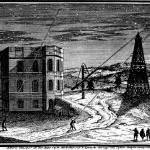
Paris Observatory XVIII Century
Paris Observatory in the times of Cassini during the late 1600’s showing the very long focal length refracting telescopes of the day. Credit: Wikimedia Commons
Prior to the invention of the achromatic doublet in 1758 the main limitation of refracting telescopes was chromatic error. A single lens is also a prism, focusing the different colors of light at different focal lengths. The only solution to this was to make objective lenses with very long focal lengths. Today’s telescopes use compound lenses of two or three elements in the objective with different types of glass. This combination of lenses can be cleverly arranged to cancel out chromatic error resulting in an achromatic lens.

The long focal lengths of those first singlet lens telescopes appear absurd by modern standards, huge instruments with long tubes suspended from masts or with the objective lenses mounted upon tall towers while the observer and eyepiece were at ground level. Telescopes were thirty or even a hundred feet long. Unlike today’s convention of referring to a telescope’s aperture, telescopes were referred to by focal length. Cassini’s primary instruments had focal lengths of between 17 and 40 feet, with one having the incredible focal length of 150ft! As familiar as I am with using small telescopes I shudder at the challenges of aligning and aiming such an instrument, much less tracking a target across the sky.

Continue reading “Cassini’s Optics”

Venus and Saturn

On the morning of January 8th and 9th Venus and Saturn will be quite close in the dawn.

Moon and Mercury
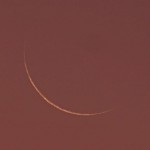
The Moon appears as a thin crescent beside the planet Mercury, photo taken from the summit of Mauna Kea on 12Oct2007
Tomorrow morning the two can be seen rapidly closing upon each other, less than 3° apart. A slim crescent Moon will be only 4° above Venus making for a lovely trio in the dawn. The morning of the 7th will also feature a nice trio, with the Moon now below the pair, closer to the horizon.

As the pair rises on the morning of the 8th they will be only 32′ apart, easily close enough to fit in the low power field of most amateur telescopes. The morning of the 9th will see the pair again close, only 34′ separation. They will slide past each other much closer, about 5′ apart, but this will not be visible from the central Pacific as it occurs around 11:42 HST on the 8th, while the planets are below the horizon.

Moon, Venus and Saturn

Tomorrow’s dawn, January 6th, will see the Moon, Venus and Saturn in a nice conjunction. A beautiful 12% illuminated crescent Moon will be a bit over 4° above Venus shining brightly at -4 magnituide. Saturn will be another 3° below Venus. As an added accent the bright star Antares will be 6° south of the trio.

Quadrantid Meteor Shower Reminder

A reminder that tonight is the peak of the annual Quadrantid meteor shower. Given our 20° latitude here in Hawaii the radiant does not rise until 01:30HST, thus observations must wait until well into the morning hours. A 28% illuminated moon will rise about 02:13 to create some interference in observing the shower.

Watching meteors requires no more equipment than your eyes and a dark sky, and can be enjoyable for just about anyone.

Earth at Perihelion

Today the Earth is closest to the Sun, a point called perihelion. We will be about 147,099,000km (91,403,000miles) from the Sun. Compare this to the 152,096,000km (94,508,000miles) we will be at aphelion on July 4th, a difference of about 4,996,000km (3,104,000miles) occurs throughout one orbit.

It may seem odd that we are actually at the closest for the middle of northern winter, you just have to remember that proximity to the Sun is not the cause of the seasons. The seasons are caused by the axial tilt of the Earth, creating short and long days throughout the year, with a resulting change in the angle and intensity of the sunlight.

2016 Solstices and Equinoxes
  UT HST
Perihelion Jan 2 22:49UT Jan 2 12:49HST
Vernal Equinox Mar 20 04:30UT Mar 19 18:30HST
Summer Solstice Jun 20 22:34UT Jun 20 12:34HST
Apehelion Jul 4 16:24UT Jul 4 06:24HST
Autumnal Equinox Sep 22 14:21UT Sep 22 04:21HST
Winter Solstice Dec 21 10:44UT Dec 21 00:44HST
 
Source: USNO data Services


The Sky for 2016

Looking ahead to sharing a fun and pretty 2016 with everyone. As usual you can come to Darker View for heads up on everything happening in the sky for 2016. I have spent the last month setting up pre-scheduled posts with all of the significant sky events for the year. We have a couple interesting eclipses, including a total eclipse across the Pacific, and some nice conjunctions. Comet C/2013 US10 Catalina continues to be naked eye into January and C/2013 X1 PanSTARRS should be marginally naked eye in June.

Young Moon
A very young moon over Waikoloa, this is only 26 hours after new, visible to the unaided eye as a sliver in the fading glow of sunset
Setting up all of the scheduled astronomy posts for the year allows me an excellent overview of what the coming year will bring. As I go though the schedules I have assembled a summary here to give my readers a preview of the year and to allow advance planning.

The Moon

Below are tables of all of the new and full moons of 2016 for those who prefer to plan early for those observing outings. Eclipses are noted with an asterisk in the tables and are explored more fully in the following section.

For those who like supermoons you will have to wait for later in the year when the orbit and lunar phase align. November will be the best supermoon of the year when full moon occurs only two hours away from perigee on the 14th of the month. For a few months either side of the November full moon you will find perigee occurring within a day or two of full, allowing for larger and brighter than average full moons.
Continue reading “The Sky for 2016”

A Photo Review of 2015

Cobbler
Old boots and an older sewing machine in a cobbler’s shop

A review of my favorite photographs of 2015. So many wonderful images, so many memories! It was a very good year for photography with a number of excellent photo opportunities. Opportunities I did not waste. of course living in Hawaiʻi and working atop Mauna Kea often provide a photo or two. Add a trip to Nicaragua allowed a whole new range of photos.

In past eras it was popular to keep a detailed diary of one’s life. While real diaries are rarely kept anymore, blogs and photographs serve much the same purpose. As I have often stated, Darker View is a blog in the original sense, a personal diary of my life. To look back through these photos I relive much of the past year, the good parts anyway.

Click through for the full gallery and click on any photo for a slideshow.

Continue reading “A Photo Review of 2015”