On the morning of January 8th and 9th Venus and Saturn will be quite close in the dawn.
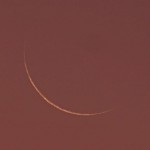
The Moon appears as a thin crescent beside the planet Mercury, photo taken from the summit of Mauna Kea on 12Oct2007Tomorrow morning the two can be seen rapidly closing upon each other, less than 3° apart. A slim crescent Moon will be only 4° above Venus making for a lovely trio in the dawn. The morning of the 7th will also feature a nice trio, with the Moon now below the pair, closer to the horizon.
As the pair rises on the morning of the 8th they will be only 32′ apart, easily close enough to fit in the low power field of most amateur telescopes. The morning of the 9th will see the pair again close, only 34′ separation. They will slide past each other much closer, about 5′ apart, but this will not be visible from the central Pacific as it occurs around 11:42 HST on the 8th, while the planets are below the horizon.
Tomorrow’s dawn, January 6th, will see the Moon, Venus and Saturn in a nice conjunction. A beautiful 12% illuminated crescent Moon will be a bit over 4° above Venus shining brightly at -4 magnituide. Saturn will be another 3° below Venus. As an added accent the bright star Antares will be 6° south of the trio.
A reminder that tonight is the peak of the annual Quadrantid meteor shower. Given our 20° latitude here in Hawaii the radiant does not rise until 01:30HST, thus observations must wait until well into the morning hours. A 28% illuminated moon will rise about 02:13 to create some interference in observing the shower.
Today the Earth is closest to the Sun, a point called perihelion. We will be about 147,099,000km (91,403,000miles) from the Sun. Compare this to the 152,096,000km (94,508,000miles) we will be at aphelion on July 4th, a difference of about 4,996,000km (3,104,000miles) occurs throughout one orbit.
It may seem odd that we are actually at the closest for the middle of northern winter, you just have to remember that proximity to the Sun is not the cause of the seasons. The seasons are caused by the axial tilt of the Earth, creating short and long days throughout the year, with a resulting change in the angle and intensity of the sunlight.
Looking ahead to sharing a fun and pretty 2016 with everyone. As usual you can come to Darker View for heads up on everything happening in the sky for 2016. I have spent the last month setting up pre-scheduled posts with all of the significant sky events for the year. We have a couple interesting eclipses, including a total eclipse across the Pacific, and some nice conjunctions. Comet C/2013 US10 Catalina continues to be naked eye into January and C/2013 X1 PanSTARRS should be marginally naked eye in June.
A very young moon over Waikoloa, this is only 26 hours after new, visible to the unaided eye as a sliver in the fading glow of sunsetSetting up all of the scheduled astronomy posts for the year allows me an excellent overview of what the coming year will bring. As I go though the schedules I have assembled a summary here to give my readers a preview of the year and to allow advance planning.
The Moon
Below are tables of all of the new and full moons of 2016 for those who prefer to plan early for those observing outings. Eclipses are noted with an asterisk in the tables and are explored more fully in the following section.
For those who like supermoons you will have to wait for later in the year when the orbit and lunar phase align. November will be the best supermoon of the year when full moon occurs only two hours away from perigee on the 14th of the month. For a few months either side of the November full moon you will find perigee occurring within a day or two of full, allowing for larger and brighter than average full moons. Continue reading “The Sky for 2016”
Old boots and an older sewing machine in a cobbler’s shop
A review of my favorite photographs of 2015. So many wonderful images, so many memories! It was a very good year for photography with a number of excellent photo opportunities. Opportunities I did not waste. of course living in Hawaiʻi and working atop Mauna Kea often provide a photo or two. Add a trip to Nicaragua allowed a whole new range of photos.
In past eras it was popular to keep a detailed diary of one’s life. While real diaries are rarely kept anymore, blogs and photographs serve much the same purpose. As I have often stated, Darker View is a blog in the original sense, a personal diary of my life. To look back through these photos I relive much of the past year, the good parts anyway.
Click through for the full gallery and click on any photo for a slideshow.
The first meteor shower of 2015 is the annual Quadrantid meteor shower. The Quadrantids are a reliable shower, producing 60-120 ZHR, one to two meteors per minute. The Quadrantids are named for the obsolete constellation Quadrans Muralis, now part of the constellation Boötes.
A pair of Leonid meteors streak through OrionUnlike other showers where activity can occur for days or even weeks, the Quadrantids have a sharp peak, activity falls off rapidly on the preceding and following nights, or even a few hours away from the peak. Thus it is important to observe the Quadrantids quite near the peak prediction.
This year’s peak is calculated for January 4th at 08:00UT, this would be January 3rd at 22:00HST for observers in the islands. For northern observers the radiant is circumpolar, thus the shower is observable all night long. Given our 20° latitude here in Hawaii the radiant does not rise until 01:30HST, thus observations must wait until well into the morning hours. A 28% illuminated moon will rise about 02:13 to create some interference in observing the shower. Thus for island observers the predawn hours of January 4th is when you want to observe this meteor shower, this will be several hours after the predicted peak.
The 08h UT timing for the peak will be too late even in the extreme west of mainland Europe while North American observers are in a better position. The λ⊙ = 283.16° maximum timing is based on the best-observed return of the shower ever analysed, from IMO data collected in 1992, as confirmed by radio results in most years since 1996. Typically, the peak is normally short-lived, so can be easily missed in just a few hours of poor northern-winter weather, which may be why the ZHR level apparently fluctuates from year to year. Model calculations of Vaubaillon provide indications that the peak may occur earlier and may show a maximum between January 3, 22h, and January 4, 2hUT. This timing would be optimal for European longitudes. An added level of complexity comes from the fact mass-sorting of particles across the meteoroid stream related to the comet 96P/Machholz and the minor planet 2003 EH1 may make fainter objects (radio and telescopic meteors) reach maximum up to 14 hours before the brighter (visual and photographic) ones, so observers should be alert throughout the shower. – IMO 2016 Meteor Shower Calendar
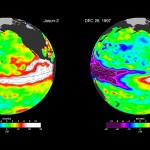
The current strong El Niño brewing in the Pacific Ocean shows no signs of waning, as seen in the latest satellite image from the U.S./European Ocean Surface Topography Mission (OSTM)/Jason-2 mission.
The latest satellite image of Pacific sea surface heights compared with 1997. Credit: NASA/JPL-CaltechEl Niño 2015 has already created weather chaos around the world. Over the next few months, forecasters expect the United States to feel its impacts as well.
The latest Jason-2 image bears a striking resemblance to one from December 1997, by Jason-2’s predecessor, the NASA/Centre National d’Etudes Spatiales (CNES) Topex/Poseidon mission, during the last large El Niño event. Both reflect the classic pattern of a fully developed El Niño. The images can be viewed at: http://sealevel.jpl.nasa.gov/elnino2015/index.html
The images show nearly identical, unusually high sea surface heights along the equator in the central and eastern Pacific: the signature of a big and powerful El Niño. Higher-than-normal sea surface heights are an indication that a thick layer of warm water is present.