
Selling Vegetables
When you want to see the stars, find someplace dark


Local residents seem to take little notice of this ongoing environmental disaster, going about their business. They even stop and take photos of the fallen leaves. The effect is admittedly quite pretty, with striking colors.
Traveling Central America offers a wide range of photographic opportunities, but few offer the concentrated view of local culture that is offered by a city market. A real market is something that has been lost in the US, long ago pushed aside by supermarkets and shopping malls. A central location, filled with small shops or simply stalls, where one can buy everything they need. These markets still exist in much of the world.

A market brings everything together in one place, the very character of the country. The people of the region, produce and tropical fruits, the goods and services of everyday life. You can spend hours in a few city blocks, wandering and shooting, a good photo around every corner and down every dim alleyway between the stalls. From vegetable stalls to cobblers and barbers plying their trades, cell phone accessories and racks of colorful shoes, everything is on sale here.
Markets are public spaces, a place where people take little notice of the camera and seldom object to being photographed, where your wanderings will draw little attention, except perhaps from peddlers hoping to make a sale.
Yes, Darker View has been a bit quiet lately. I have been not only off-island but out of the country for the last couple weeks. I flew to Portland to join my parents on a trip to Nicaragua.

Back at home and back online, I have a series of posts in the works to record my experiences. The trip was extraordinarily memorable, with interesting stories to share. Along the way I did a lot of photography, thus I have gigabytes of material that needs to be sorted through. The best of this will appear here on DV as I have a chance to process it. My hope is that I can preserve a bit of the experience here in blog form. Not only for you to read, but as a record that I can read many years from now to remember this wonderful trip.
Another fun video from Mark, diving the harbor at Honokohau…
Mark is at is again, publishing a couple fun videos of diving the Kona Coast. As I have been off island for a couple weeks I have not been diving, watching the vids has reminded me all too vividly of that! Need to get some bottom time!

One of the advantages of a mirrorless camera, like the EOS-M, is the very shallow backfocus requirement. The distance from the lens mount to the sensor is quite small, allowing use of just about any series of lenses on the market. All that is needed is the correct adapter, a need that several specialty manufacturers have addressed with products. The result is that the camera is useful in a wide range of photographic experiments and projects.
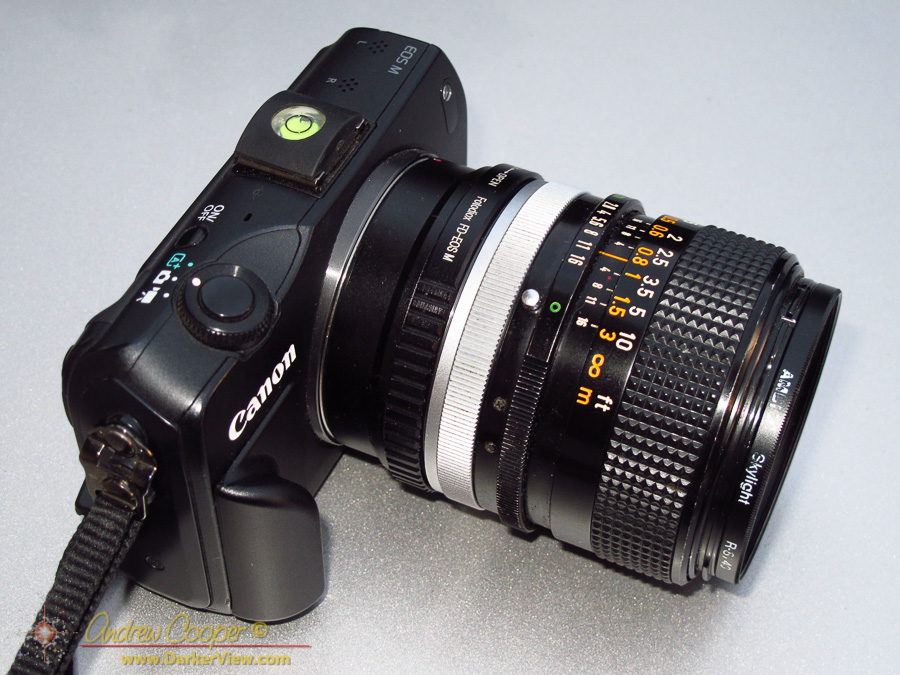
Any sort of zoom lens need not apply, the quality of the older zoom lenses often suffered. Designed without the aid of modern optical design software and without aspheric elements these designs fall short of modern standards.
You can find these classic lenses languishing on shelves in the back of camera stores, in garage sales and on eBay. There is a lot of junk out there, it takes some research to differentiate the good from the bad. A couple quick rules of thumb will sort out most of the junk… Stick to a first rank name in old camera gear; Canon, Nikon, Ziess, Hasselblad, and Leica. The next hint of a hidden gem is the focal ratio. The classic primes were fast, f/2.8 or faster. Still, it is wise to look up the history of the lens before plunking down any cash. The good lenses will be well written about, even in modern times. You will find good references with a quick web search.
Today Venus is at maximum elongation, as high in the dawn sky as it will get for this morning apparition, about 46°. After today the planet will begin its long slide back into the glare of dawn. It will disappear from view around the beginning of May, 2016 and reach superior conjunction on June 6th, 2016.