We have been through weeks of the TMT permit contested case hearings at this point, with no end in sight. I have often kept the live feed in the corner of my computer screen through the day.
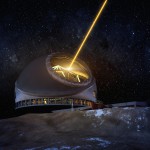
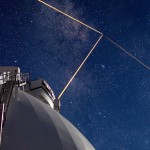
An artist concept of TMT at night, with the laser guide star system illuminated.Many of the petitioner’s efforts are well prepared and professional, particularly those from Mauna Kea Anaina Hou. Other are less so, to be expected when the participants are not experienced in legal proceedings.
Other petitioners seem unable or unwilling to understand repeated instructions from the hearing officer. At least most of the grandstanding has settled down as it became apparent that it would not be tolerated in the hearing room and that Judge Amano would evict those who repeatedly disrupted proceedings.
Several times during the recent contested case hearings I have listened to telescope opponents ask witnesses on the stand and under oath, “Have you asked the mauna?” or “Have you asked Poliʻahu?” I have heard a dozen variations on the question, but that is the general sense of it. They are asking if the witness has asked the gods or goddesses who are reported to dwell on Mauna Kea if building the telescopes is allowed. Poliʻahu in particular, the goddess of snows and ice, is identified with the summit of Mauna Kea.
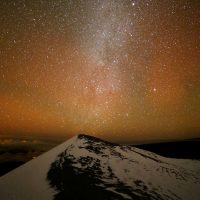
The winter Milky Way over the summit of Mauna KeaThe question strikes a particular resonance with me, returning to my thoughts again and again. I consider my relationship with the mauna, is it pono that I continue to work at an observatory and support the construction of TMT?
I think of all the nights I have spent alone on the mountain. So often I have sat in the quiet, with nothing but the mauna and the stars. Sometimes I am sitting beside a small telescope, and taking a break to simply enjoy the night. Sometimes I am waiting for a camera, somewhere nearby in the dark. Sometimes I am just sitting doing nothing at all, simply enjoying the beauty of this place. In any case I am alone with the silence, the stars, the mountain, and my thoughts.
A dark night under the stars! It has been too long… Why not?
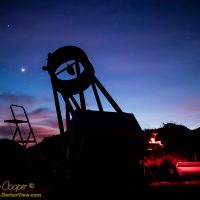
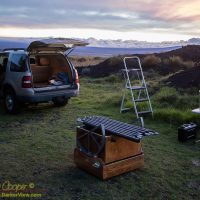
The 20″ Obsession telescope awaiting full dark at Kaʻohe, on the side of Mauna Kea
After all the work restoring the 20″ Obsession it was time to get it out under the stars for a decent observing run. During the many hours of work I had looked forward to simply using this telescope for a bit. While it would eventually be stored at the observatory and used for outreach, it seemed a shame not to spend a night or two under the stars with this instrument. Not like I need a 20″ telescope, my 18″ is just fine, but I loaded it up just the same, leaving Deep Violet in the garage.
The 20″ Obsession telescope being set up at Kaʻohe, on the side of Mauna Kea
My favorite close by site is KaʻOhe, taking only a twenty minute drive from home to reach. At 5,700 feet on the side of Mauna Kea nearby home does not mean second rate. I really like this spot, the view is spectacular with the coastline below and the Mauna Loa and Hualālai volcanoes dominating the horizon. The entire southern horizon is unobstructed, allowing observations of southern objects right down to the horizon.
Better yet, recent rains meant green grass and a spot near the road maintenance gravel pile was hard packed rock, no dust! The area had even been mown recently! I sometimes have a few uncharitable words to describe DLNR, but not this evening.
While most states have yet to see any snow this winter, Hawaiʻi is not one of them. A light dusting of snow graced the summit of Mauna Kea this morning.
Interestingly recent forecasts have revisited the possibility of a La Niña event forming in the central Pacific this fall. If this does come to pass Hawaiʻi may be looking at a wetter than usual winter with the potential of significant snowfall on Mauna Kea. While this can wreak havoc with observatory operations, it can also be quite pretty.
A light dusting of snow on the summit of Mauna Kea on the morning of October 18, 2016A light dusting of snow on the summit of Mauna Kea on the morning of October 18, 2016
Yesterday’s post stirred a blaze of comments over on Facebook, there are 50 shares and climbing fast. While there were those who took both sides of the sign, the majority seem to agree with the opinion I put forth in yesterday’s post. Most agree that the sign is inappropriate and quite possibly counterproductive.
Paul Hirst That sign annoys me, I think it’s ineffective at best, and very probably counterproductive. I too have hiked up there many times, but not since the sign appeared. Though to be honest and having given it more thought now, I don’t think the sign would stop me if I wanted to go again, though it may have dissuaded me in the past at times when I might otherwise have gone.
The sign asking for people to not hike to the true summit of Mauna KeaThe fundamental problem I have with it is that it’s completely un-enforceable, so it has the effect where now the people who do go are the ones who ignored the sign and thus perhaps less likely to respect other things like not disturbing things or leaving litter. Essentially, it reduces the number of people who go to the true summit and take care to have minimal impact on the land, and it has no impact on the number of people who will go up there and don’t care so much. So it just alienates the people who they ought to be befriending as allies in caring for the mountain.
Lynn Paul Richardson I respect cultural sites and always remain within designated walkways. This sign rings hollow to many people who would normally pause at that point.
A fair point was raised in considering the impact that foot traffic has on the summit… Erosion of the area could be an issue. Though I believe this could be mitigated with proper trail maintenance.
Matthew J D’Avella In my opinion people should stay off the true peak for several reasons. Erosion being my number one reason.
Quite a few have suggested that the sign be replaced with something that educates visitors to the importance of the site, request that the be respectful, and stay on the marked trail to minimize the impact to the area.
Chris Runnells Yeah I’m not sure I agree with that. The mountain is sacred to many people regardless of whether or not you’re of Hawaiian ancestry. It’s possible to go to the summit and be respectful without having Hawaiian blood. I think this sign should be replaced with a message to tread with care, pack out what you pack in, etc. I doubt it’s going to actually stop anyone.
I fully agree with different, better signage. This is an idea I should have thought of when writing yesterday’s post, my thanks to those who suggested it. I will probably compile the comments into a letter to Stuart at OMKM, maybe we can get the sign changed. My thanks to the many who commented on this, a productive discussion!
The kerfuffle has served to illustrate the issues that access to Mauna Kea exemplifies. This is a public land access issue. Do you set aside areas as off-limits to the public to appease a specific cultural group. Or should public land be open to everyone, the people of the State of Hawaii? Having had Hawaiian protesters yell at me “Get off our mountain!”, I have to push back. Mauna Kea belongs to all of us, we should care for it, but we can not close access to anyone like this.
The sign asking for people to not hike to the true summit of Mauna KeaNever mind that the trail to the true summit of Mauna Kea is nicely maintained and outlined in rock, the sign requests that you do not take this trail out of respect for the sacredness of the site.
How many people even pause when considering the message on the sign? The trail and the desire to stand atop the real summit of the mountain is substantial. As we pass the trail head and sign each day I usually see several people walking to or standing atop the summit.
Aloha
Maunakea is historically, culturally, and environmentally significant. Help preserve our cultural and natural landscape and show your respect by not hiking beyond this point to the summit.
I have walked this short trail to the summit several times over the years, though not since the sign appeared. There are no particularly sensitive archaeological sites at the summit. This is in contrast to Lake Waiau, which is ringed with shrines and offerings, is just as sacred, and has no such sign to deter the curious from taking the trail.
Personally I am troubled by this sign. Placing such a sign could very well be counter productive. People are going to ignore it, walking right past it to the summit of Mauna Kea. It simply teaches people to ignore boundaries that could protect sensitive sites.
The summit is public land, belonging to the people of Hawaiʻi. I have trouble with the idea that it should be accessible only to a few on the pretense of religious or cultural heritage. Certainly some might view the summit with less than ideal respect for a special place, simply a pile of rock to be conquered. I suspect most see the summit as more than that, a symbol, a place to sit and think about the world.
I am not a religious person, but still, there are places where I find myself stopping and taking a moment to contemplate our world. The summit is one of these places, a focal point of culture, history, and perhaps the future.
Update Oct 4th: Several folks have commented that a sign educating people about the significance of the place, asking them to be respectful, and asking them to stay within the marked trail would be far more appropriate and productive in terms of protecting the site. I have to agree.
Update Oct 5th: I have posted a follow up article. The response to this article has been impressive, with a lot of heartfelt comments. How we view and respect true summit of Mauna Kea is obviously a subject very important to may people.
The tour guides give the basic story behind the creation of Mauna Kea. The story given is simple… A hot spot in the mantle is the source for a plume of magma that punches through the oceanic crust and forms the Hawaiian volcanoes. As the pacific plate moves the islands are formed one by one, the latest being the Big Island of Hawaiʻi.
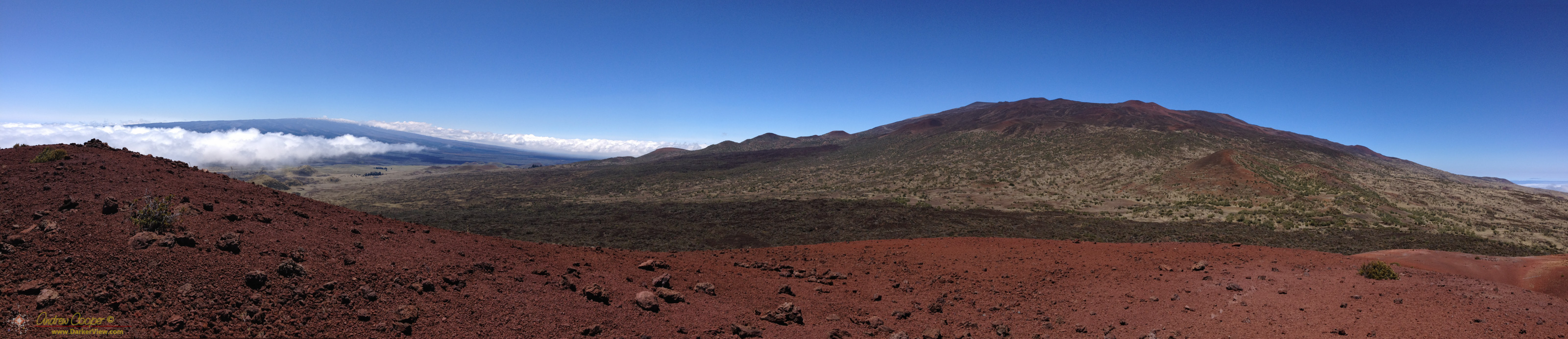
A panarama from atop Puʻu Kole showing Mauna Kea and a distant snow covered Mauna LoaThis is basically correct, but is also a vast simplification of the process. If you want to learn more about the formation of these impressive volcanoes you need to look further.