The Hive
When you want to see the stars, find someplace dark

No, I am not talking about TMT. I have something a bit smaller in process. For the first time in many years I am building a telescope. Just a little one.
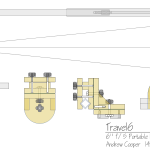
It has been a while, my cred as an ATM is in jeopardy of being revoked.
When I say a little one I am being serious, a 6″ f/5 is the design specification. This is the same optical specification as Primero, my first telescope. The difference here is in building a travel telescope, something that will fit in carry-on baggage with room for clothing.
I am modelling the telescope off a small telescope built by Brett Schaerer he named WikiKea, a telescope I had a chance to examine at Oregon Star Party a couple years ago. He incorporated a clever focus mechanism into that ‘scope that got my attention.
Brett built his telescope for a trip to Hawaiʻi, thus the Hawaiian influence in the name. I will follow suit and have decided that I am building Makaʻiki, which translates as little eye.
I have generated a full set of plans based on a couple photographs of the original telescope. That exercise itself was fun, I love designing things like this. When these plans are complete, a few details are to be settled during building, I will publish them here on DV.
I have manufactured many of the mechanical parts over the last week. A couple more days will be required to make the remainder. I have sourced many of the materials from my stash in the garage, including the plywood, scraps left over from building other telescopes including Deep Violet. I have found that the selection of stainless steel hardware at the Waimea ACE truly sucks, they are out of stock on everything.
Other parts are coming in from eBay merchants, like knobs and HDPE tape. The optics will likewise be from the eBay, most likely GSO. Later today there will be a stop at Home Depot, I am out of wood glue, the last bit thrown out as it had hardened in the bottle. And unlike the local ACE, their hardware selection is pretty good.
Update! The new ‘scope is complete, you can read more about it here.
The dome is rarely open in the daytime. Only under certain conditions and for specific reasons do we open the dome in the daytime. When it is the light streams in, providing a far different quality of light in the dome…

Today Venus is at inferior conjunction, passing between the Earth and Sun. It will reappear in the dawn sky near the end of the month to become the morning star for the remainder of 2015 and well into 2016. The planet will reach maximum elongation on October 26th at 46° from the Sun.
W. M. Keck Observatory press release…
A team of astronomers discovered a Jupiter-like planet within a young system that could serve as a decoder ring for understanding how planets formed around our sun. The W. M. Keck Observatory on Maunakea, Hawaii confirmed the discovery. The findings were headed by Bruce Macintosh, a professor of physics at Stanford University, and show the new planet, 51 Eridani b, is one million times fainter than its parent star and shows the strongest methane signature ever detected on an alien planet, which should yield additional clues as to how the planet formed. The results are published in the current issue of Science.

While NASA’s Kepler space observatory has discovered thousands of planets, it does so indirectly by detecting a loss of starlight as a planet passes in front of its star, the Gemini Planet Imager was designed specifically for discovering and analyzing faint, young planets orbiting bright stars.
“To detect planets, Kepler sees their shadow,” said Macintosh, who is also a member of the Kavli Institute for Particle Astrophysics and Cosmology. “The Gemini Planet Imager instead sees their glow, which we refer to as direct imaging.”
Akin to trying to detect a firefly in front of a lighthouse, the team analyzed the light from the star, then blocked it out. The remaining incoming light was analyzed, with the brightest spots indicating a possible planet.
Continue reading “Hot Jupiter-esque Discovery Hints at Planet Formation”
Another pick from the slides I am busily digitizing. After basic training and tech school with the USAF and before deployment to England, I took a month’s leave. Much of this was spent visiting favorite places around Portland in the late fall of 1986…


By Doug Simons and Hilton Lewis…

The cultural, spiritual, historical, scientific, and political perspectives being discussed in our community today are the building blocks of resolution. Maunakea is a critically important site of tremendous tradition and strength for the people of Hawai‘i. One of those strengths is the fact that Maunakea is the foremost site for astronomical observation in the world, providing a significant fraction of the new knowledge of the universe available to all of humanity. The challenge before us, the people of Hawaii, is to come together to create a lasting, inclusive, and beautiful union of all of our strengths. We must find a holistic vision for Maunakea, as the pinnacle of our past and the beacon of hope for our future. The voices opposing TMT have given all of us the opportunity to create the next chapter in Hawaii’s history with Maunakea at its heart. Let us seize this moment and do this together.
Continue reading “The Future of Maunakea Rests in the Hands of Hawaii’s People”
More scanning, more memories. Taking these old photos out of the boxes has been fun. So many little treasures on celluloid. Photos of myself as a teenager, photos of the neighborhood I grew up in. There is so much of my life stowed away out of reach, converted to digital they live again…


Regular readers may have noted that I have recently published three articles exploring the subject of the sacred mountain. Each article may have had a different subject, but all overlapped and intertwined. All three articles end with the same paragraph.

Respecting the Sacred
Conflict of the Sacred
Using the Sacred
Mauna Kea is sacred to some, who believe that this place is pivotal, the piko of creation. Others believe that the telescopes are sacred, a testament to the finest aspirations of mankind, to learn and explore, to answer the great questions. It is a mistake, made by many in this controversy, to deny either of these views.