I have been writing quite a bit about the TMT controversy lately. This has had several effects… I have had many kind comments from people across the island and even the globe. I am grateful that some have found my writings useful. My website traffic has multiplied, with daily traffic up about five times normal. This and the large number of Facebook shares I have seen on some posts lets me know that I am not writing for the void, somebody is actually reading what I write. That is a little gratifying.
The winter Milky Way over the summit of Mauna KeaWhy am I writing? People have asked me this and as I have realized, there is a good reason. Writing has become my way of thinking things through. In the process of composing a post I have to organize my thoughts, find references to back up my often faulty memory, find the words to express my feelings on the matter at hand. In the process of doing this I often find myself changing my own views on the subject. The skills of good writing, or in captivating oration, are the most challenging use of our language, and this language is the key to rational thought.
There is an art to composing a subject into a readable post, an art I am still a novice at. Maybe someday I will get better at it. Let me know if you have any suggestions on this.
One of the first binders of slides I grabbed for digitizing happened to be a trip through Switzerland that I took in 1987 with my family.
I was living in England at the time with the USAF. My parents and brother joined me there. We then crossed the channel from Dover to Calais, changed trains in Paris, taking a high speed train to Lausanne. From there my brother and I bounced around with some Swiss bus and rail passes until we rejoined my parents in Zermatt.
It was a memorable trip, there is so much I can remember from thirty five years ago. Going through these old slides certainly brought back memories!
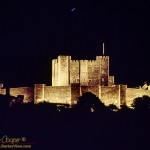
Dover Castle lit up at night
Arriving at the Paris Norde train station from Calais
The Eiffel tower over central Paris
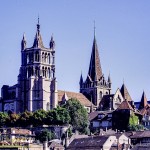
The Lausanne Catherdral looms above the city
Chapel Bridge in Lucern
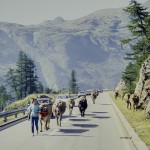
Herding cattle up a Swiss mountain highway
The Madonna del Sasso church above Locarno, Switzerland
A train navigates a mountain railway on the way to Domodossola, Italy
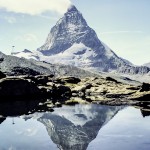
The Matterhorn as seen from near the top of the Gornergrat cable car
Using a new age-dating method and the W. M. Keck Observatory on Maunakea, an international team of astronomers have determined that ancient star clusters formed in two distinct epochs – the first 12.5 billion years ago and the second 11.5 billion years ago. These results are being published in Monthly Notices of the Royal Astronomical Society.
A cosmic timeline showing the birth of the Universe in a Big Bang 13.7 billion years ago to the present day. Credit: NASA/CXC/SAO and A. RomanowskyAlthough the clusters are almost as old as the Universe itself, these age measurements show the star clusters – called globular clusters – are actually slightly younger than previously thought.
“We now think that globular clusters formed alongside galaxies rather than significantly before them,” research team leader, Professor Duncan Forbes of Swinburne University of Technology said.
The new estimates of the star cluster average ages were made possible using data obtained from the SAGES Legacy Unifying Globulars and GalaxieS (SLUGGS) survey, which was carried out on Keck Observatory’s 10-meter, Keck II telescope. Observations were carried out over years using the powerful DEIMOS multi-object spectrograph fitted on Keck II, which is capable of obtaining spectra of one hundred globular clusters in a single exposure.
DEIMOS breaks the visible wavelengths of objects into spectra, which the team used to reverse-engineer the ages of the globular clusters by comparing the chemical composition of the globular clusters with the chemical composition of the Universe as it changes with time.
The 2015 evening apparition of Venus is drawing to a close. Already quite low in the sky at sunset the planet will disappear into the bright glow over the next couple weeks. Venus will pass through inferior conjunction on August 15th and reappear in the dawn during the first weeks of September.
The problem is several thousand color slides stored in containers in a closet. These slides range in date from my earliest forays into photography as a teenager, through years of living in Europe on active duty with the US Air Force, to many years of traveling the desert southwest with a camera. I have carried a camera for my entire adult life, as a result there is a photographic treasure in my old photos.
Slide film awaiting digitizingEverything taken in the last thirteen years is digital, a record of my life and travels that is very precious to me. Before that the photos seem locked away and inaccessible, as if my life did not exist before 2002, when I bought my first digital camera. I have found my digital photo collection enormously useful, it is indexed, key-worded and instantly accessible. While locating a slide for use is a major effort, find the right box, the right binder, then I have to scan it for use in digital media. Or even remember that the photo exists!
The digital archive is also quite easy to duplicate for safekeeping. A two terabyte hard drive can hold the entire collection. A couple hours to copy and every image is safely stored, preferably at a remote location in case of disaster. There are several copies, one in my office at work, another at my parents house in Portland.
These arguments are obvious, the collection needs to be digitized, but the effort of scanning those slides is enormous. I really need a way to perform this task with a minimum of effort and cost. I have started this project several times over the years, only to be discouraged by the effort needed and quality issues.
Scanning
Many authoritative sources recommend scanning as the method of conversion and various scanners are recommended, usually the Nikon CoolScan or Plustek units.
Why do so many recommend scanning as the preferred method of digitizing slides? Certainly professional photo lab scanners are the best possible method, offering resolution far in excess of any scanner generally available at any reasonable cost. I suspect that one factor is decisive… Until the latest generations of digital cameras the resolutions of scanners were far higher than cameras could offer. the linear CCD’s used in scanners offered very high resolutions at a very affordable price point.
The W. M. Keck Observatory has confirmed the first near-Earth-size planet in the “habitable zone” around a sun-like star. This discovery and the introduction of 11 other new small habitable zone candidate planets were originally made by NASA’s Kepler space telescopes and mark another milestone in the journey to finding another “Earth.”
This artist’s concept compares Earth (left) to the new planet, called Kepler-452b, which is about 60 percent larger in diameter. Credit: NASA/JPL-Caltech/T. Pyle“We can think of Kepler-452b as bigger, older cousin to Earth, providing an opportunity to understand and reflect upon Earth’s evolving environment,” said Jon Jenkins, Kepler data analysis lead at NASA’s Ames Research Center in Moffett Field, California, who led the team that discovered Kepler-452b. “It’s awe-inspiring to consider that this planet has spent 6 billion years in the habitable zone of its star; about 1.5 billion years longer than Earth. That’s substantial opportunity for life to arise, should all the necessary ingredients and conditions for life exist on this planet.”
The data from Kepler suggested to the team there was a planet causing the light from it’s host star to dim as is orbited around it. The team then turned to ground-based observatories including the University of Texas at Austin’s McDonald Observatory, the Fred Lawrence Whipple Observatory on Mt. Hopkins, Arizona, and the world’s largest telescopes at Keck Observatory on Maunakea, Hawaii for confirmation.
Specifically, the ten-meter Keck I telescope, fitted with the HIRES instrument was used to confirm the Kepler data as well as to more precisely determine the properties of the star, specifically its temperature, surface gravity and metallicity.
The discovery of a super-Earth-sized planet orbiting a sun-like star brings us closer than ever to finding a twin of our own watery world. But NASA’s Kepler space telescope has captured evidence of other potentially habitable planets amid the sea of stars in the Milky Way galaxy.
This artist’s conception of a planetary lineup shows habitable-zone planets with similarities to Earth: from left, Kepler-22b, Kepler-69c, the just announced Kepler-452b, Kepler-62f and Kepler-186f. Last in line is Earth itself. Credit NASA/Ames/JPL-CaltechTo take a brief tour of the more prominent contenders, it helps to zero in on the “habitable zone” around their stars. This is the band of congenial temperatures for planetary orbits — not too close and not too far. Too close and the planet is fried (we’re looking at you, Venus). Too far and it’s in deep freeze. But settle comfortably into the habitable zone, and your planet could have liquid water on its surface — just right. Goldilocks has never been more relevant. Scientists have, in fact, taken to calling this water-friendly region the “Goldilocks zone.”
The zone can be a wide band or a narrow one, and nearer the star or farther, depending on the star’s size and energy output. For small, red-dwarf stars, habitable zone planets might gather close, like marshmallow-roasting campers around the fire. For gigantic, hot stars, the band must retreat to a safer distance.
About a dozen habitable zone planets in the Earth-size ballpark have been discovered so far — that is, 10 to 15 planets between one-half and twice the diameter of Earth, depending on how the habitable zone is defined and allowing for uncertainties about some of the planetary sizes.
The new discovery, Kepler-452b, fires the planet hunter’s imagination because it is the most similar to the Earth-sun system found yet: a planet at the right temperature within the habitable zone, and only about one-and-a-half times the diameter of Earth, circling a star very much like our own sun. The planet also has a good chance of being rocky, like Earth, its discoverers say.
Kepler-452b is more similar to Earth than any system previously discovered. And the timing is especially fitting: 2015 marks the 20th anniversary of the first exoplanet confirmed to be in orbit around a typical star.
Today Mercury passes through superior conjunction, passing behind the Sun as seen from the Earth. The planet will appear in the sunset in ten days or so, reaching maximum elongation on September 4th.