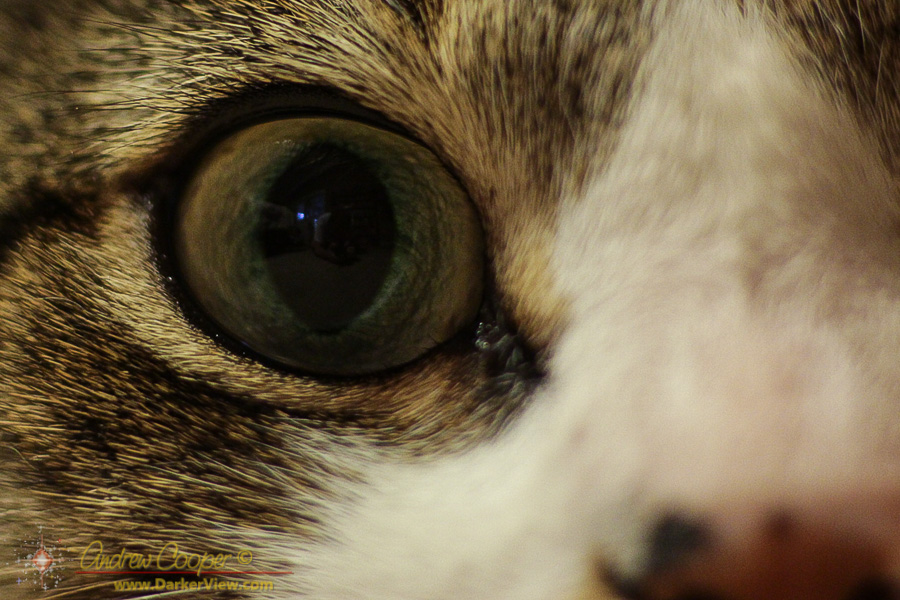
Cat’s Eye
When you want to see the stars, find someplace dark

I do not do experimental photography… Usually.
I have an uncle that does. He slides the saturation to eleven and publishes the results on his Facebook account. The results are… Interesting? But then it was this same uncle who is at least partly responsible for my getting started in photography when I was a teenager.
Occasionally I come up with the odd bit of happenstance. I was testing some photo processing Python code, a script intended to allow HDR processing of digitized slides. I needed a bunch of test frames so I just shot a bunch of bracketed sets at my desk and on the lanai a few feet away to create a whole directory of test material.
I did not intend any of these frames to be kept. HDR sets taken with a handheld camera? Nothing would align correctly!
A couple of them were… Interesting?

A snowfall on the summit of Mauna Kea in mid-summer. A very pretty event, always nice to have some white atop the white mountain. It is even a better as a contrast to the very hot weather we have been having down below. Everyone has been commenting on the unusually warm weather, particularly Hilo residents who have suffered through record breaking warm days and near 100% humidity.

I have been raised on Big Island all my life (which is a long time) and I have NEVER heard of it snowing in July, snow in May is the talk of the town, but in July? It is a miracle! Especially with the hot humid temperature breaking records, how did a trough get through? It must be a message from above and Poliahu’s blessings to our Mauna Protectors. Now all we need is the Kamakani to blow all of the existing telescopes away! EO – Anela2 comment on the West Hawaii Today website
I would point out to the comment author that I have photos in my archive of midsummer snows from almost all of the last eight summers. I can not remember a summer that has not featured snow atop the mountain, even if my photo collection is not complete. Snow can happen anytime of the year on the summit of Mauna Kea. Most summer snows are like this one, fairly minor and mostly melted away by the end of the day.
If the TMT goes up, I can be that this type of thing won’t happen anymore. That monstrosity will block the trough’s moving through the island as well as the winds. It will throw everything off. – Shalee Kekawa comment on the West Hawaii Today website
Either this is a good example of Poe’s Law, or the author really believes that, a truly sad state of science literacy. It gets worse…
Is anyone testing the snow for any chemicals sprayed from the sky? – Josephine Keliipio Facebook comment
An astute observer will note this same sort of occurrence whenever something unusual happens. A few volcanic eruptions hit the news within a few days and people are claiming it is a sign of imminent apocalypse. While anyone who pays attention to volcanoes is fully aware that 12-20 volcanoes are erupting at any given time on the planet, the event is nothing unusual. Earthquakes are good for the same phenomena.
This common misconception occurs when a person’s attention is attracted to something they do not normally pay any attention. Without any baseline data stemming from experience, everything seems new and unusual. I have yet to see a name for this phenomena, though I am sure it exists.
With all of the attention paid to Mauna Kea this year, I really expect this sort of thing to happen again… And again… And…

I walk a short distance from the road looking for a vantage point to set up a camera and note three different offerings within a minute, you can do this at any random spot with a good view along the summit road. They are everywhere, old leis pinned underneath rocks, the remains of little bags filled with shells and coral, ti leaf bundles bleached nearly white by the weather.

Out of respect I leave them alone, as does most everyone who spends time on the mountain. They are never in my way, I just note them and move on. But what can you do about these offerings when they begin to be an issue for the environment?
Previously the rate of offerings was fairly sedate, their appearance uncommon but steady. At the summit, at Lake Waiau, at out of the way ahu that few ever notice. Since the TMT controversy started the rate of offerings appearing on the mountain has multiplied tremendously.
In the lowlands, the forest, the seashores, offerings like these would quickly return to the earth from which they were created. The natural process of decay ensuring that the materials are cycled back into nature. The summit of Mauna Kea is different, the very dry environment preserving plant materials for years or decades. Other offerings include materials that do not break down so readily, shell, coral and cloth can persist for a very long time.
Is there a correct way for a cultural practitioner to remove offerings from an area? Is there someone who can be tasked to do this? Many other religions include rules for handling offerings left at shrines or altars, if only to make way for further offerings to be left. Is there no choice but to leave them in place?

It is going to take a while.

Each LORRI image is a 1Mpix image at a 12bit depth, even with image compression this is 2.5Mbyte per image. LORRI was one of three cameras taking imagery during the encounter, there is also the data from Alice and Ralph. At the distance of Pluto about the best data transfer rate we can expect is around 1Kbit/sec. I am old enough to remember the days when a 1200 baud modem was state-of-the-art, large files were painful. At this data rate it will take about sixteen months for the entire Pluto encounter data set to be returned to Earth. I can only imagine the anticipation within the mission team, waiting for their data to be arrive.
With the New Horizons spacecraft successfully making its flyby of Pluto, we are now getting the first close up images of this distant world. The spacecraft went into radio silence for 22 hours while it maneuvered to photograph Pluto and its moons. The first signal returned was simply a full status report, and only now, a day later are we beginning to see the imagery returned. Given the 2.9 billion miles between the spacecraft and Earth, it will take about 16 months to get all of the data back.
The first images are fascinating! Eleven thousand foot high ice mountains create a rugged landscape. I find myself waiting for further images, the surface of Pluto promises to be far different than any terrain we have seen elsewhere in the solar system.

I read every comment posted to DV, partly to moderate them. On a rare occasion I need to delete something that violates the rules. I also read them seriously, sometimes they contain something to think about, or even write about…

“People do not belong on the mountain if they don’t care about it’s sacredness.” – Anonymous comment on DarkerView
I will give whomever wrote this comment credit, he only asks that we care about the belief of others, not necessarily share them. This is an important distinction and a wise one. I have seen social media comments that take this much further, that claim an ownership of Mauna Kea and express the opinion that “haoles” should be excluded totally from the summit of Mauna Kea.
Personally, I think that anyone should be able to visit Mauna Kea, that no test for their personal beliefs should be necessary. The mountain does not belong to anyone one, or any specific group. It is a special place that belongs to all. It is important that we should care about the beliefs of others, to have some respect for those about us. But we need not share that belief.