As we are all aware, the TMT protests are having direct consequences for everyone who goes to the mountain. Regular mountain users and tourists alike are dealing these consequences. The summit road closed to the public for a second week, the MKVIS also closed, even before these closures the protests had curtailed many activities.
My 18″ telescope Deep violet set up under the stars at the MKVIS.It looks to get worse.
Go the the Mauna Kea Visitor Information Station on the weekends nearest new Moon and you will find telescopes. While the MKVIS telescopes get put away at 10pm there are ‘scopes that are operating late into the night, often still there when dawn colors the sky. These telescopes belong to local amateur astronomers who bring them here to enjoy perfect Mauna Kea skies.
There has been a tangible shift in mood on the mountain. I sense this change in all I talk to. The sentiment toward the TMT protesters has turned from one of tolerance to active hostility. They crossed a line, and I think everyone knows it, including the protesters.
An ahu built in the downhill lane of the Mauna Kea summit access roadFrom everyone’s comments it was the blocking and damage to the summit road that was the critical moment. There has always been a certain sympathy for the protesters among the mountain crews. We may disagree, but at least we understand the source of that disagreement. We are Americans, with an understanding of the right to protest, of respect for those who stand up for their beliefs.
That has changed.
Everyone who works on the mountain understands that the road is an absolutely vital link. It is the only means by which to evacuate the summit in an emergency, the only route by which help can come in the case of trouble. Contrary to many glib Facebook assertions our local fire department helicopters can not operate safely at high elevation. I have seen comments by protesters that downplay the danger, they simply do not understand the seriousness of their actions.
Meanwhile, the mainstream media has been parroting this “public safety concern” language. Of course, they are trying to deceive the public into thinking the Mauna Kea Protectors and the pohaku present the safety hazard. They are lying. – Will Falk
“Pohaku” is of course the Hawaiian word for stone. In his writing Will waxes poetic about the effort and the beauty of placing the rocks on the road, then calls the safety concerns “lying”. His casual disregard for safety is distressing, and typical of those who simply disrespect the mountain, her beauty and her risks.
Today the Earth is furthest from the Sun, a point called apehelion. We will be about 152,096,000km (94,508,000miles) from the Sun. Compare this to the 147,099,000km (91,403,000miles) we were at perihelion on January 3rd, a difference of about 4,996,000km (3,104,000miles) occurring throughout one orbit.
It may seem odd that we are actually at the furthest for the middle of northern summer, you just have to remember that proximity to the Sun is not the cause of the seasons. The seasons are caused by the axial tilt of the Earth, creating short and long days throughout the year, with a resulting change in the angle and intensity of the sunlight.
Growing up in the west I have seen quite a few rodeos. I have always preferred small town rodeos.
Riders compete in the 2015 Parker Ranch 4th of July RodeoI have seen the big rodeos, living in Tucson we attended the Tucson Rodeo several times. Six days of professional level events, riders competing for a chance at the national championships. No question, the competitors were very, very good.
The big rodeos do feature very high levels of performance, the top riders making it look easy. It isn’t of course, but professional level sports just seem contrived to me. Be it bull riding, pro football, or any professional sport, something is lost when it becomes a profession.
Small town rodeos are entirely different. Here cowboys, or paniolos in Hawaii, demonstrate the same skills they use day to day on the ranch. The event may be practiced, but the skills of great horsemanship, roping and riding are real. The scores tell another story, wildly different from rider to rider. These are not polished professionals, these are real cowboys.
A rider and horse lean into the curve at the 2015 Parker Ranch 4th of July Rodeo and Horse RacesThe island rodeos are perfect examples of this, small town rodeos that showcase local ranching skills and traditions.
It has been a few years since we last attended the Parker Ranch 4th of July Rodeo and Horse Races. The last couple years we seem to have found ourselves elsewhere come early July. Last year we were in Alaska when the 4th appeared on the calendar. Not so this year, a couple tickets and an early alarm for a Saturday saw us headed to Waimea.
Good timing all around, a beautiful day with perfect weather for a rodeo. Deb and I moved about, looking for good photo opportunities. Down at the end of the spectator area for the horse races. From there we could shoot the riders coming around the curve of the track. A little elevation was needed to shoot over the rails of the fencing. Unfortunately a barrier now keeps spectators away from the arena fence, this was not there years ago. No shooting through the rail. Maybe a press pass next year?
I have no idea who won or lost, it was just not important to me. Simply watching the skills on display was the good part. Each throw of the rope, the steer going down, the horse neatly backing and keeping tension in a rope without a rider giving directions. Simply impressive to watch.
The new dome and shutter control PLC finally had it’s first night on-sky. The result? No fuss, no trouble, it just worked as designed. To have everything go so smoothly was very satisfying. So much work and trouble, so much worry on my part. Yes, I had performed two days of testing, but this would be on-sky, at night, the final test.
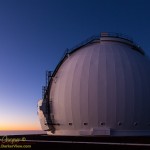
The Keck 2 dome in the glow of sunsetI arrived on the summit after lunch to convert the system, removing the old PLC and connecting the new controller. A few tests, moving the dome and shutters showed that everything seemed to be working. The plan was to stay into the night to insure that if there was trouble I was on hand to fix it, or convert back to the older system.
As the last rays of sunset gleamed I took Capt. Marvel (the radio controller for the dome) and went up onto the roof. From there I commanded the shutters to open, watching with satisfaction as the giant assemblies smoothly opened to the night.
Better yet, the night was partially used for testing the new telescope control system, the TCSU project. Thus the new PLC was tested with both the old system and the new telescope control system.
The result of all my worry was a simple one line write-up from the telescope operator in the logs the next morning… “New dome PLC operations successful. No issues.”
I missed the closest approach of Venus and Jupiter. Not for lack of trying. I had set up the telescope and camera in the driveway. A clear afternoon clouded over at sunset, leaving me only glimpses of the planets through a fleeting gap in the clouds. I had time to focus enough to see the crescent of Venus, which promptly faded from sight.
The next evening I am on the summit. No small telescope available, but I did have the camera to record a stunningly beautiful evening atop the mountain.
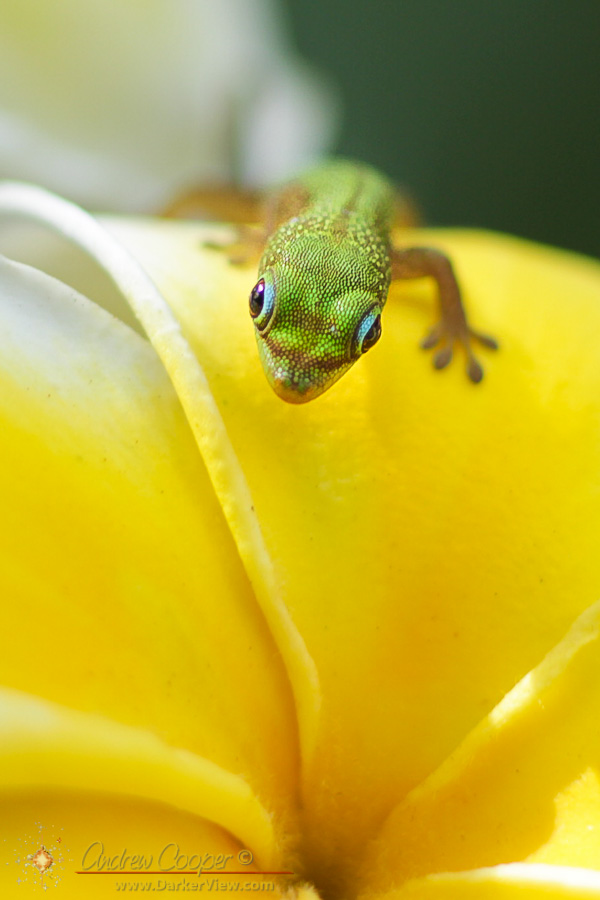
This little guy was not afraid of me in the least. Indeed he had no problem hopping on and off my fingers as I sought to pose him on the flower. It was a warm afternoon and he was quite active, more interested in the ants on the flowers than in sitting still for a portrait.
Shot with an old Canon 100 f/2.8 FD lens (manual focus) and a 25mm extension tube on the Canon EOS-M camera. I got the focus right by simply rocking back and forth through focus while rapidly taking images in servo. This was not with the focus ring, but simply leaning back and forward slowly.
A gold dust day gecko (Phelsuma laticauda) on a plumeria blossom