
Two Lasers on the Galactic Center
When you want to see the stars, find someplace dark

As the Dawn spacecraft settles into lower orbits around Ceres the photos of this small world are of ever better resolution. The mysterious bright spots have slowly resolved into an interesting arrangement of multiple spots. Despite many wild claims on YouTube and UFO websites of alien cities or crashed spacecraft, the spots are looking more and more like a set of ice outcroppings. They are still fascinating, if just a bit more ordinary than some would hope.
My bet? Some sort of cryovolcano.
NASA’s Dawn mission captured a sequence of images, taken for navigation purposes, of dwarf planet Ceres on May 16, 2015. The image showcases the group of the brightest spots on Ceres, which continue to mystify scientists. It was taken from a distance of 4,500 miles (7,200 kilometers) and has a resolution of 2,250 feet (700 meters) per pixel.
“Dawn scientists can now conclude that the intense brightness of these spots is due to the reflection of sunlight by highly reflective material on the surface, possibly ice,” Christopher Russell, principal investigator for the Dawn mission from the University of California, Los Angeles, said recently.
Dawn arrived at Ceres on March 6, marking the first time a spacecraft has orbited a dwarf planet. Previously, the spacecraft explored giant asteroid Vesta for 14 months from 2011 to 2012. Dawn has the distinction of being the only spacecraft to orbit two extraterrestrial targets.
The spacecraft has been using its ion propulsion system to maneuver to its second mapping orbit at Ceres, which it will reach on June 6. The spacecraft will remain at a distance of 2,700 miles (4,400 kilometers) from the dwarf planet until June 30. Afterward, it will make its way to lower orbits.


A photographer needs a guide around Keck for the night? Setup time-lapse cameras throughout the facility? Sounds like fun… Sign me up.
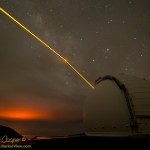
Two lasers, both aimed at the galactic center were on the schedule for the second half of the night. Andrea Ghez and her team having time on both telescopes. The weather looked a bit problematic, thick cirrus covered the sky, but the forecast called for clearing after midnight.
Jason came with a carefully drafted plan, where to set and aim each camera, timer settings, lens choice, all carefully considered. A pretty good plan too, only a few details needed changing as we placed each camera. Four cameras in Keck 1, another two in Keck 2. One camera placement was my idea… Clamped to the Keck 1 dome where it would track with the telescope. I had spent a few minutes in the machine shop putting together a solid camera clamp.
Unfortunately the clouds did not clear as predicted, thin cirrus hanging on through the night. It was clear just to the west, but stubbornly would not give us the clear skies we needed overhead. Several times it looked to clear, but the clouds would thicken again. We did have both lasers on sky for a few minutes, just enough for a few photos and not long enough to do any science.
With high hopes for some dual laser time-lapse I was ready to set up my own camera, but ended up with only a few still photos. Jason got a few nice shots during that short time, having eight cameras helped make the most of those few minutes. I did get a nice video clip of the telescope shot by rotating the dome with a camera.
Jason is working on a personal project and will be out shooting more images in the dark. I will certainly feature the results of his effort here on DarkerView when he finishes. For myself? I will have to schedule another opportunity to go up and shoot some laser time-lapse. There is an intriguing night at the beginning of July on the schedule with both Keck lasers. I also need to mail Jason a camera remote, an accomplishment that only one bit of camera gear got left behind.
W. M. Keck Observatory press release…

“If the Milky Way is a sea of stars, then these newly discovered galaxies are like wisps of clouds”, said van Dokkum. “We are beginning to form some ideas about how they were born and it’s remarkable they have survived at all. They are found in a dense, violent region of space filled with dark matter and galaxies whizzing around, so we think they must be cloaked in their own invisible dark matter ‘shields’ that are protecting them from this intergalactic assault.”
The team made the latest discovery by combining results from one of the world’s smallest telescopes as well as the largest telescope on Earth. The Dragonfly Telephoto Array used 14-centimeter state of the art telephoto lens cameras to produce digital images of the very faint, diffuse objects. Keck Observatory’s 10-meter Keck I telescope, with its Low Resolution Imaging Spectrograph, then separated the light of one of the objects into colors that diagnose its composition and distance.
Continue reading “Scientists at Keck Discover the Fluffiest Galaxies”
W. M. Keck Observatory press release…
Using the W. M. Keck Observatory in Hawaii, a group of astronomers led by Joseph Hennawi of the Max Planck Institute for Astronomy have discovered the first quadruple quasar: four rare active black holes situated in close proximity to one another. The quartet resides in one of the most massive structures ever discovered in the distant universe, and is surrounded by a giant nebula of cool dense gas. Because the discovery comes with one-in-ten-million odds, perhaps cosmologists need to rethink their models of quasar evolution and the formation of the most massive cosmic structures. The results are being published in the May 15, 2015 edition of the journal Science.

Quasars constitute a brief phase of galaxy evolution, powered by the in-fall of matter onto a supermassive black hole at the center of a galaxy. During this phase, they are the most luminous objects in the Universe, shining hundreds of times brighter than their host galaxies, which themselves contain hundreds of billions of stars. But these hyper-luminous episodes last only a tiny fraction of a galaxy’s lifetime, which is why astronomers need to be very lucky to catch any given galaxy in the act. As a result, quasars are exceedingly rare on the sky, and are typically separated by hundreds of millions of light years from one another. The researchers estimate that the odds of discovering a quadruple quasar by chance is one in ten million. How on Earth did they get so lucky?
Clues come from peculiar properties of the quartet’s environment. The four quasars are surrounded by a giant nebula of cool dense hydrogen gas, which emits light because it is irradiated by the intense glare of the quasars. In addition, both the quartet and the surrounding nebula reside in a rare corner of the universe with a surprisingly large amount of matter. “There are several hundred times more galaxies in this region than you would expect to see at these distances,” said J. Xavier Prochaska, professor at the University of California Santa Cruz and the principal investigator of the Keck Observatory observations.
Continue reading “Astronomers Baffled by Discovery of Rare Quasar Quartet”
A night on the summit and a stay at Hale Pōhaku offers an opportunity to explore the mountain. The plan had been to take a short hike in the Hale Pōhaku area to visit some interesting geologic features before heading down the mountain. A cold misting rain made that idea much less attractive. Instead I paid a visit to my friends at the Visitor Information Station and along the way visited the protest camp across the street. The experience of the day was a conversation I had with the occupants of the camp, a conversation both interesting and odd, I spent the entire drive back down the mountain and much of the day mulling over what I had seen and heard in that conversation.

The first to greet me as I came across the street was a gentleman I will call Mr. Sovereignty for his position on the matter. The argument atop Mauna Kea has become embroiled in a range of issues that have simmered in the islands for a long time. Among those who are against the construction of TMT are some who are simply against any further telescopes on Mauna Kea and also those who see the issue as wrapped up in questions on the legal status of the State of Hawaii. The main thrust of a common argument is that the Kingdom of Hawaii was illegally overthrown. Their goal is nothing less than the restoration of the kingdom as a sovereign entity.
Keck again holds the record, for the moment at least, of the farthest galaxy ever observed. It is a record that we have been passing back and forth with the neighboring Subaru Telescope for some years now. We currently have the advantage of MOSFIRE, a fantastic spectrograph to discover these objects. I expect our hold on this title will be transitory, there are candidate objects that may even be somewhat further away and back in time.

W. M. Keck Observatory press release…
An international team of astronomers, led by Yale and the University of California, Santa Cruz, pushed back the cosmic frontier of galaxy exploration to a time when the Universe was only five percent of its present age. The team discovered an exceptionally luminous galaxy more than 13 billion years in the past and determined its exact distance from Earth using the powerful MOSFIRE instrument on the 10-meter Keck I telescope at the W. M. Keck Observatory in Hawaii. These observations confirmed it to be the most distant galaxy ever measured, setting a new record. The findings are being published in Astrophysical Journal Letters today.
Continue reading “Scientists at Keck Measure Farthest Galaxy Ever”
Our mountain is home to a wide range of geologic features, Aside from the wide range of volcanic features expected on a shield volcano, there are also glacial features and a small lake. Indeed, one could teach a fairly thorough course in geology simply visiting places on Mauna Kea. It is the lake that seems completely out of place, Lake Waiau should not exist.
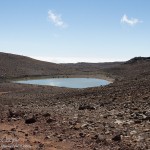
The lake is an anomaly. The cinder of Mauna Kea is highly permeable, water disappears into the ground at an impressive rate almost anywhere else on the summit. Something within the crater forms an impermeable layer that allows the water to persist at the surface.
The two most common theories are a layer of volcanic ash and/or clays, or a layer of permafrost beneath the surface. I prefer the ash and clay theory, there is suitable material present on several of the other cinder cones, most notably seen as yellow streaks down the side of Puʻu Poliʻahu and on the sides of Puʻu Waiau itself.
Upgrades. With 20 year old systems upgrading and replacing old gear is a constant job. It is even worse over at CFHT, their facility is quite a bit older than ours at Keck. Does this mean the telescope is obsolete? No way. most systems have been constantly updated with new technology. But it does take quite a bit of work…
Canada France Hawaii Telescope Upgraded TCS testing from CFHT on Vimeo.