My Facebook post describing a last moment mission to the volcano caught the attention of one of our local reporters. Result? An interview and a little piece about volcano viewing carried on several of the local media outlets. Nothing serious, they are just trying to capture the event of the moment and the local response. Perhaps something positive in the face of all the tragic fallout from the Lahaina disaster that fills the local news. Not my first time in the news, but the first time in a while, it is always fun…
The First Few Hours
Watching the recent and repeated eruptions in the Kilauea caldera has made an interesting bit of info clear… The first few hours are the most spectacular.

Months of inflation Kilauea had stored large quanities of gas and built up a considerable amount of pressure, enough pressure to lift the megatons of rock above the magma chamber and cause the entire summit region to swell outwards.
Beween eruptions USGS geologists and armchair vulcanologists like myself keep an eye on the tiltmeters as the pressure in the volcano builds, awaiting the time that accumulating magma and increased pressure bursts through the overlying rock to begin a new eruptive cycle.
At 15:13 HST Sunday afternoon that moment came.
Continue reading “The First Few Hours”Shore Party

Oregon Star Party 2023
A large star party is an experience worth seeking out… Hundreds of people, hundreds of telescopes, all under a dark sky.

A star party is a meeting of geeks. Technical talk of optics, electronics, and fabrication techniques like 3D printing abounds. In the afternoon and evening you will find small conversations in the shade, pull up a chair and join the discussion.
The plan was something I had executed successfully before… Fly into Portland, spend some time with my folks, then borrow the family camper for the trip out to the Ochoco Mountains for the star party.
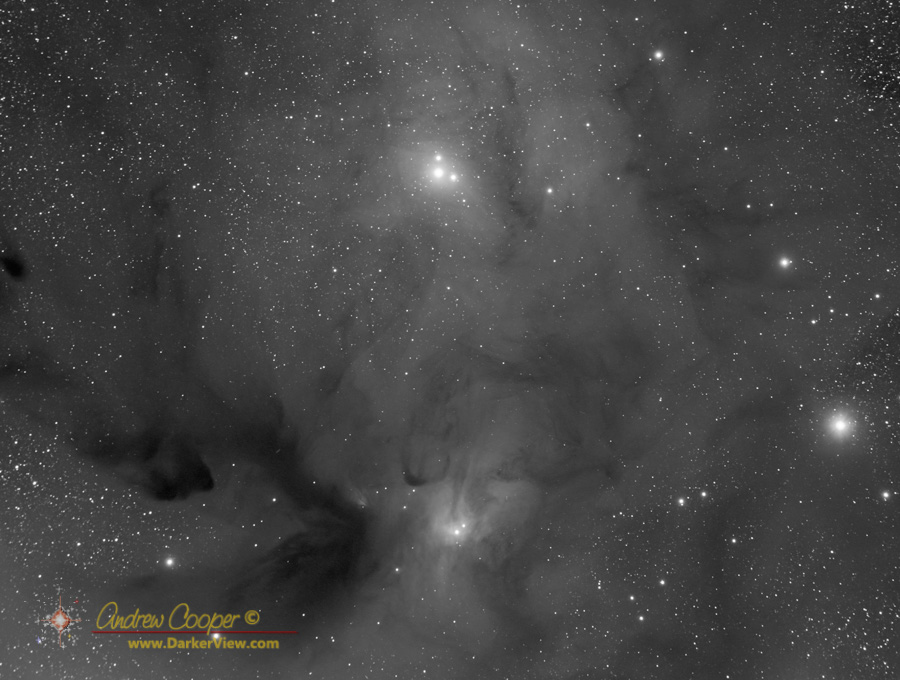
Continue reading “Oregon Star Party 2023”Rho Ophiuchi Region in Monochrome
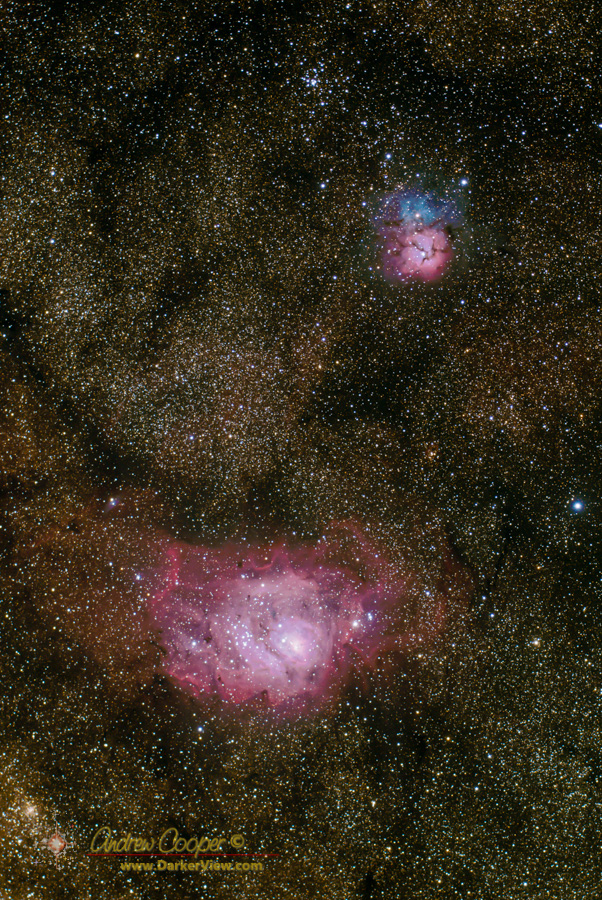
Lagoon Region
Taking the AT6RC tube off and installing the Televue 76mm on the mount changes the game a bit. Lower magnification, wider field, a setup I find more appropriate for Waikoloa skies.
The average seeing in Waikoloa is 2 or 3 arcseconds, or worse… Not the 0.5 arseconds typical at the summit. This leads to mushy stars at higher magnification, fuzzballs rather than pinpoints. Lower magnification sidesteps this problem.
Still using the borrowed ASI2600MC color camera for a few more days, seeing just what it is capable of. The slightly larger sensor is nice and the data easier to process, but still I am seeing limitations that annoy me in the fine details. The color balance is difficult to deal with as well.
I will be going back to the ASI1600MM and filter wheel soon enough. I do need to up my processing game, the software side has changed substantially over the years and I need to transition. Will be giving PixInsight a spin over the next month.
Of Green Stars…
Wandering the sky using a telescope and a field guide published in 1844, the better part of two centuries ago, is… uhhm… interesting. In mid-April the classic winter constellations are dissapearing into the sunset, with constellations like Monocerus and Puppis well placed for observing from my driveway just after dark. On my observing table is a reprint of that 1844 field guide, The Bedford Cycle.
Working through the entries I come to the entry for a double star Argo Navis 72 P. VIII, a designation from a very old catalog. It takes a few moments research to convert 72 P. VIII to the slightly more modern catalog number HD 71176. Modern? The Henry Draper Catalog was first published by Harvard Observatory in 1918, still over a century ago.
With the HD number I can look up the position on a modern chart and spend a few moments star-hopping the Astrola to the correct star. This double star is now located in the constellation Puppis after the ancient and absurdly large constellation Argo Navis was broken up into Puppis, Vela, and Carina.
Continue reading “Of Green Stars…”Rainbow Falls

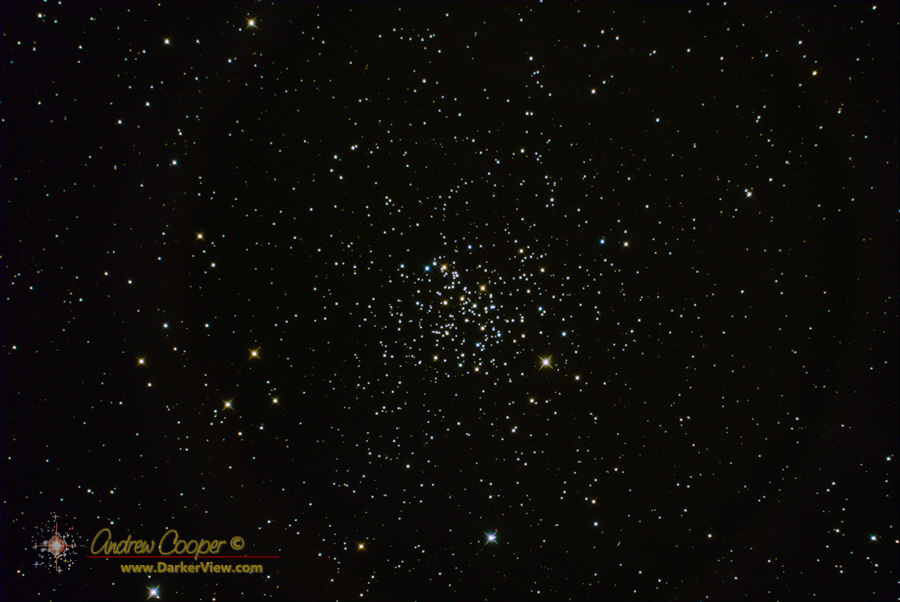
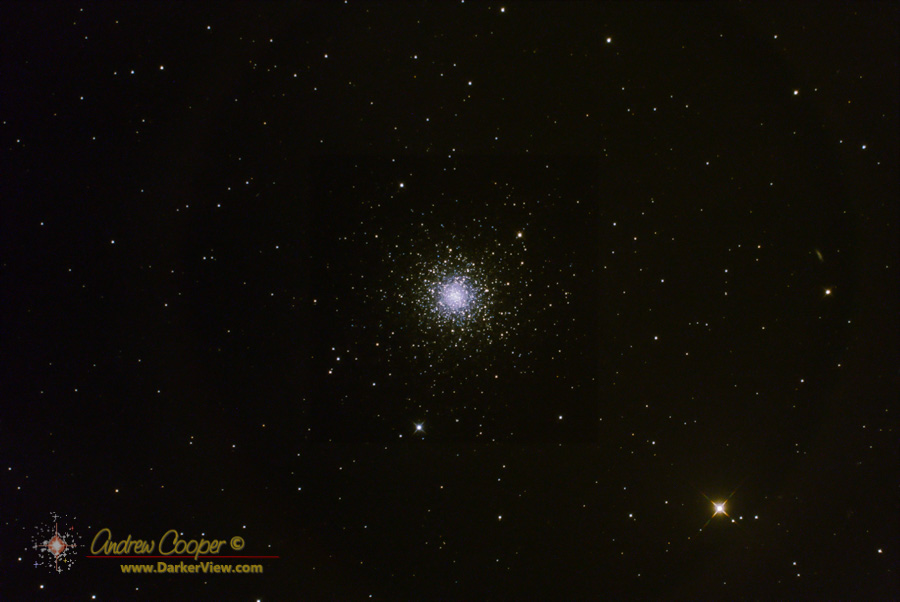
M3
M67