Waimea Cherry Blossom Festival

This weekend was Cherry Blossom Festival in Waimea!

There are a huge number of events, exhibits and vendors at multiple venues scattered across town. You really need to pick and choose what you want to see. In years past we had checked out the events at Parker Ranch Square or visited the historic Puʻu Opelu home at Parker Ranch. This year I started at church row, parking at Keck and walking over. The large lawn in front of the churches is really the center of the whole event, here are the cherry trees for which the festival is held.

Cherry Blossoms
Cherry blossoms on a tree in Waimea
Actually the cherry trees were at their best last week. We have been enjoying them, they are right next door to Keck. There were still a few trees in blossom for the festival. Everyone stopping to take a few photos of the blossoms. Even better, the notoriously fickle Waimea weather produced an absolutely glorious day for this year’s festival.

The first event I look for on the schedule is Taiko drumming! This island boasts several excellent Taiko groups and performances are always a treat. This year I caught Hui Okinawa Kobudo Taiko’s early performance at church row. A chance to enjoy the performance, take some great photos, and just feel the pounding of the drums pass through you. One set was a great Shishi Mai (lion-dog) performance, the dancers interacting with the crowd.

Hui Okinawa Kobudo Taiko
Hui Okinawa Kobudo Taiko performs at the 2015 Waimea Cherry Blossom Festival
Food is available in abundance. Traditional Japanese fare at the Hongwanji Mission, cooking demonstrations from local resturant and resort chefs, and local island favorites everywhere. No problem getting lunch. Well, there was one problem… making a choice!

I particularly enjoyed a bonsai exhibit, there were some gorgeous examples of the art. I also visited the Hongwanji Mission, a Buddhist temple of the Jōdo Shinshū school. The building is almost next door to Keck, but I had never given it much thought.

The only downside of the festival is the traffic. Half the island comes to Waimea for the day, the result is no parking, near gridlock on the main street, and crowds everywhere. As with most of these Waimea events, get there early!

Mercury Appears in the Dawn

The planet Mercury is starting a morning apparition. The planet should become visible this week just above the dawn as a magnitude -1 object. The planet is moving more than 1° further from the Sun and higher in the morning sky each day, reaching a maximum elongation of 27° on February 24th. This will be the best morning apparition for Mercury in 2015.

Continue reading “Mercury Appears in the Dawn”

The Main Pressure Regulator

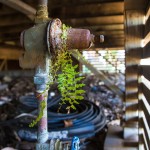
Raking leaves out from underneath the lanai I just happen to look up. The water line into the house is right there and can be seen through a opening I cut in the lattice to allow the main shutoff valve to be reached without crawling under the house. There are pretty little ferns growing on the water pressure regulator.

That is not good.

Household Water Pressure Rregulator
A leaking household pressure regulator… Another weekend repair required.

The regulator is weeping, a steady dripping from the bottom of the assembly. A closer look shows that the valve body is badly corroded. This is not something I want to mess with until I have replacement parts on-hand. It is likely to come apart when disturbed, leaving the house without water.

Thus a mid-week trip to HPM is made. No matter, a lunchtime trip is an excuse to stop in Big Island Brewhaus and try some of the new menu items, the burgers are great! I note that the cherry trees are also beginning to bloom nicely, all good for the Cherry Blossom Festival next week.

A new regulator, a water pressure gauge, a handful of copper fittings. I have the rest of the needed tools on-hand already… Torch, propane, pipe cutter, flux, solder and pipe compound. I make sure I have everything before I shut off the water. I also warn my wife that the house will be without water for a few hours.

The old regulator is in bad shape, but not that bad. Failure was not imminent, maybe in a few months, but not tomorrow. It was leaking quite a bit, a steady drip. Water shut off at the street and at the supply to the solar water heating system I can open the lines. A little struggle ensues before the old fittings yield and the old regulator can be removed.

Of course the new regulator is smaller, I can not just thread it into place. This is what the copper fittings are for… I cut away the old threaded fittings and measure some new pieces of pipe. While I am cutting and fitting copper I add a new valve above the regulator, a convenient way to drain the household system and a place to attach a pressure gauge when adjusting the new regulator.

Yes, I raked out the pile of old leaves caught in the corner before lighting up the propane torch. No need to burn the house down to do a little plumbing repair.

All done I open the valves and return water pressure to the house. The gauge reads just below 50psi… good, just what the manual stated for the setting from the factory. This is not, of course, satisfactory for Deb, not enough pressure! Adjusting upwards to 60psi and my wife is happier.

The job cost a bit over $100 in parts. All good, and vastly cheaper than calling out a plumber for an easy job. Never mind that Hawaii law requires a licensed plumber to do such a job. Another weekend repair completed. What would I be doing else-wise? Probably painting or cleaning the garage.

Citizen Scientists Lead Astronomers to Mystery Objects in Space

NASA/JPL press release

Sometimes it takes a village to find new and unusual objects in space. Volunteers scanning tens of thousands of starry images from NASA’s Spitzer Space Telescope, using the Web-based Milky Way Project, recently stumbled upon a new class of curiosities that had gone largely unrecognized before: yellow balls. The rounded features are not actually yellow — they just appear that way in the infrared, color-assigned Spitzer images.

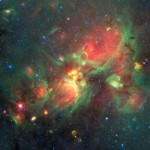
The center of our Milky Way Galaxy taken by NASA's Spitzer Space Telescope.   Image credit: NASA/JPL-Caltech
The center of our Milky Way Galaxy taken by NASA’s Spitzer Space Telescope. Image credit: NASA/JPL-Caltech
“The volunteers started chatting about the yellow balls they kept seeing in the images of our galaxy, and this brought the features to our attention,” said Grace Wolf-Chase of the Adler Planetarium in Chicago. A colorful, 122-foot (37-meter) Spitzer mosaic of the Milky Way hangs at the planetarium, showcasing our galaxy’s bubbling brew of stars. The yellow balls in this mosaic appear small but are actually several hundred to thousands of times the size of our solar system.

“With prompting by the volunteers, we analyzed the yellow balls and figured out that they are a new way to detect the early stages of massive star formation,” said Charles Kerton of Iowa State University, Ames. “The simple question of ‘Hmm, what’s that?’ led us to this discovery.” Kerton is lead author, and Wolf-Chase a co-author, of a new study on the findings in the Astrophysical Journal.

The Milky Way Project is one of many so-called citizen scientist projects making up the Zooniverse website, which relies on crowdsourcing to help process scientific data. So far, more than 70 scientific papers have resulted from volunteers using Zooniverse, four of which are tied to the Milky Way Project. In 2009, volunteers using a Zooniverse project called Galaxy Zoo began chatting about unusual objects they dubbed “green peas.” Their efforts led to the discovery of a class of compact galaxies that churned out extreme numbers of stars.

Continue reading “Citizen Scientists Lead Astronomers to Mystery Objects in Space”

Eye of the Predator

Trumpetfish are stealthy hunters, using their oddly shaped body to strike unsuspecting prey. They are also known to follow large creatures on the reef, turtles or groupers, to take advantage of prey flushed out in their passage. This trumpetfish was using me for the same purpose, hoping to strike whatever the big, noisy diver scared up. The fish hovered quite close to me, not even moving away despite several bright flashes from the strobe. The cave is a very popular dive site, this fish may have learned to use divers to find an easy meal.

Eye of the Trumpet
A trumpetfish (Aulostomus chinensis) considers the camera

2004 BL86 Passes By

Asteroid 2004 BL86 is not small, it is large enough for astronomers to take notice as it passed near the earth yesterday at a close, but safe distance of 745,000 miles. Numerous telescopes were trained on this object as it passed by, including a deep space radar at Goldstone that confirmed that the asteroid is about 1,100 feet in diameter. They did get a surprise as well, 2004 BL86 has a small moon.

Close approach was earlier in the day, thus it was some hours after that I was able to photograph the asteroid from Hawaii. The most difficult part in taking the photo is locating the object. An asteroid this close by will move across the sky very quickly. To locate the asteroid I used a high precision ephemeris generated by the JPL Horizons Database with time intervals of every half hour. This was necessary as the asteroid was moving several degrees each hour. If I used coordinates even an hour off it would have been out of the frame. It took half an hour of hunting, comparing frames taken a couple minutes apart.

Below is the streak created as the asteroid moves over the course of an eight minute exposure…

2004 BL86
Asteroid 2004 BL86 just after close approach on January 26, 2015