One of the things the recent controversy has starkly revealed is the lack of understanding of what we do on the mountain. Myths and misunderstandings pepper the comment sections of local newspapers and echo on Facebook.
Looking at the Keck domes from the Subaru catwalkIn an effort to change this the obsevatories are introducing a new tour opportunity. The Kamaʻāina Observatory Experience is a free tour of an observatory, with free transportation to the summit for local residents. All that is necessary is a local ID to get a chance to see inside one of the summit facilities.
Rumor has it that Hawaii Forest and Trail will be providing the transport, a comfortable service with knowledgable guides.
Surprisingly this was announced by President Obama at the White House Star Party this week. A rather high profile announcement for a local effort.
I will probably volunteer to help out and be a tour guide when it comes Keck’s turn to host the tour.
A great deal of mythology swirls about our mountain. Some of it may be true, much is probably not as wishful thinking and reality collide on the summit. The current debates have moved every little detail into the light.
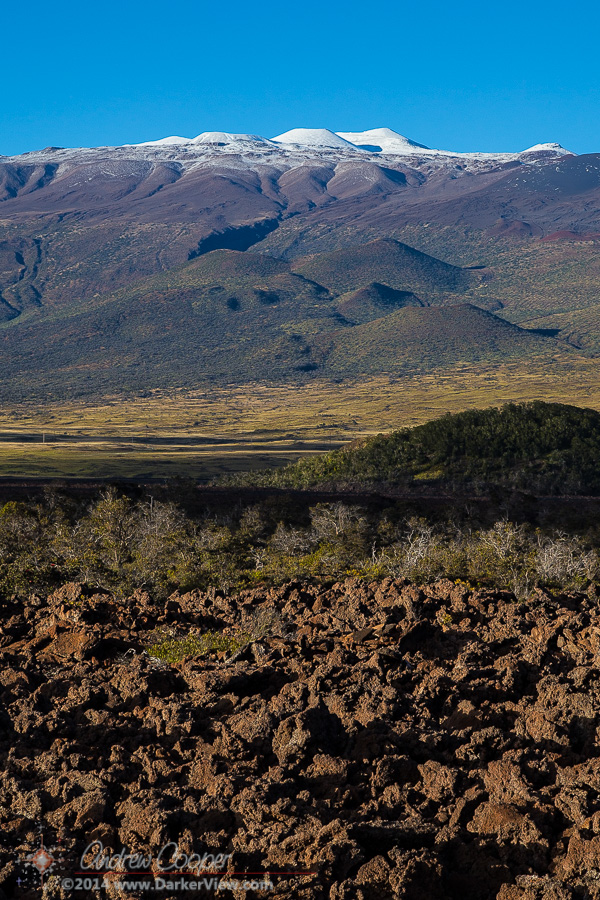
Mauna Kea with a fresh covering of snow and iceOne of the claims I have heard repeated a few times recently is that in the past Mauna Kea always had snow, even in summer, making the name “White Mountain” very applicable.
Follow the link and read the paper, it is a fascinating view into the past of Mauna Kea. Included are excerpts from ships logs and diaries of early visitors to the islands. At the end is a convenient timeline of the accounts covering the first century of written records and a set of three conclusions drawn from this information. The author’s conclusion is clear, Mauna Kea has not featured permanent snow cover any time in the last few centuries.
There was a time when the mountain featured permanent snow and ice fields. During the last ice age, around 12,000-11,000 years ago, there was permanent ice and active glaciers in the summit region. Along the access road there are textbook glacial features to be seen, glacial polish and moraines. This was gone before humans arrived in the islands. What we see today was probably much as it was over the past few centuries, as borne out in the records of the first European voyagers to make it to the islands. Snow may have been more common, but there were certainly periods when no snow was to be seen atop the summit of Mauna Kea.
These historical accounts date from long before human activities had begun dumping vast quantities of carbon dioxide into the atmosphere. We do face an uncertain climate future, warming temperatures may reduce snowfall. The opposite may also be possible, warmer sea surface temperatures may create more precipitation at the summit with heavier snowfall events possible.
It has gotten a bit confusing of late. As the argument rages over the summit of Mauna Kea even the name of the mountain is something that few can agree upon. Mauna Kea, Maunakea, Mauna Akea, Ka Mauna a Kea, or Mauna a Wakea are all used by the various parties involved. This is not an idle question, what to call the mountain, the various names are used to present a point of view, a context from which to view the mountain.
Mauna Kea with a fresh covering of snow and iceThe argument has even become contentious on occasion as many insist the correct name is Mauna a Wakea, essentially the mountain of the god Wakea. As this is heavy in religious connotation and procliams the sacredness of the summit, one can understand why this name has become such a symbol.
“The districts of Amakooa and Aheedoo are separated by a mountain, called Mauna Kaah, which rises in three peaks, perpetually covered with snow, and may be clearly seen at 40 leagues’ distance… On doubling the East point of the island, we came in sight of another snowy mountain, called Mouna Roa.” – Journal of the Cook expedition March 17791
The name of this mountain is found in the journals of the Cook expedition, recorded as “Mauna Kaah”. This would be the first record of the mountain’s proper name in writing, and possibly the most accurate record of the ancient usage. The journal does not translate Kaah, but does translate Mauna as mountain. Attempting to translate kaah or kaʻah using modern references does not seem to yield any useful result.
“the summit of the mountain Monakaa, which had been obscured by the clouds since our making the land, was now clear” – Captain Joseph Ingraham, May 22, 1791
First light is complete… It works very nicely, the images of rich star fields and sweeping nebulae are worth the hours of work it takes to complete the fabrication of a telescope.
Makaʻiki under the stars for the first time at Hale Pōhaku on the side of Mauna KeaThe telescope is Makaʻiki, a new 6″ travel scope. Hours of design, cutting and drilling, sanding and spraying paint. There is nothing particularly hard about building a telescope, but it always takes more work that you remember from the last.
As usual the most difficult part of assembly is the last. Installing and aligning the optics. Adjustment of the secondary mirror for the correct position takes an hour of mucking about with allen keys, a Cheshire eyepiece, and a laser collimator. Get it centered, get the tilt right, correct placement of the secondary is critical for good performance of the telescope.
The final step is first light, the traditional ceremony when a new telescope is aimed at the sky for the first time. My traditional first light target is M42, the Great Orion Nebula. An old friend and telescope maker, Bob Goff, often stated he would like to tour this nebula in spirit after he died. I do not know if he made it, but I remember him each time I commission a new telescope and peer at the beauty of this nebula.
Given the time of year I had to get up before dawn for a view of this nebula. Driving uphill from the village I could see Orion rising above the dark shadow of Mauna Kea. In the predawn darkness I set up near Hale Pohaku for my first light checks. Set up is a bit grandiose for this telescope, there is not much to it. Open the tripod, set the scope on top, take the covers off and aim at the sky.
The first object to focus in the telescope was M42, the nebula appearing quite nice at low power. The 40mm eyepiece gives a 3.3° field at about 19x, wide enough to comfortably fit the entire nebula region in the field, from NGC1980 to NGC1981. From there I wandered about the sky… M1, M78, M79, M41, M35 made for a nice sampling of objects.
Higher powers shows that collimation can be a bit touchy in the ‘scope, not a surprise given the single strut design.
There were also three bright planets in the dawn. The brilliant Venus is shining near its maximum brightness right now, showing a nice crescent in the telescope. Mars is still too far away to show much of anything and Jupiter was still quite low in the brightening dawn, the moons barely visible.
First Light complete I knew that the effort to create a new telescope was worth it. Makaʻiki performs as designed. With a sense of satisfaction I headed uphill for breakfast and to join the crew for a day on the summit.
One of the more sublime sights seen from Mauna Kea is the shadow of the mountain rising through the mist and haze at sunset. One of the more sublime sights in the heavens is the Earth’s shadow crossing the face of the Moon, a total lunar eclipse. It is possible to combine these two phenomena if the timing is right, the Earth’s shadow seen twice.
The eclipsed moon rising in the shadow of Mauna Kea, February 20, 2008, photo by Alex Mukensnable, used with permissionThe moment of totality in a lunar eclipse occurs when the full Moon is directly opposite the Sun in the sky. By simple geometry this same anti-solar point is where the tip of the mountain’s shadow will be projected for an observer standing near the summit of the same mountain. If the eclipse is in progress at sunset, and you are standing on the summit of a suitably prominent mountain, you will see the Earth’s shadow both in the sky and obscuring the Moon.
Back on Feb 20th, 2008 the timing was right. A friend of mine, Alex Mukensnable, noted the timing and set up to catch the eclipsed Moon rising in the shadow. The result was a great set of photos. The photo is nice enough as a still, be he did more than that, he shot the event as a timelapse and assembled a video of the rising Moon.
There are several possible variations depending on the timing with this sort of event… If the Moon was at the height of totality rising it would also be right at the tip of the mountain shadow as it rises. This is a relatively rare event as the timing requirements are tight. Unfortunately it would also be quite dim, darkened by the shadow, and not easily seen as it rose.
As lunar eclipses are long events, taking several hours to complete, the likelihood of the Moon being in at least the partial eclipse phase at sunset is fairly good. Still a rare event, but not extraordinarily so. Thus for a single site, the summit of Mauna Kea this even happens in both 2008 and 2015.
As the Earth’s shadow is about 2.6° across at lunar orbit, the closest a partially eclipsed Moon will be seen from the the very tip of the shadow is about 1.3°. This is a bit less than three lunar diameters. Of course these numbers will vary a few percent depending in the distance to the Moon which changes as it makes its elliptical orbit.
The Moon moves slowly across the sky from west to east, thus before totality the Moon would be above the tip of the mountain shadow. After totality, with the eclipse ending, the eclipsed Moon will be in the shadow. Placing the Moon in the shadow also makes it easier to see, the bright crescent a better contrast to the dark shadow. This is the case for the 2008 eclipse captured by Alex.
Of course you could reverse all this timing and watch the event at moonset and sunrise. If the eclipse was just starting at dawn it would again place the eclipse in the mountain shadow.
Another important point to remember is that the shape of the mountain’s shadow has little to do with the shape of the mountain. The shadow will always be a neatly conical form due to the effects of projection.
What brings this event back to the fore is that the timing will soon be correct to see this same event again. The total lunar eclipse of Sept 27th, 2015 will be a bit of a dud for Hawaii, most of the eclipse already over as the Sun sets and the Moon rises over the islands. However, this event will feature very similar timing to the 2008 eclipse. The Moon will still be in partial eclipse when it rises. As it rises a short time after full Moon it will again be deep in the shadow of Mauna Kea as it comes over the horizon.
You know where you will find me on the evening of the 27th. Now I just need some clear weather that day.
The summit of Mauna Kea, credit Ric NoyleThe international astronomical community has converged in Honolulu. The timing—in the midst of the controversy surrounding the construction of TMT on Maunakea—has motivated some who oppose TMT to engage these distinguished guests, hoping they will take a stand. Though well intended and keen to see a lasting, peaceful resolution, these visiting astronomers are not the solution to Hawaii’s longstanding issues. They will leave just a few short days from now, returning to distant countries, yet our challenges will persist. It is our responsibility—those of us who call Hawai‘i home and care deeply about the future of Maunakea—to come together, listen to each other, and find a new path forward.
The cultural, spiritual, historical, scientific, and political perspectives being discussed in our community today are the building blocks of resolution. Maunakea is a critically important site of tremendous tradition and strength for the people of Hawai‘i. One of those strengths is the fact that Maunakea is the foremost site for astronomical observation in the world, providing a significant fraction of the new knowledge of the universe available to all of humanity. The challenge before us, the people of Hawaii, is to come together to create a lasting, inclusive, and beautiful union of all of our strengths. We must find a holistic vision for Maunakea, as the pinnacle of our past and the beacon of hope for our future. The voices opposing TMT have given all of us the opportunity to create the next chapter in Hawaii’s history with Maunakea at its heart. Let us seize this moment and do this together.
Regular readers may have noted that I have recently published three articles exploring the subject of the sacred mountain. Each article may have had a different subject, but all overlapped and intertwined. All three articles end with the same paragraph.
A radio telescope of the Very Long Baseline Array stands in the background of an ancient ahu atop Mauna KeaAll were started at the same time, I just kept having different lines of though while exploring the subject. I could not weave the result into a single article. In the end I separated the three posts into a trilogy…
Mauna Kea is sacred to some, who believe that this place is pivotal, the piko of creation. Others believe that the telescopes are sacred, a testament to the finest aspirations of mankind, to learn and explore, to answer the great questions. It is a mistake, made by many in this controversy, to deny either of these views.