
Postcard from the Reef – Trumpetfish
When you want to see the stars, find someplace dark


I was just a bit surprised… A clear sky over Kealakehe High School in the evening. This almost never happens, usually the lee side of Hualalai is a mass of clouds in the late afternoon and evening. There is only one thing to conclude… We got lucky.

We had five scopes, from Charlie’s 80mm refractor to a Cliff”s 24″ dob. Add Tony’s 14″ dob, Keck support astronomer Hein with the observatory’s 8″ outreach telescope, and myself with the usual 11″ Nexstar I use for outreach. (Thanks guys!!) It was a big crowd, every telescope was in business with lines of folks waiting to see. The event was hosted by a high school, but the students attending this evening were of all ages. The whole family was there to enjoy the night, little brothers and sisters, and mom and dad taking turns at the eyepiece to view.

As we waited for it to get dark and for the clouds to break, I did my “On-Sky” talk about Keck to a cafeteria with a couple hundred kids and parents. The talk is designed for a general audience, and has improved with repetition. Judging by the non-stop questions it was going over well, giving folks a glimpse into the daily operation of the observatory.
A fun evening, the best sort of astronomy outreach… A crowd of folks enjoying the night, a little education mixed with fun. A chance to explain what we at Keck do to our local community.
TBAD is our Transponder Based Aircraft Detector, used to avoid illuminating an aircraft with the AO laser. A specially designed receiver that uses an antenna at the front of each telescope to detect the TCAS anti-collision transponder that is carried by all commercial and most civil aircraft.
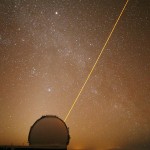
Still, we are mandated to avoid the situation and to put in place measures to avoid such an occurrence. Before TBAD this involved hiring guys to sit outside and watch the skies for aircraft. I have done this, it can be pretty on a clear night with calm weather. It can be brutal on a cold and windy night. Even when taking precautions such as rotating two spotters every hour or two there is always the question of human fallibility under adverse conditions. Using an automated system like TBAD is far preferable.
W. M. Keck Observatory press release…
An international team of scientists, led by astronomers at Queen Mary University of London, report of two new planets orbiting Kapteyn’s star, one of the oldest stars found near the Sun. One of the newly-discovered planets could be ripe for life as it orbits at the right distance to the star to allow liquid water on its surface. The paper is being published by the Monthly Notices of the Royal Astronomical Society on June 4.

The astronomers used new data from the 3.6 meter La Silla Observatory in Chile to measure tiny periodic changes in the motion of the star, and followed up with two more high-precision spectrometers to secure the detection: W. M. Keck Observatory’s HIRES instrument installed on the 10-meter Keck I telescope on the summit of Mauna Kea, and PFS at the 6.5 meter Las Campanas Observatory in Chile.
Using the Doppler Effect, which shifts the star’s light spectrum depending on its velocity, the scientists can work out some properties of these planets, such as their masses and periods of orbit.
Continue reading “Ancient Worlds from Another Galaxy Discovered Next Door”

As I headed to the mid-week farmers market I spotted this absurdity behind the Parker Ranch center. Never mind there are no large trees nearby, never mind there are no fir trees in sight, firs are rare on the island. No… They decided to disguise this cell tower as a tree. It would have looked better as a simple tower.
You are not fooling anyone…

The fourth batch is processed and underway.
Our mango tree did not have a heavy crop this year, but has produced far more than we can use in the week or two they ripen. The food dehydrator has been in heavy use, three batches done and one underway. The end results are pretty good, better than some stuff I have bought at the farmers market. Perfect for snacking on in the middle of the night next to a telescope.
Between me and the birds, the tree is now picked out. I have enough mangoes on hand for at least one more go…

This evening the Moon and Jupiter will be close. The two will be visible in the sky throughout the day becoming a striking pair as the sky grows dark. The Moon will be 11% illuminated and about 6° from the bright planet at sunset.
Mercury should be visible 18° below Jupiter, a 1.3 magnitude object lower in the sunset glow.
