
Winter Sky over the Telescopes
When you want to see the stars, find someplace dark

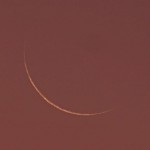

A possible meteor shower, a dark. moonless night, the beautiful skies of Mauna Kea… Why not plan for a trip up the mountain? We all hoped that the new meteor shower would produce a show for us. If not, it would be a dark night with a late rising crescent moon. As I would be working the holiday on Monday, I took Friday off, did some chores around the house and packed my gear.

The second bit of kit was Deep Violet, my 18″ telescope. As usual, setting up the big scope quickly gathered a crowd. The line did not dissipate until well after 10pm, a steady flow of visitors hoping to check out the view in the largest telescope present.

Today Mercury reaches maximum elongation, the furthest point it will reach from the Sun in our sky and the highest it will be above the sunset for this evening apparition. The planet is easily visible as a bright, starlike object about 23° above the setting Sun as twilight begins. Over the next couple weeks Mercury will slide back into the sunset, heading for inferior conjunction on June 19th.
Tomorrow morning, May 25th, will see a brilliant Venus paired with a crescent Moon. Look for the pair to rise about 03:30HST to be 30° above the horizon at sunrise. A 10% illuminated Moon will be a nice match for Venus shining brilliantly at -4.0 magnitude. Separation will be just over 2°.
A reminder that there is the possibility of a strong meteor shower this evening. The Earth may pass through a cloud of debris left by comet 209P/LINEAR. Sky watchers should observe around 21:00 to 22:00HST on the evening of May 23rd.
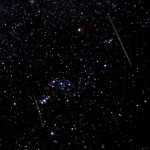
For Hawai’i the radiant will be low in the north, about 20 degrees above the horizon, near Polaris. This means that any meteors we see will be hitting the atmosphere at a low angle. Combined with the low speed of the meteors this could lead to very showy bolides streaking across much of the sky.
As with any meteor shower, any predictions are to be taken with a large dose of skepticism. It is important to point out that meteor prediction is not an exact science, rather a bit of an art form. In this case there are any number of unknowns involved, we could see nothing, we could see a true meteor storm. This event could be anything from “meh” to “oh wow!!!”. To their credit, the folks making these predictions have been impressively right on several recent showers.
I would strongly suggest that you at least take an effort to step outside after 9pm on Friday evening and see what the sky has to offer. All you need is a clear dark sky.
I am truly jealous! My friend Dan Birchall got the photo I had hoped to get… All four Mauna Kea lasers in operation at the same moment. Better yet, all four lasers were on the same target, the center of our Milky Way galaxy. The result is a great photo of four yellew beams converging to the same spot in the sky.

The four beams come from our two Keck telescopes, plus one from Gemini and one from Subaru. the lasers are used to create reference beacons for the adaptive optics systems used on these large telescopes. I will, with a little possessive pride, point out that the Keck lasers are much more powerful than the others.
The scheduling of all four lasers at once is a rare occurrence. All four lasers on the same target? Even more luck was involved! It helps that Dan is a telescope operator and spends far more dark time on the summit than most of us. He took advantage of the situation correctly… Grabbing the camera and shooting.
Below is more footage from Dan, a little time lapse of the telescopes working…
W. M. Keck Observatory Press Release…
A team of researchers has discovered and photographed a gas giant only 155 light years from our solar system, adding to the short list of exoplanets discovered through direct imaging. It is located around GU Psc, a star with one-third the mass of the Sun and located in the constellation Pisces. See the article in The Astrophysical Journal.

The object was discovered using Gemini-South and followed-up with Gemini-North spectroscopy and CFHT photometry. Once Naud’s team had the entire spectrum, they realized the object had a very low temperature, with properties similar to substellar objects like brown dwarfs or planets.
One possibility was that the object had a peculiar spectrum simply from its youth, and that this had nothing to do with it being a binary, but the other tantalizing possibility was it was a binary planet, with one component being slightly warmer than the team derived from their analysis and the other component slightly cooler.