This is the seventh year I have travelled to Hilo to help out. The seventh year of watching students attempt a difficult mission of the bottom of a swimming pool. The 2014 MATE ROV Regional competition was held Saturday, May 11th at the Hilo High School pool.
The team from Kailua High School ready and test their ROV for a mission in the 2014 MATE Regional in HiloThe mission this year is to explore a Great lakes shipwreck. As usual the “shipwreck” is made of PVC pipe, shade cloth and other hardware store parts. By measuring the wreck and discovering various features the identity of the ship could be determined. The robots are also built with hardware store parts, most with frames of PVC pipe. Interestingly there was a notable presence of parts manufactured with laser cutters and 3D printing this year. It is great to see these technologies making their way into educational programs, giving students unprecedented power to design and create.
Students from Highlands Intermediate School run a mission in the poolSome teams did quite well. I was impressed by the professionalism and dedication it took to build and operate the ROV’s. Teams travelled from neighbor islands to compete in Hilo, raising the funds for plane tickets and to ship the ROV’s they had created. Besides the underwater activities the teams must also make presentations and supply technical reports that are also scored.
A scout class ROV getting ready for the waterIt takes a lot of work to properly judge the competition. I have noted that the rules and scoresheets just keep getting longer every year. I must tip my hat to the folks that make this competition happen every year, giving the kids a chance for invaluable experience.
Who won? Not really that important, even failure in the pool results in learning, even if the lessons are uncomfortable. The students will take that experience forward in life.
Tonight the Moon will be close to Mars. The pair will be obvious at sunset, having risen mid-afternoon. Look for the bright planet just 3° north of the Moon. Just a month after opposition the planet is still quite bright, shining at magnitude -0.9 and notably orange in color. The star Spica is about the same magnitude and visible 15° east of the Moon.
Today the planet Saturn will pass through opposition, directly opposite the Sun in our sky.
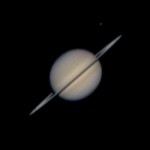
Saturn with Titan aboveSaturn orbits the Sun once every 29.45 years. As the ringed planet continues on its way the Earth swings around much faster on our inside track. As a result we lap Saturn once every 378.1 days, passing between the planet and the Sun. During opposition Saturn will be well placed for observation all night long, rising at sunset, transiting at midnight, and setting at sunrise.
It has been a long time since I shot a full frame 35mm camera. Not since I shot film have I used a camera with a full 35mm image size. My older DSLR cameras have use APS-C sized sensors. The Canon 6D is a full frame camera with a 36x24mm sensor, something that has quite an impact on the camera’s capabilities.
Vines now keep this old gate permanently shut, Canon 6D and 24-105mm f/4 L lensA few months of shooting have given me a better appreciation of the camera. the camera is great to use. It is an enjoyable camera to shoot. The photos speak for themselves, the thousand words thing applies here. I have gotten shots where none of my other cameras would have, particularly in low light. The Canon 6D is one of the best cameras currently available for use in low light. It even edges out its more expensive siblings the Canon 5DmkII and III for making the best use of every available photon. Not just astronomy either, but star parties and lecture halls. The astronomy capability is excellent, attaching the camera to a telescope allows capture of more than just our small world.
Blackjack and bokeh, Canon 6D and 50mm f/1.8 lensThere are other implications of full frame… The large format sensor behaves much differently than smaller sensors when it comes to focus. Depth of field changes the game. Very small sensors, particularly cell phone sensors, have enormous depth of field by nature of the optical design. Nearly everything is in focus, from near to far. Photographers love shallow depth of field, it allows the subject to be isolated from the background. Everything closer of further away becomes a soft blur, something photographers call bokeh.
By the time you get to this point you are almost there, you are also out of breath from climbing the vertical ladders. The price of getting to the top of the Keck 1 dome.
Also a good spot to take a photo while catching your breath…
Looking up the stairway to the top of the Keck 1 dome
A job that takes me high inside the dome, installing a test antenna for TBAD. Going so far up in the basket is always a treat, the view of the telescope is great. A view few people ever get to see…
Looking down on the Keck 1 telescope from the manlift basket.