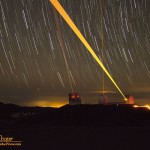
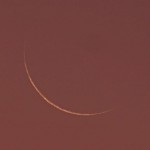
A very young moon over Waikoloa, this is only 26 hours after new, visible to the unaided eye as a sliver in the fading glow of sunsetNew Moon will occur today at 20:14HST.
Today Mercury passes through superior conjunction, passing behind the Sun as seen from the Earth. The planet will appear in the sunset in ten days or so, reaching maximum elongation on May 24th.
A different sort of dive. There are few wrecks to dive on the Big Island, the Naked Lady is one of the few. An Easter Sunday morning spent out on the water, enjoying a beautiful day. As we came back across Kailua Bay from diving at Casa Cave we decided to dive the wreck as our second dive of the day.
Andrew Cooper diving on the wreck of the Naked Lady, photo by Pete TuckerThe Naked Lady is a sailboat that burned and sank in Kailua Bay. Apparently the Naked Lady is not the vessel’s real name, simply the name acquired as a result of how it arrived on the bottom of the bay. Hard details are difficult to come by, but the story goes something like this… The sailboat was moored in the bay when the lady aboard needed to eliminate the “little green men” infesting her boat. The result was a burning sailboat and the lady arriving on shore minus her clothing.
It is 110 feet to the sand where the Naked Lady lies on the bottom. This is a short dive, at this depth our bottom time is limited to less than 20 minutes due to nitrogen absorption. Even with the safety stops on ascent the entire dive was about half an hour, I surfaced with over 1200psi of air left in the tank. Considering I often last over an hour with a 80cft tank this was a short dive indeed.
Deb and I did not bother with the mooring line as we dropped to the bottom. The water was clear enough we could see the wreck on the sand 100ft below. With no current we simply dropped, in the clear water this was a surreal, slow motion free-fall. Seeing the sand approaching I did not bother to trim buoyancy, but allowed myself to hit the sand a few feet from the hull. The gauge read 109ft as I knelt on the bottom. I took a couple photos, trimmed for neutral buoyancy and started exploring.
Sky exploring the wreck of the Naked LadyThe hull is more or less intact, with the mast lying to the port side. The entire upperworks are gone, consumed in the fire one would assume. The bowsprit and stern railings lie in the sand in front and aft of the wreck. Inside a few pipes and other fitting are all that remain of the interior.
Aside from a few colonies of cauliflower coral on the wreck itself there is no coral visible, simply a flat plain of sand that stretches in all directions. A swarm of fish surround the wreck, snappers and dasyllus the most numerous. Oddly there are numerous rough spined urchins on and around the hull.
There is little sign of life away from the wreck, the sand seems sterile from a distance. Upon closer examination even this sand desert teems with life. Burrows and tracks betray numerous residents. I take a few photos of a colorful goby I have yet to identify, it does not appear in the usual guidebooks.
The Atlantis Submarine that gives tourists a ride in Kailua Bay often tour the Naked Lady. The submarine was present when we arrived at the mooring, but had moved off by the time we dropped to the wreck. It would have been fun to wave at the tourists.
Deb on the wreck of the Naked LadyA lot of photos got taken, mostly of each other as we orbited the wreck. The remains of the sailboat on the sand makes an interesting subject, particularly with the divers poking about. Pete was diving his new 5DMkII rig with a wide angle lens. The wreck was a perfect wide angle target, I found myself wishing I had brought something wide angle like the GoPro. At 110′ there is only blue and more blue, so that the photos turn out rather blue. It becomes interesting to convert the photos to black and white.
The location results in a different dive profile as well. On this island we usually dive deep and then spend the rest of the dive slowly working our way back up the reef, ending in shallow water. A slow ascent eliminates the required safety stops used in recreational diving. Here there is no sloping reef, simply a drop to the bottom. Time to remember those safety stops and monitor the dive computer closely. This ascent required two stops, one at 50′ and another at 15′ to allow the nitrogen to transpire out of our tissues.
With two dives done it had been a great day and we were ready for more. Alas we had a pile of empty tanks and a distinct lack of full. Nothing left but a return to harbor, clean up the boat and an early dinner at the fish market. A great Easter Sunday, far more fun than sitting in church.
Tomorrow morning, April 25th, will see a brilliant Venus paired with a crescent Moon. Look for the pair to rise about 03:41HST to be 30° above the horizon at sunrise. A 15% illuminated Moon will be a nice match for Venus shining brilliantly at -4.1 magnitude. Separation will be about 4°.
The following morning, April 26th, will see the Moon much closer to the horizon, over 11° west of the planet.
Hakalau is a place I love to visit… Stunningly beautiful native forest high on the side of Mauna Kea. A place where the calls of native birds form a chorus in the treetops. The refuge holds an open house once each year, always great to attend. We have done so three times now, taking advantage of a day when volunteers and guides are on hand to teach you about this special place. Normally held in October, the 2013 open house was a victim of the government shutdown. They were forced to cancel the event, but the staff and volunteers made the effort to reschedule and open for Earth Day this year.
Hakalau Forest National Wildlife Refuge encompasses more than 32,000 acres of forest high on the windward side of Mauna Kea. The koa and ʻōhiʻa forest is a refuge for the native birds that are endemic to the island. Staff and volunteers have spent decades slowly restoring the forest in an effort to preserve a little native habitat so that so many species, avian, insect and plant, may have a small place to survive.
Our guide points out some of the local species on the chartWe arrived as soon as the refuge opened, having bounced our way along Mana road to join a crowd waiting for the open house to open. Despite the remoteness of the refuge the event was very well attended, the large parking area at the old barn quickly filling.
We began with a birding hike. Multiple guides were departing the barn area with groups in tow. Heading down a rough track we followed into the rich koa and ʻōhiʻa forest. Bird calls echo from tree to tree, soon we spot many of the birds that are rare elsewhere, but relatively common here. The wild Hawaiian raspberries have had a good winter, I found a few ripe berries to sample, nice flavor if a bit tart.
Iʻiwi, ʻapapane, and a courting pair of ʻelepaio were caught in our binoculars. We did not see the Hawaiian creeper, but we heard them. I really need to drill myself on the calls sometime, birding in Hawaiʻi is an audible exercise as much as visual. Twice we saw ʻio pass overhead, and a nene was to be seen along the road. A good day birding in the forest. One of the guides, a National Park Service ranger, pointed out one of the native lobelias, a plant called Hāhā, by the Hawaiians.
The Hakalau greenhouses, filled with the seedlings of native plants used in the forest restoration effortWe also made an effort to visit the greenhouses, a apart of the event we had missed in past visits. It is here that the thousands of plants used in the restoration effort are propagated. Entire tables covered with rare lobelias, a half dozen species of native mints, plants rarely seen in the wild outside of Hakalau.
One of the mints was believed extinct until on plant was found on the Hamakua coast. Later, when biologists went to examine this plant again they found it had been killed by wild pigs rooting about. Fortunately cuttings had been successfully propagated at the nursery and the many descendants are doing well. For now the plant is extinct in the wild, but that may change if it can be reintroduced.
A couple of the volunteers related tales of trouble… Gear stolen, fences cut, a general antipathy for the refuge mission from some segments of the community, particularly pig hunters. I have encountered the same mindset myself on occasion… A feeling that one can take and take from the environment and never give back, that the resource is endless. I have met those who believe any restriction, however minor, is an affront to their entitlement to hunt or take whatever they need. Some locals seem to have forgotten the old lessons of resource management that the ancient Hawaiians knew so well. Today is is not that aliʻi who make the rules, it is wildlife managers that set the kapu. At least modern enforcement is not at the sharp end of an ihe.
While there may be some who do not believe in the refuge goals, support from other segments of the community is strong. The volunteer program racks up thousands of hours each year, a dedicated crew that puts in long days of planting native species and removing the harmful invasives. The success of their work can be seen in the lush forest teeming with bird-life. They have created a special place that is a pleasure to visit, eve if they open the doors only once each year.