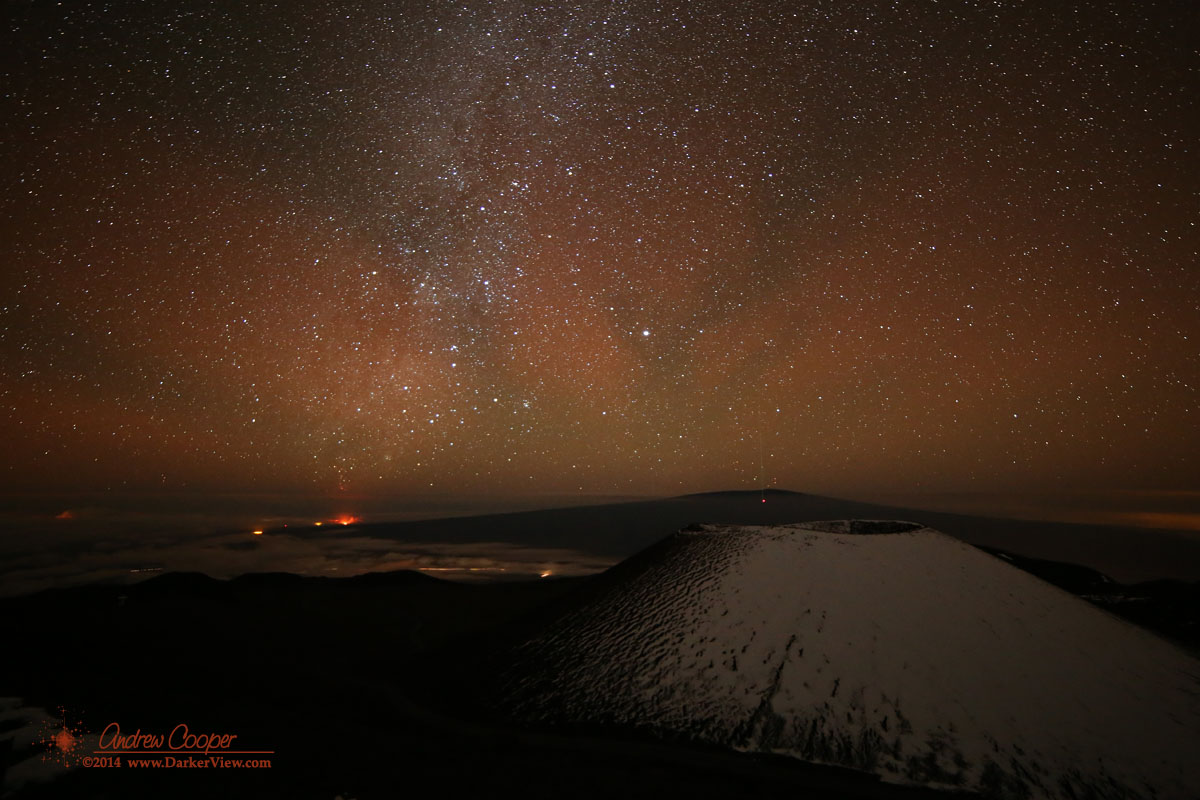
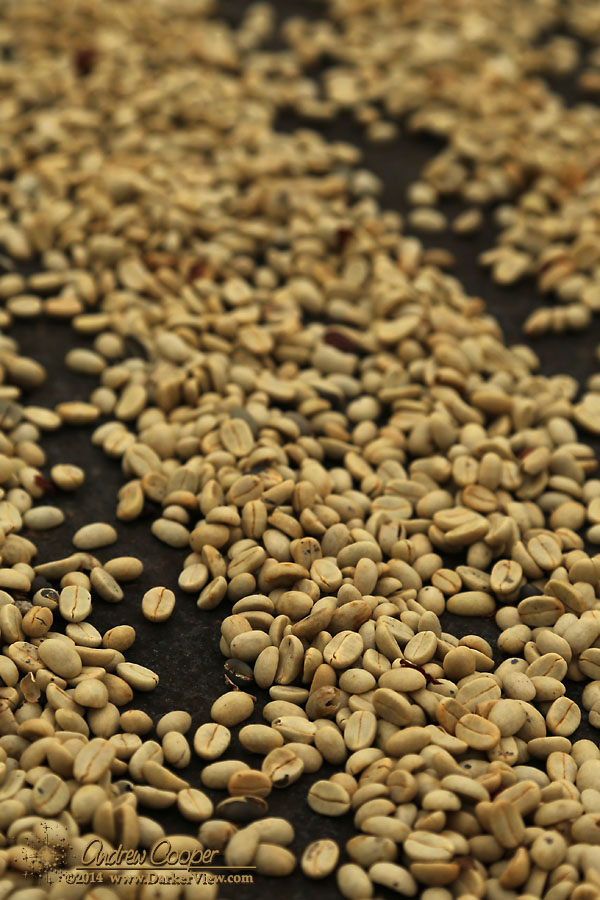
A contest for local photographers, the Hawaiʻi Photo Expo is a full juried competition. A local contest, but a decent one, the entries will hang in the Wailoa Center gallery for a few weeks.
My chances of winning? I think my entries are fairly strong. Looking through the archives of past winners I feel my images are as good as anything there. I should be competitive at least, the rest is up to the standards of the jurors.
There are still a few days left to enter, the deadline is March 16th. Have any really good photos?
Airglow or auroral glow? An odd red glow in the photos during a strong geomagnetic storm.
Tonight the Moon and Jupiter will be close. The Moon will rise first, at 13:04HST, about ten minutes ahead of Jupiter, placing the two well up in the eastern sky by sunset. The Moon will be quite large, 65% illuminated and about 6° from the bright planet. Tomorrow night the pair will still be seen together, about 11° apart.
With Jupiter this close to the Moon it is an excellent time to see Jupiter in the daytime sky. Look 6° northeast of the Moon for a bright pinpoint of light. 6° is 12 times the size of the Moon seen in the sky, north will be to the left seen as the pair rises above the eastern horizon.
The current astrophoto setup in the driveway… The TeleVue 76mm atop the iOptron ZEQ-25 mount. The camera is currently the Canon 6D, providing a 5.35° x 3.57° field of view with a 3.52 arcsecond per pixel image scale.
Atop the main scope an SBIG STi provides auto-guiding. With a 100mm lens it has a 15 arc-second per pixel image scale. It is mounted with a custom mount machined for this setup.
The setup is intended to provide a high performance astrophoto setup with a minimum of fuss. This is about as far as I can reduce things without giving up performance. It is pretty portable, airline luggable at least. The whole setup fit in two suitcases for the trip to Oregon Star Party last summer.
The only real issue with this setup is the laptop. The big old 17″ HP Pavalion chews a lot of power, requiring an AC outlet to supply. I have my little Asus netbook configured to run the setup, a far more power efficient machine. With the netbook I can setup anywhere and shoot.
Cable management is a bit of a chore. A lot of separate cables must be routed to connect everything together. Much of the time I keep the setup assembled in the garage for deployment in the driveway. The cable tangle can be tamed with a handful of zip ties and velcro strips this way. A wheeled dolly allows the entire setup to be rolled out of the garage.
With this setup I have a capable astrophoto rig, capable of producing very nice material for processing. I just need a chance to get out and use it more often.
Not the first time I have shoveled snow here. Somehow the novelty of snow in a tropical paradise never grows old. Not that shoveling snow at nearly 14,000ft gets any easier. The weekend storm left a foot of fresh snow on the mountain. As the Monday crew never made it to the summit, it fell to those of us working Tuesday to clear out the snow for access.
It was only a foot of snow? Not too bad? The snow came with 120mph winds, stripping the slopes bare and piling a three foot deep, fifteen foot wide drift in front of our loading dock and main doors. That was going to be a chore.
We needed power. The grader was working to clear the IRTF access road just above us. As the crew moved the vehicles I made a trip up to intercept the grader. At my request the driver joking asked how much cash I had. No. Beer? No. I offered cookies and the deal was made. A few minutes later the grader was clearing much of the snowdrift in our way.
The crew shovels the loading dock clear while the OMKM grader clears a troublesome snowdrift.
For my first pass on the Rosette I used about an hour of data. Ten four minute exposures, ten one minute exposures and ten 15 second exposures. The stack is designed to capture a wide dynamic range by using several different exposure lengths. Multiple images taken at each exposure to reduce the noise inherent in long exposure astrophotgraphy. All of this data is aligned and stacked to produce the final image.
The first pass at the Rosette nebula with one hour of data, 10x240s+10x60s+10x15s @ISO6400When looking at the result it was apparent that I had not been successful in reducing the noise far enough. More exposure time was needed. The shorter exposures were not the problem, I needed more of the longer four minute exposures to reach the faint nebulosity.
The next night I acquired and shot again, another 24 exposures on the Rosette, another 1.6 hours of exposure. A planned astrophoto outing to the MKVIS at 9,200ft elevation offered a chance to get even more high quality exposures. This time I got 30 more exposures, another two hours of total exposure time.
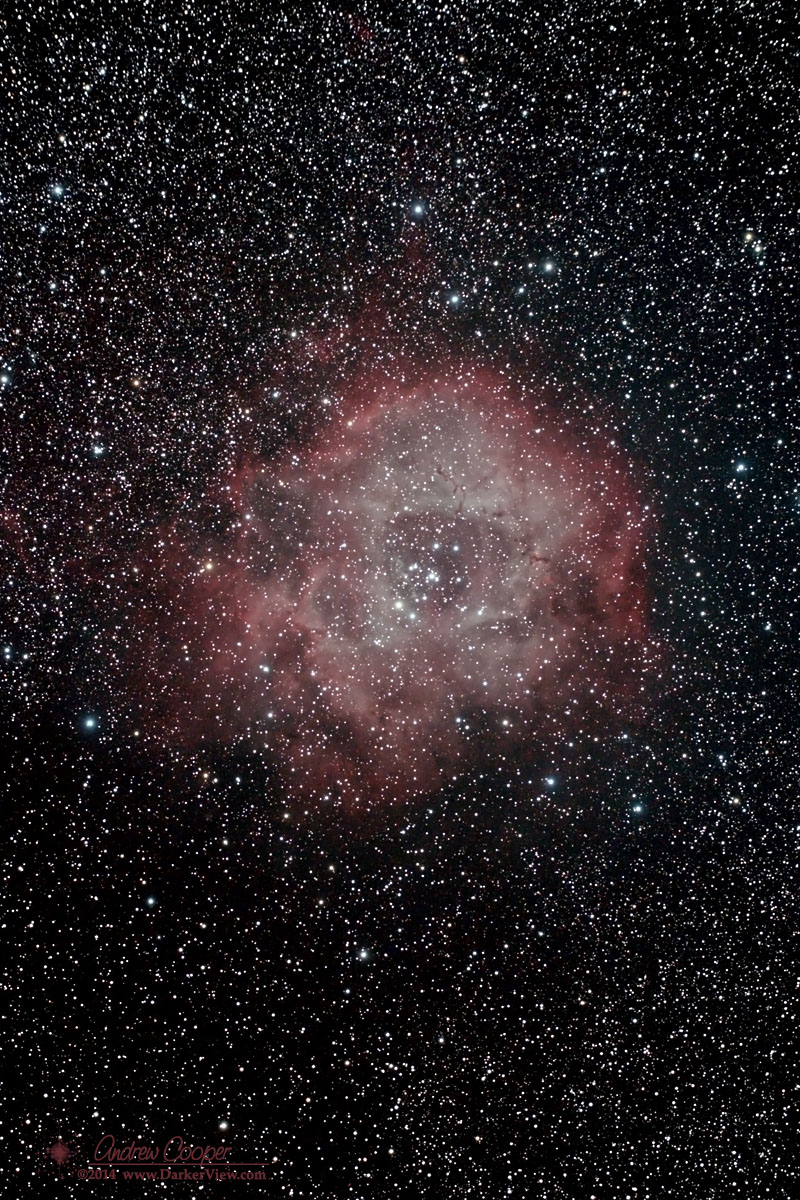
Combining all 3.8 hours of exposure resulted in a notably nicer image. The noise in the fainter sections of the image is pleasantly reduced. It should be with 54 four minute exposures used.
I need to do some sort of systematic comparison of the data gathered in my driveway versus the data obtained at the MKVIS up on the mountain. Having a series of exposures taken with the same gear, on the same target, and at the same time of night just a few days apart should allow a reasonable comparison. I was unable to expose any longer at the VIS despite the colder temperatures (the camera was about 10°C colder). How much better is the VIS? Can I get data nearly as good without packing up the gear and heading up the mountain?
The Rosette Nebula, NGC2237, NGC2238, NGC2244, NGC2246, Canon 6D and TV-76mm, 54x240s+10x60s+10x15s @ISO6400