
Summit and Winter Milky Way
When you want to see the stars, find someplace dark

Taking starscape photos last week I was surprised at the intense red glow appearing in the photographs. All across the southern sky were glowing areas of sky, here and there dark rifts cut through the glow. Set beside the Winter Milky Way it created beautiful photographs.

The airglow was intense enough to be visually seen when I stepped away from the camera and let my eyes adapt to the darkness. Away from the Milky Way, in what should be dark sky, a faint red glow pervaded. I wondered what was going on, the normal airglow over Mauna Kea is quite faint and usually very green.
I was even further surprised when I later found out that a strong geomagnetic storm was in progress that night. Kp=6 conditions from back to back CME’s were creating strong aurora over Canada and the upper US.
Was I seeing some sort of auroral glow? In Hawaii? At 20°N latitude? This did not seem likely, but something unusual was occurring!
The plan was to do some astrophotography Saturday night. The weather forecast forced a re-schedule, a winter storm arriving Saturday afternoon, Friday it was to be.
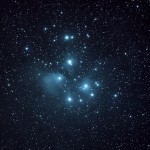
Setting up at the Mauna Kea VIS means a crowd of people. Hundreds of tourists that have come to enjoy a dark Mauna Kea Sky. I was joined by Raymond, a Hilo amateur also looking to take some photos. We setup side by side in a parking space just off the patio where the VIS was setting up their telescopes for the night. We would be in the center of the crowd for a while.

W. M. Keck Observatory press release…
After 8 years of observations scientists from the SETI Institute have found an exotic orbit for the largest Trojan asteroid, (624) Hektor—the only one known to possess a moon. The formation of this system made of a dual primary and a small moon is still a mystery, but they found the asteroid could be a captured Kuiper body product of the reshuffling of giant planets in our solar system. The results are being published today in Astrophysical Journal Letters.

In 2006, a small team of astronomers led by Franck Marchis, astronomer at the Carl Sagan center of the SETI Institute, detected the presence of a small 12 km diameter moon around the large Trojan asteroid (624) Hektor. They used the 10 m Keck II telescope atop Mauna Kea, fitted with the NIRC-2 (the Near-Infrared Camera 2) instrument behind the adaptive optics and laser guide star system (LGS-AO).
Continue reading “Distant Asteroid Revealed to be a Complex Mini World”
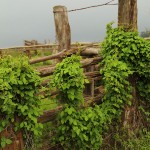
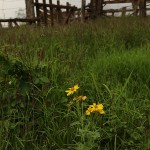
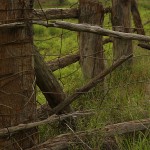
The corral is one of the relics of ranching that litter the Waimea countryside. Just a short detour off my daily commute, I have long noted the photo potential of the place. A foggy day offered an interesting opportunity to shoot the corral, enough that I missed my usual turn to take advantage of the even, subdued light offered by a grey afternoon.
Arriving I noted that recent rains had transformed the brown grass into a verdant green. Vines had appeared to cover the old fence posts in foliage. This was a good day to go shooting.
Photography is an art that has to be constantly practiced. You need to shoot, shoot some more, and critique the results with a stern eye. I have better gear than I have ever had, it helps. Still, the magic is up to the photographer, not the camera. A practiced eye, composition and creativity, any camera can shoot a great photo in the right hands.
I did get some good shots. But did I get any great shots? I am always my own worst critic.


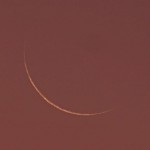
Tomorrow morning, Feb 27th, the planet Mercury can be seen about 3° below the rising Moon. Mercury will rise about 05:29HST and be over 15° above the horizon at sunrise. The Moon will be quite old, a very thin 4% illuminated crescent. the pairing should make for a pretty dawn.
W. M. Keck Observatory press release…
California Institute of Technology (Caltech) astronomers using data gathered at the W. M. Keck Observatory have developed a new technique for planetary scientists that could provide insight into how many water planets like Earth exist within our universe. The results have been published on February 24th by The Astrophysical Journal Letters.

Credit: Alexandra Lockwood (CalTech) background image used with permission from David Aguilar (CFA)
However, a significant portion of the population of extrasolar planets does not fit either of these criteria and there wasn’t really a way to find information about the atmospheres of these planets. Looking to resolve this problem, Lockwood and her advisor Geoffrey Blake—Caltech professor of cosmochemistry, planetary sciences and chemistry—were inspired by the recent detection of carbon monoxide in the extrasolar planet, tau Boo b and they wondered if they could detect water in a similar manner.
Continue reading “Water Vapor Detected in the Atmosphere of a Hot Jupiter”

The following morning, February 25th, will see the Moon 7° below Venus. Observant sky-watchers will note Mercury another 16° closer to the eastern horizon and the rising Sun.