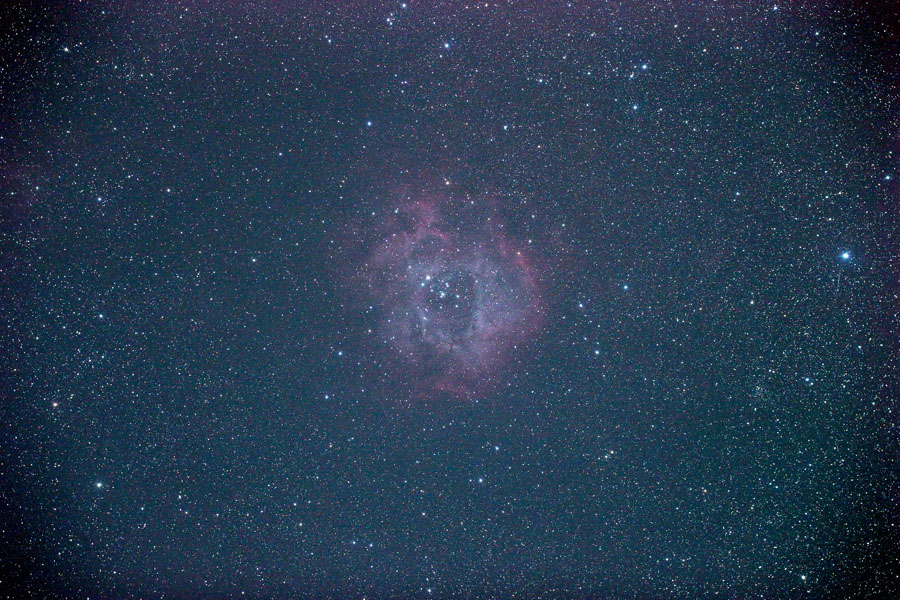
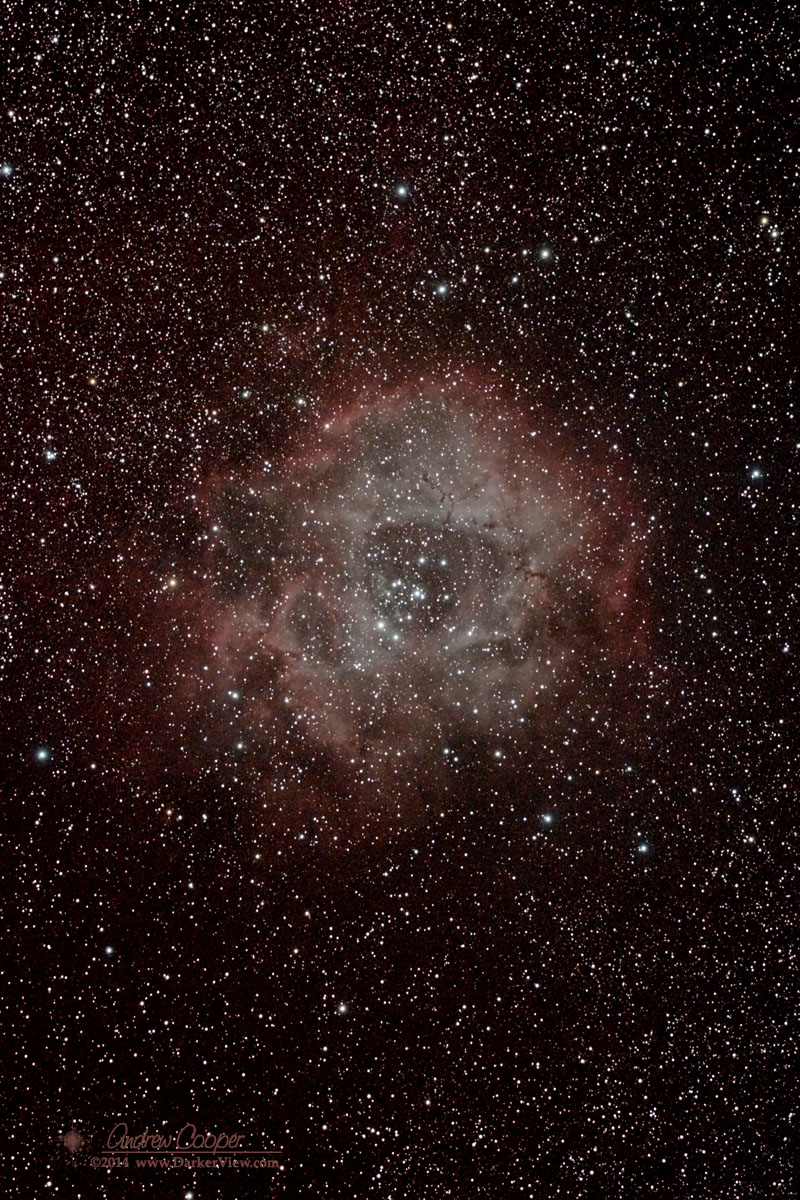
A result from Saturday night. About an hour of integration all told… Good color, very nice stars, good detail. While encouraging, I really need more time on this one, there is too much noise in the fainter regions of the nebula. I can get more data and add it to the stack to continue to improve the result. From up on the mountain I should be able to use longer exposures with darker skies. Colder conditions will reduce the dark current in the camera, also aiding in longer exposures.
A single unprocessed subframe of the Rosette Nebula, Canon 6D and TV-76mm, 240s @ ISO6400Compare the processed shot with the single subframe I published yesterday. The final shot is a stack of 10 x 4min, 10 x 1min, and 10 x 15s frames, 30 frames for just under an hour of exposure. Also needed is another 10 x 240s dark frames and 10 flat field frames to use for calibration. This takes another hour, but was done after the telescope was rolled back into the garage and I went to bed.
The Rosette Nebula is a large star forming region just east of Orion in the constellation of Monocerus. It is quite large, the main body seen in the photograph is well over a degree across. The dark region in the center is about the size of the Full Moon
The Rosette Nebula, NGC2237, NGC2238, NGC2244, NGC2246, Canon 6D and TV-76mm, 10x240s+10x60s+10x15s @ISO6400
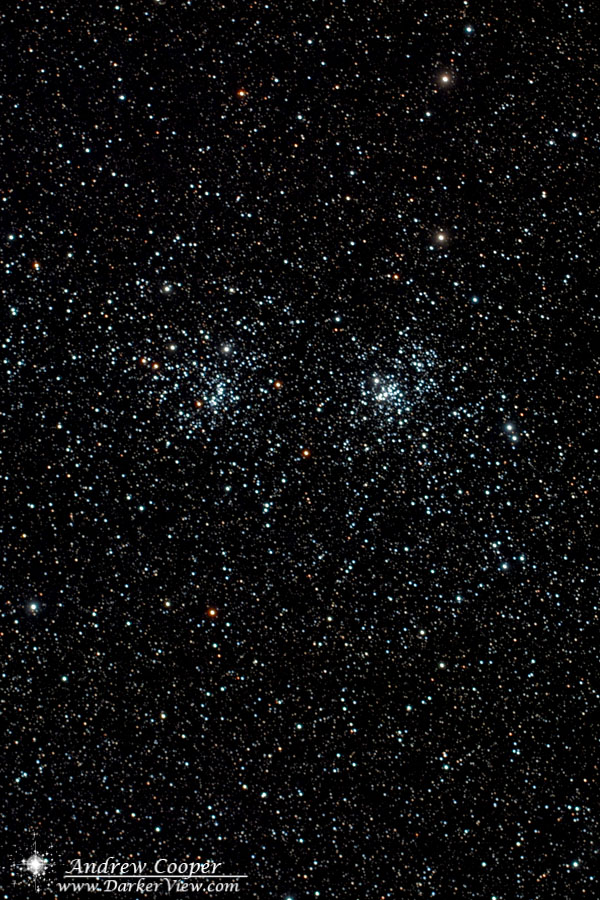
A single unprocessed subframe of the Rosette Nebula, Canon 6D and TV-76mm, 240s @ ISO6400After solving the little equipment issues, waiting out weeks of bad weather and waiting for the Moon to go away, I finally had a nice photographic night. Setting up at sunset I shot until the Moon rose. Most of the targets I have shot before, Orion, Rosette, Markarian’s Chain. I also shot Melotte 111, an object that has always intrigued me. The full frame camera and the TV-76 has a wide enough field to capture this very large and nearby star cluster.
I want to use this combination camera and telescope with a very wide field to work over the dark nebulae of the Summer Milky Way. With 384mm focal length the full frame camera gives me over 5.35° x 3.56° field of view. The beehive also lent itself to the wide field, another large object that was worth a stop to shoot.
Aside from one little equipment issue to start, more an operator education issue, the gear worked great. Note to self… Must turn off camera WiFi before the camera will link to the computer via USB. I am currently using APT to control the camera, a very impressive bit of software. The auto-guider worked perfectly, frame after frame nearly identical. I can slideshow through dozens of sub-frames and not see any difference, no drift!
A single sub-frame of the Rosette Nebula is shown to the right. The Rosette is an emission nebula with most of the light emitted at the wavelength of Hα 656.28 nm. My Canon 6D is stock, no astrophoto modifications. Despite an IR cutoff filter that blocks much of the Hα light the camera captures a fair amount of the nebula. Perhaps I should get a 48mm Hα filter for the camera to shoot from the driveway.
With everything working so well I really need to haul the rig up to Hale Pohaku for a night of imaging under darker skies than I get down at 1000ft. Next weekend is dark-of-the-Moon weekend. Need to plan an outing?
It will take a bit to process the results of the night. As usual, keep an eye here on Darker View for the finished photos.
We found a few of these when hiking in Volcanos NP a couple weeks ago. A little searching revealed some ripe ones. Nice flavor, a little tart, not unlike cranberry they need a little sweetener to make them really good.
ʻŌhelo berry (Vaccinium reticulatum) fruiting on lava flows along Saddle Road
Occasionally I use the Google image search function to see if any of my photos are being used on other websites. Yes… It is something to do when insomnia strikes.
Earlier this month I found quite a few of my photos being used on an very obnoxious site. The same page also contained numerous images from the West Hawai’i Astronomy Club website. I will forgo including the URL or link here, no need providing them one more incoming referral. Suffice it to say that the entire website was constructed of stolen or scraped material, the sole purpose of which is to serve as search engine bait. Once on the website clicking on anything generated pop-ups, pop-unders, a slew of ads. This was not innocent infringement, this is a business built on theft of intellectual property.
A little sleuthing revealed that the site was located on a hosting service out of the Netherlands, WorldStream.nl. As this site is not within the US a DMCA takedown notice is not legally enforceable. However, European law is pretty good with respect to copyright, the hosting provider should take a notice of infringement seriously. Thus I sent an email off to the listed customer service address…
I really have been putting off the repairs too long. There are several boards that have had dry rot set in. One deck board is right next to the usual route of travel, much more rot and it will become a safety hazard.
Replacing a section of railing cap that has been destroyed by dry rot.The lanai is all exposed woodwork, protected only by paint. Paint that is beginning to fail. The first step will be to replace or repair several bits of woodwork that really need attention. That process is now started.
After the repairs a full coat of paint is in order. That is going to be a major job. the latticework of the shaded area will require power-washing. Repainting all of those detailed bits will also require a lot of work. I do have an air compressor, perhaps a spray rig is the right way to go.
I have a quart of exterior white paint to try out. The first item painted will be the first replaced board. I need to see how the paint looks beside the older trim paint used around the entire house. I long ago learned just how many variations of white exist in paint.
It will be a lengthy chore to complete the entire lanai. It is something I can do in stages, a few hours here, a few hours there, it will get done.
Tomorrow morning, Feb 21st, the Moon will be in close attendance with Saturn, separated by a little under 4°. The two will be high in southern the sky before dawn, a last quarter Moon will be 61% illuminated. Saturn can be seen as a 0.5 magnitude object just East of the Moon and west of the head of Scorpio. The following morning, Feb 22nd, the Moon will have moved to the other side of the ringed planet with a separation of just over 8°.
Viewers on the other side of the world will be able to see a very close pairing of the two, less than half a degree apart or even in occultaion depending on location. Close approach will be about 14:00 HST on the 21st. You could make an attempt to view the pair in the daytime sky, Saturn is bright enough to be seen next to the Moon in a modest telescope or even a good pair of binoculars. Unfortunately the Moon sets around 11:00, a few hours before close approach here in the islands.
The plan was simple. Stay on the summit after work to do some nighttime scenic photography.
I was hesitant in going up after suffering my recent ear infection. The ear is vastly better, no problems with clearing the ear for several days. After two weeks absence the list of things I needed to get done on the summit was getting lengthy and urgent. Yet I worried a bit about going up. An idea… Take my own vehicle. If I have trouble I can go at my own pace without holding up the rest of the guys. If the trouble is serious I can abort and head back down.
If I did bring my own vehicle I could get in a little photography along the way. I had not really had a chance to try out the Rokinon 14mm f/2.8 lens I had bought specifically for starry sky work. Why not stay late, watch sunset and take a few photos after dark? There is snow on the summit, the weather looked promising, the Moon would not rise until after 10pm, all good things.
The plan worked as envisioned. A good day getting stuff done. Actually a rather hectic day. The filter wheel problem of TRICK found and eliminated, the heater circuit at least looked at, I think the problem is still there. Warping data recorded for a segment in Keck 2 for the refurbishment project. Some wiring on TBAD completed, still more to do. An issue with the Keck 2 interlocks that popped up during the day was dealt with. Yes, a very good day.
A minimal dinner of instant ramen, and some paperwork accomplished while waiting for sunset.
Into the cold dark I go… The combination of the Canon 6D and the fast 14mm lens is impressive. This gear will really allow me to step up my game. I was able to shoot great material under very dark conditions. Photos that had been just out of reach for me until now. It will take me a couple days to go through and process the material, but a first look is very pleasing.
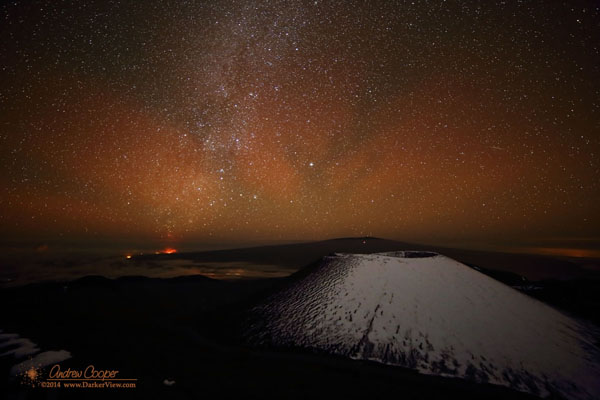
Only one problem… What is this red stuff showing up in my photos? Normal airglow is green, but this is crimson red and has very distinct structure? The idea of aurora crosses my mind, almost immediately dismissed as I am standing at 20°N latitude. I step away from the camera and the light for a bit. With some effort I can convince myself that I am seeing red in the sky, at least in the darker areas away from the Milky Way. But it is fleeting, and perhaps just an overactive desire to see something.
I get home and just out of curiosity I check the planetary Kp index… What?!? We have a Kp=6 geomagnetic storm in progress! Beautiful aurora photos are being posted from the upper midwest. Reports of aurora from across much of the United States. There is certainly a dramatic storm in progress. Perhaps this is a low latitude auroral glow!
It is a nice photo. You can see the glow from the lava lake at Halemaʻumaʻu, the winter Milky Way, and a research laser shining straight up from the atmospheric lab atop Mauna Loa.
Airglow or auroral glow? An odd red glow in the photos during a strong geomagnetic storm.