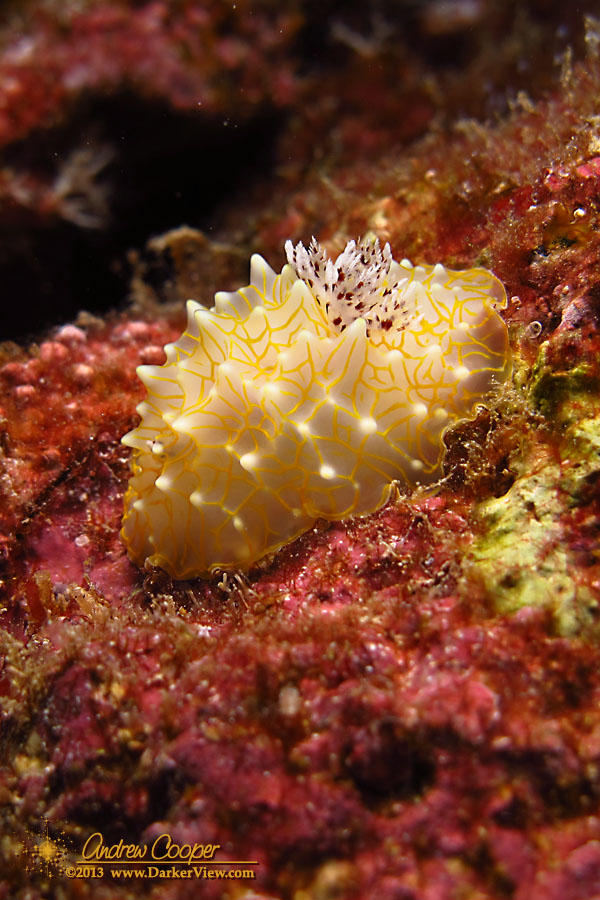
Not where I expected it, a tiny cavity in an otherwise sheer rock wall covered with sponge. It was red… A flash bright red in the dive light had my attention quickly. I could not see the fish well enough to ID it, red is uncommon enough that I set up and fired anyway, just taking a photo was hard enough in the surge.
Only after downloading the photo I realized it was a scarface blennie…
Scarface blennie (Cirripectes vanderbilti), in a small crevice, depth 15ft.
There is one question we all have to ask when a beautiful comet graces the skies…
Comet C/2007 N3 Lulin on the evening of 26 Feb 2009Where to look?
Like any other solar system object, comets move against the sky. Even worse, when close to the Earth or Sun they can be moving so quickly against the stars that coordinates quickly become out of date. Aiming a telescope using coordinates a day old, or sometimes even only an hour old will result in a view of empty sky. A few stars perhaps, but no comet.
You need a table of coordinated calculated for regular time intervals, an ephemeris. Alternately you need a set of coordinates calculated for the exact time you will be looking.
Mercury will begin a morning apparition this week. The planet is currently about 10° above the rising Sun, climbing higher each morning. Look for a 2nd magnitude star-like object just above the glow of dawn. Mercury will reach a maximum elongation of 19° on November 17th.
This evening a pretty crescent Moon will be about 8° north of Venus. The brilliant pair will be high in the southern sky at sunset, rather hard to miss if you take a moment to look up. Take note of how far the planet is from the Sun, Venus is currently near maximum elongation, which occurred on October 31st.
Today at 01:29HST Saturn will pass through superior conjunction with the Sun. The planet will reappear in the dawn sky later in the month.
On the 23rd and 24th Saturn will be quite near the brightening comet C/2012 S1 ISON and the planet Mercury, creating an odd planet and comet conjunction. The trio will have about 5° separation. Even more odd, the comet 2p/Enke will be inside the triangle formed by the trio, probably at 7th magnitude.
It is possible to see planets in the daytime. Both Jupiter and Venus are bright enough to see fairly easily in full daylight if conditions are right. You need to know where and how to look, but once glimpsed they are fairly easily seen. It is the knowing how that makes it possible. Try these simple hints…
Try when the planets are far from the glare of the Sun, in the first hours after dawn or last hours of the day are best.
Clean air is necessary. If the air is hazy, dusty or smoggy it will hide the planets from view, particularly when near the Sun. There will just be too much solar glare to pick out the planet. For the same reason try when the planet is high in the sky and you are looking through much less air.
The human eye will relax and defocus if there is nothing to focus on. This happens when looking at a plain expanse of blue sky. You could be looking right at the planet and not see it. A few puffy clouds around, or better yet, the Moon, will give the eye something to focus on, allowing the planet to be easily seen.
Put the Sun out of sight to reduce glare. Simply position yourself in the shadow of a tree or building to get a better view.
Pick a day when the Moon is near the object you are looking for, it will provide a simple signpost to the correct location.
It is this last hint that can be particularly useful today. Venus is about 8° degrees south of the Moon today. It helps that Venus is near maximum elongation, as far as it will get from the Sun for this evening apparition. If you can find the Moon high in the midday sky check just below it for Venus. The planet will be about a sixteen lunar diameters away from the Moon, seen as a bright star-like object.
The little teardrop butterfly was playing peek-a-boo with me. It would peek out, the strobe would fire, it would dart back into the coral. Repeat cycle…
This little fish had good reason to be shy, it is a favorite of the aquarium collectors.
Teardrop butterflyfish (Chaetodon unimaculatus) peeks out from under cover
It was horrible. Yelling, screaming shoppers cram the aisle, while store security is helpless to intervene in the mayhem. A mob of shoppers fighting over the last red bottle. Black Friday sales? No. Just the struggle for the last shipment of Sriracha. Looming shortages have created a nationwide panic. Where will we get the spice!
Scientists from University of California, Berkeley, and University of Hawaii, Manoa, have statistically determined that twenty percent of Sun-like stars in our galaxy have Earth-sized planets that could host life. The findings, gleaned from data collected from NASA’s Kepler spacecraft and the W. M. Keck Observatory, now satisfy Kepler’s primary mission: to determine how many of the 100 billion stars in our galaxy have potentially habitable planets. The results are being published November 4 in the journal Proceedings of the National Academy of Sciences.
Artist’s rendering of the planetary system HR 8799 at an early stage in its evolution. Credit: Dunlap Institute for Astronomy & Astrophysics“What this means is, when you look up at the thousands of stars in the night sky, the nearest sun-like star with an Earth-size planet in its habitable zone is probably only 12 light years away and can be seen with the naked eye. That is amazing,” said UC Berkeley graduate student Erik Petigura, who led the analysis of the Kepler and Keck Observatory data.
“For NASA, this number – that every fifth star has a planet somewhat like Earth – is really important, because successor missions to Kepler will try to take an actual picture of a planet, and the size of the telescope they have to build depends on how close the nearest Earth-size planets are,” said Andrew Howard, astronomer with the Institute for Astronomy at the University of Hawaii. “An abundance of planets orbiting nearby stars simplifies such follow-up missions.”
Astronomers, professional and amateur alike, are getting ready for comet C/2012 S1 ISON, possibly the highlight of a year that has already seen several good comets.
Discovered in September 2012 by Vitali Nevski and Artyom Novichonok, of the ISON project, a group of telescopes dedicated to discovering and tracking solar system objects. The comet was then an 18th magnitude object in the outer solar system, an impressive find for a small telescope.
An image of comet C/2012 S1 ISON acquired by the Hubble Space Telescope on October 9th, 2013, credit: NASA, ESA, and the Hubble Heritage TeamWhen astronomers first calculated the comet’s orbit they found a surprise. The comet will pass close to the Sun. Not just close, but extremely close! On November 28th the comet will pass perihelion, its closest approach to the Sun. At a mere 1,860,000km (1,150,000miles) this will be a close pass indeed. As perihelion is measured from center to center, the distance is even closer if you consider the 695,500km (432,200mile) radius of the Sun. Subtracting the solar radius you realize the comet will pass a mere 1,165,000km (724,000miles) above the surface of the Sun. At this distance the intensity of the solar radiation will be nineteen thousand times more intense than a sunny day on Earth.
The next surprise was hinted at by the orbital calculations. The orbital solution indicated a nearly hyperbolic path, suggesting that this was a new comet, one that had not visited the inner solar system before. This possibility was strengthened by later observations of the comet.