
This evening a pretty crescent Moon will be about 8° north of Venus. The brilliant pair will be high in the southern sky at sunset, rather hard to miss if you take a moment to look up. Take note of how far the planet is from the Sun, Venus is currently near maximum elongation, which occurred on October 31st.
Saturn at Superior Conjunction
Today at 01:29HST Saturn will pass through superior conjunction with the Sun. The planet will reappear in the dawn sky later in the month.
On the 23rd and 24th Saturn will be quite near the brightening comet C/2012 S1 ISON and the planet Mercury, creating an odd planet and comet conjunction. The trio will have about 5° separation. Even more odd, the comet 2p/Enke will be inside the triangle formed by the trio, probably at 7th magnitude.
Seeing Venus in the Daytime
It is possible to see planets in the daytime. Both Jupiter and Venus are bright enough to see fairly easily in full daylight if conditions are right. You need to know where and how to look, but once glimpsed they are fairly easily seen. It is the knowing how that makes it possible. Try these simple hints…
- Try when the planets are far from the glare of the Sun, in the first hours after dawn or last hours of the day are best.
- Clean air is necessary. If the air is hazy, dusty or smoggy it will hide the planets from view, particularly when near the Sun. There will just be too much solar glare to pick out the planet. For the same reason try when the planet is high in the sky and you are looking through much less air.
- The human eye will relax and defocus if there is nothing to focus on. This happens when looking at a plain expanse of blue sky. You could be looking right at the planet and not see it. A few puffy clouds around, or better yet, the Moon, will give the eye something to focus on, allowing the planet to be easily seen.
- Put the Sun out of sight to reduce glare. Simply position yourself in the shadow of a tree or building to get a better view.
- Pick a day when the Moon is near the object you are looking for, it will provide a simple signpost to the correct location.
It is this last hint that can be particularly useful today. Venus is about 8° degrees south of the Moon today. It helps that Venus is near maximum elongation, as far as it will get from the Sun for this evening apparition. If you can find the Moon high in the midday sky check just below it for Venus. The planet will be about a sixteen lunar diameters away from the Moon, seen as a bright star-like object.
Have a try.
Teardrop
The little teardrop butterfly was playing peek-a-boo with me. It would peek out, the strobe would fire, it would dart back into the coral. Repeat cycle…
This little fish had good reason to be shy, it is a favorite of the aquarium collectors.

Sriracha Shortage?
It was horrible. Yelling, screaming shoppers cram the aisle, while store security is helpless to intervene in the mayhem. A mob of shoppers fighting over the last red bottle. Black Friday sales? No. Just the struggle for the last shipment of Sriracha. Looming shortages have created a nationwide panic. Where will we get the spice!
Maybe not… A judge has ordered a partial shutdown of production at the Huy Fong Foods plant in Irwindale, California. It is not expected to impact supply, but fans of the sauce are jittery, with the possibility of a sriracha shortage making news across the country.
Supplies are still plentiful at our local supermarket. Just as a precaution I bought the large bottle.

One in Five Stars Has Earth-sized Planet in Habitable Zone
W. M. Keck Observatory press release…
Scientists from University of California, Berkeley, and University of Hawaii, Manoa, have statistically determined that twenty percent of Sun-like stars in our galaxy have Earth-sized planets that could host life. The findings, gleaned from data collected from NASA’s Kepler spacecraft and the W. M. Keck Observatory, now satisfy Kepler’s primary mission: to determine how many of the 100 billion stars in our galaxy have potentially habitable planets. The results are being published November 4 in the journal Proceedings of the National Academy of Sciences.

“For NASA, this number – that every fifth star has a planet somewhat like Earth – is really important, because successor missions to Kepler will try to take an actual picture of a planet, and the size of the telescope they have to build depends on how close the nearest Earth-size planets are,” said Andrew Howard, astronomer with the Institute for Astronomy at the University of Hawaii. “An abundance of planets orbiting nearby stars simplifies such follow-up missions.”
Continue reading “One in Five Stars Has Earth-sized Planet in Habitable Zone”
Preparing for Comet C/2012 S1 ISON
Astronomers, professional and amateur alike, are getting ready for comet C/2012 S1 ISON, possibly the highlight of a year that has already seen several good comets.
Discovered in September 2012 by Vitali Nevski and Artyom Novichonok, of the ISON project, a group of telescopes dedicated to discovering and tracking solar system objects. The comet was then an 18th magnitude object in the outer solar system, an impressive find for a small telescope.
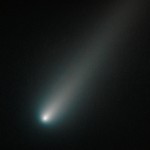
The next surprise was hinted at by the orbital calculations. The orbital solution indicated a nearly hyperbolic path, suggesting that this was a new comet, one that had not visited the inner solar system before. This possibility was strengthened by later observations of the comet.
New Moon
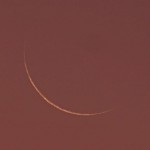
A rare hybrid solar eclipse will occur across the North Pacific and Central Africa. A hybrid eclipse is one that is both annular and total, changing from one to the other as the shadow sweeps across the Earth.
Taking Comet Photos with Keck
After our comet ISON observing session I have been asked what it is like to take a comet photograph with Keck. An apt question as all of the recent observers were taking spectra, not photos.
The answer? Not very pretty.
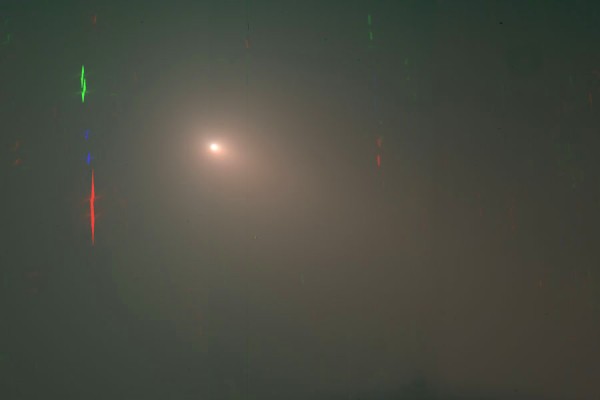
A few years back Greg Wirth and I took some frames of comet Hartley 2 with Keck 2. When I processed the frames into a color photo the results were less than impressive.
Comets are big. While the nucleus is quite small, we do not see the nucleus even with the enormous power of a 10 meter telescope. It is hidden in the coma and quite dark, the average nucleus is a shade of dark gray equivalent to charcoal.
The coma and tail are very extended, much larger than the field of view of the telescope, thus the entire frame is inside the coma. The photo of Hartley 2 Greg and I took was no exception.. The image is notable for its complete lack of any interesting structure. There are no jets, shells or other inner coma detail visible. The tail is simply a general brightening to the southwest (lower right in this image).
Small telescopes, in the hands of amateurs, are going to produce the prettiest images of comets. With fields of view measured in degrees, not arcminutes, the comet is going to be seen in all its glory.
The Celestron Cometron
I have only had three telescopes given to me this year. Telescopes in various states of disrepair. I usually fix them up, clean them up, and find a new home for them.
It was Julia who gave me this little bit of fun… A Celestron 62mm f/4.8 Cometron. A small refractor intended for low power viewing. Prefect for viewing comets or other wide field objects.
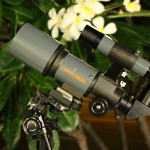
The ‘scope I was given was in pretty good shape. Nothing broken or badly damaged. The optics dirty but free of coating damage or uncleanable grime. All that was require was disassembly and a good cleaning to remove dirt, spider webs, and a few cockroach egg cases.