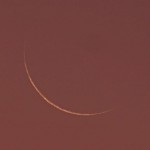
This evening the Moon will join the ongoing dance of planets in the sunset. A very thin crescent Moon will be 13° above the horizon at sunset and 6° below and south of the brilliant Venus. 5° above Venus will be Mercury notably dimmer at only 0.4 magnitude.
Tomorrow the Moon will be a bit higher and show a little more crescent at 6% illuminated. It will be above Venus and about the same elevation as Mercury, if 7° further to the south.
Jupiter is still present, but probably too low into the sunset to spot at only 6° from the setting Sun. Maybe with perfect conditions?
A very young moon over Waikoloa, this is only 26 hours after new, visible to the unaided eye as a sliver in the fading glow of sunsetNew Moon will occur today at 05:56HST.
Yes, I occasionally publish porn… Nudibranch porn.
Search engines must have fun with nudis. Just consider the website Nudi Pixel. A great website, I often use the photos to check my identification of a species. How many surfers hit upon the site looking for something totally different?
A pair of varicose phyllidia (Phyllidia varicosa) at 35ft depth, Hoover’s Tower, most likely mating
An international team of scientists using the most powerful telescope on Earth has discovered the moments just after the Big Bang happened more like the theory predicts, eliminating a significant discrepancy that troubled physicists for two decades. The discovery will be published in the international journal Astronomy & Astrophysics on June 6.
The image illustrates the detailed modelling of a small piece of the surface of an old metal-poor star used to derive its abundance of lithium-6. Image credit Karin Lind, Davide De Martin.One of the most important problems in physics and astronomy was the inconsistency between the lithium isotopes previously observed in the oldest stars in our galaxy, which suggested levels about two hundred times more Li-6 and about three to five time less Li-7 than Big Bang nucleosynthesis predicts. This serious problem in our understanding of the early Universe has invoked exotic physics and fruitless searches for pre-galactic production sources to reconcile the differences.
The team, led by Karin Lind of the University of Cambridge, has proven the decades-old inventory relied on lower quality observational data with analysis using several simplifications that resulted in spurious detections of lithium isotopes.
This week Mars will appear in the dawn sky having passed through superior conjunction on April 17. Look for a 1.5 magnitude object to rise around 04:50, about 10° ahead of the Sun. The red planet will see opposition in April of 2014.
Tomorrow morning a very thin crescent Moon will share the dawn. Rising about 05:05 a 1% illuminated Moon will be 3° below Mars, closer to the rising Sun.
Jupiter is quickly sliding into the sunset heading for superior conjunction on June 19th. This evening the planet will be 10° above the setting Sun, in the next few days it will disappear into the glare. Look for Jupiter to reappear in the dawn during the first week of July.
As anyone who has worked with glass knows, the material is fascinating. Glass is fragile, yet it can be extraordinarily strong. This is a seeming contradiction, but one that makes sense if you start to understand what makes glass crack.
Via Phil at Bad Astronomy, a truly awesome video on Prince Rupert’s Drop, a simple construct of glass that exhibits the strength and weakness of glass in a very visual way.
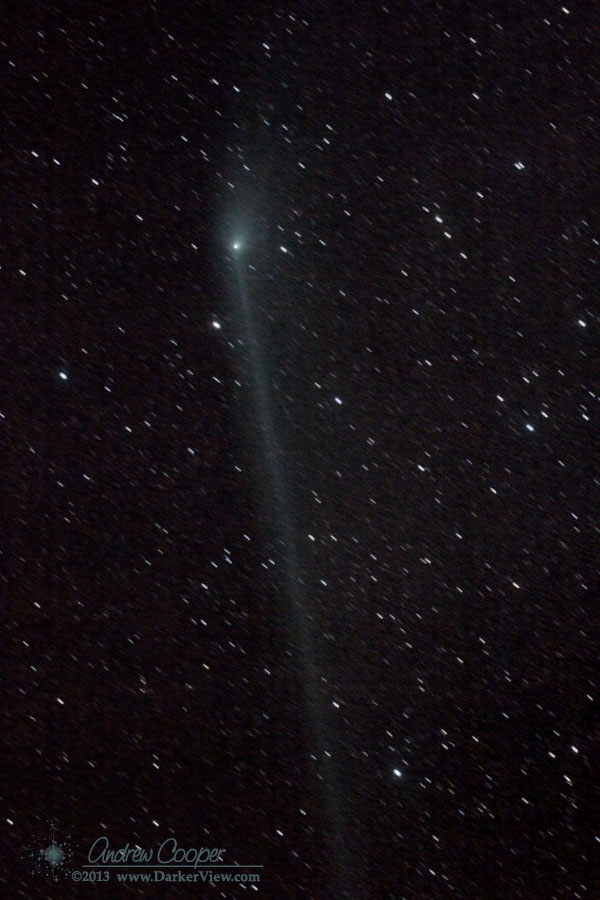
Well past perihelion comet C/2011 L4 continues to put on an impressive show. Amateur sky-watchers have been enjoying the impressive anti-tail reaching out a few degrees from the coma. True, you may need a telescope or at least good binoculars to see the comet. It may be dimming, but still worth the effort to observe.
Comet C/2011 L4 PanSTARRS, 10x4min with TV-76 and Canon 60D @ISO2000