I had been looking to acquire another astrophoto toy. The desire is for a small, portable astrophoto setup. Yes, I am aware that the words “portable” and “astrophoto” do not really belong in the same sentence, all things are relative.
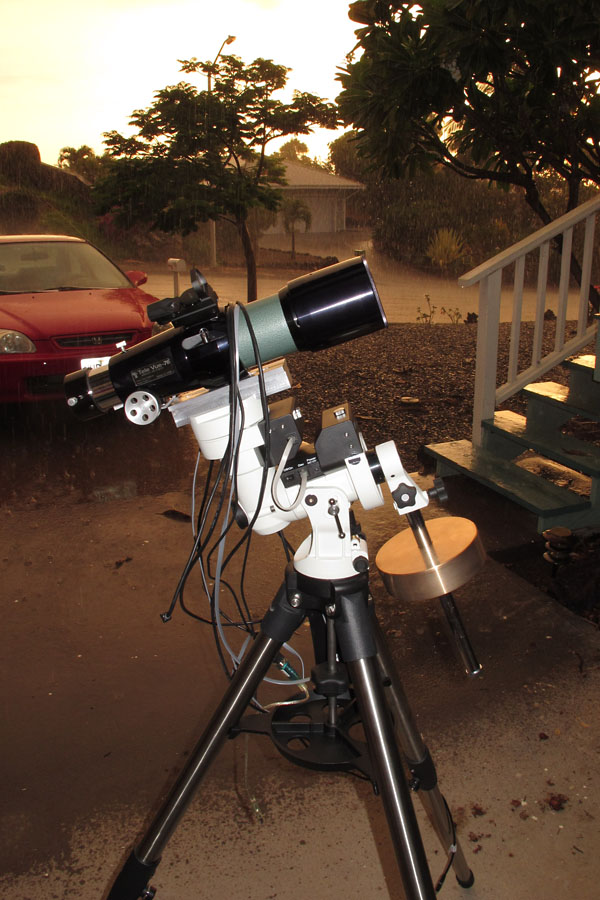
Thus I have decided on the new iOptron ZEQ25. It is a new design, with some radical differences from the more traditional German equatorial mounts.
The mount is pretty small, a mere 10 pounds of steel and aluminum. Compact enough to be packed into a suitcase for air travel. Performance sufficient to do wide field astrophotography with focal lengths up to 1000mm and a DLSR camera. Perfect for use with either my TV-76 or AT6RC. Unlike my old Losmady G-11 it features a modern GOTO system and can be run from the computer.
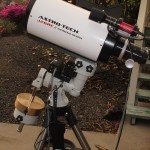
AT6RC atop an iOptron ZEQ25 mount, note the additional counterweight necessaryThe chatter over at Cloudy Nights was promising. A few early production mounts were in the hands of some stateside amateurs, and they have been posting their impressions and images. I was particularly impressed by the measurements of periodic error with results around two arc seconds. This was a small mount that could very easily be a good astrophoto option.
I ordered the mount from the good folks at OPT. It was not yet listed in the website catalog, but a phone call confirmed they were expecting delivery of three mounts shortly. I put down my deposit. A week later I had confirmation that the mount had been received and was ready for shipment to Hawaiʻi as promised.
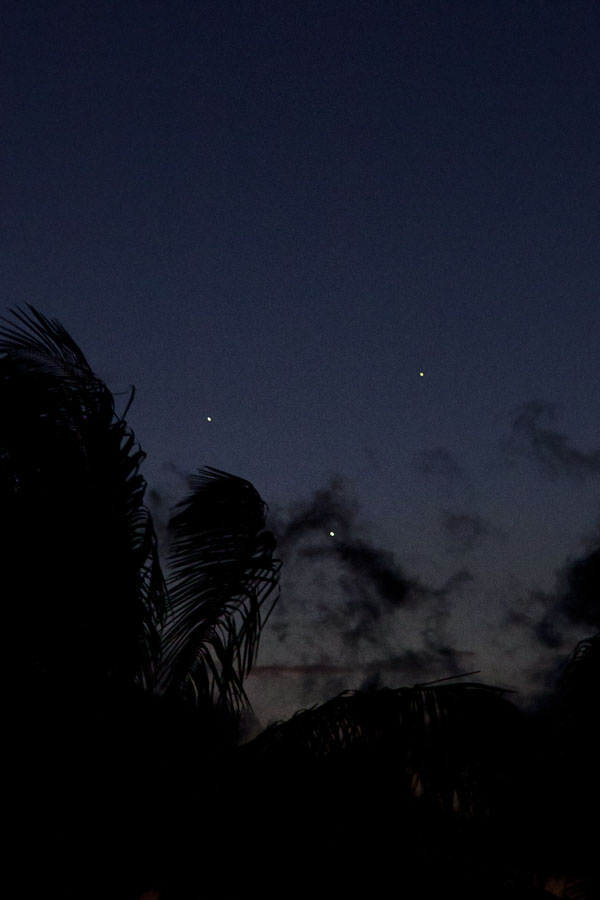
This evening will see a line of bright planets in the sunset. Easiest to spot will be the brilliant Venus, shining at -4 magnitude and 15° above the setting Sun. 4°30′ below Venus will be Jupiter, quite low in the sunset, but bright enough to spot at -2 magnitude. 4°16′ above Venus will be Mercury, notably dimmer at -0.2 magnitude. The three will form an almost perfect line of bright objects in the glow of sunset, it should be a nice sight.
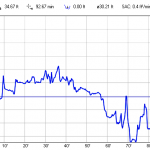
I have had a few dives over 90 minutes, an hour and a half, on a standard 80 cubic foot aluminum tank. This time I managed two back to back dives totaling nearly three hours on two tanks. Not bad for air consumption! Admittedly I was moving slow, doing photography, on the other hand neither dive was all that shallow, averaging 30ft with deeper excursions.
Leaving Honokohau Harbor for a day of diving the Kona CoastIt was another day of diving off the Aqua Safari with the usual crew. Dennis, Sky, Pete and myself headed north from Honokohau for Kua Bay.
Kua Bay is the last public day use mooring north of Kona for a long distance, the next buoys are at Anemoʻohalu Bay, almost 10 miles further north. The mooring is adjacent to the popular Maniniʻowali Beach, a beautiful crescent of sand that is well loved and heavily used. A prominent finger of coral juts out from the shore north of the beach, creating a nice 20ft wall to explore.
I spent the entire dive poking along this wall, looking for small invertebrates. I was rewarded by an assortment of nudis and flatworms. Most were species I had seen before. One flatworm was something different, a species I am still trying to identify.
Dive Profile for Kua Bay on 26March 2013For the second dive we headed north. There may be no further official day-use public moorings, but there are two large moorings just offshore the now closed Kona Village Resort. We tied up to the outer of these two moorings to see what we could find. The mooring is sited just outside of a coral shelf. While the mooring sits in 35ft of water, the shelf just inshore rises to about 15ft. Further out it appears the coral drops to a large sand flat, this we did not explore, spending the entire dive working the shallower wall of coral.
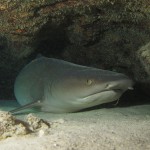
A white tipped reef shark (Triaenodon obesus) under a ledge in front of Old Kona VillageAbout 70 minutes into the dive I figured it was time for Pete to show up. I had not seen any sign of him for quite a while, he should be by any time now… He has had a habit of coming right over the top of me and trying to surprise me, it works with Mark, I think he is frustrated with my lack of reaction. Pete is right on time.
I signal to him, making a shark symbol, a flat hand held sideways to the forehead, that gets his attention. I lead him under a ledge a few feet away, where there is indeed a white tip shark hanging out. When we surface a few minutes later he sums up the encounter… “That is the biggest white tip I have ever seen!” Yeah, it was pretty big. Living up to the scientific name as well, Triaenodon obesus, a well fed shark, a little fat even.
After washing up the boat we head into Bite Me for dinner and to talk story. We thumb though the photos of the day reviewing all we had seen. It was an excellent day diving. The water conditions were notably better than a month ago. Summer is arriving, the swell settling down, bringing clearer water conditions. Looking forward to a summer of more diving!
It looks like it may clear. There should be a few dark hours before moonrise. Maybe I can get the new astrophoto rig out and get everything working properly.
<Commence tropical downpour>
Nothing like two tenths of an inch of rain in half an hour to put a damper on astronomical plans.
Planning to make a go at photographing asteroid 2008 QE2 as it passes the Earth. Before I can do that a little planning is in order. Minor questions… Is it above the horizon near close approach, in my nighttime sky? It turns out this object will be available for observation.
The table below is a precision ephemeris generated by the NASA HORIZONS web interface for Mauna Kea on the island of Hawai’i. Listed are celestial coordinates, time, local elevation and azimuth, magnitude and distance. The marks after the time column indicate daylight (*), twilight (A) and moonlight (M).
From the data it is clear that the evening of May 30th (May 31st UT) allows observation from Hawai’i, at an elevation of ~46° a few hours after dark. Nicely placed and nicely timed for observation. Close approach is actually the next day, but the difference is minor. The next evening allows a second chance at the observation while the asteroid is still close.
The evening dance of Mercury, Venus and Jupiter continues. This evening will see Jupiter and Venus draw to within 1°09′ of each other. Tomorrow will see the configuration shift a bit, Jupiter and Venus slightly closer at 1°05′ separation. Mercury will be about 3° above the close pair.
With Venus rising a little each day while Jupiter is heading into the sunset and superior conjunction, the pair will quickly separate after this close approach. After the end of the month Jupiter will depart the stage.
Watching sunset is one way to end the day, in this case it heralded the start of our activity. We were waiting for the Sun to go away, for the skies to grow dark. We were preparing for a night dive.
Once again into the black water, looking to meet the the reef’s night shift. It would be our usual crew… Pete, Sky, Mark and myself for the dive. Dennis joined for dinner, but did not stay for the dive.
Pete watching sunset over the Puako shorelineWe would meet at Pete’s place, an ʻohana he is currently renting in the middle of Puakō. From this base of operations we would have dinner, and head into the water for a night dive along the reef. Dinner itself was an event, it featured kebabs made with mouflon sheep. Sky and Pete’s latest hunt on the mountain had been successful. The mutton was pretty good, a credit to the cook, who prepared it properly.
While I had never used this particular entry, we were all familiar with the Puakō reef, having dove the area many times over the years. The layout is pretty straightforward. A shallow reef slopes away from shore for about 50-100yards, reaching about 10ft deep. There you will find ancient sea cliffs, a sheer rock wall that drops to 25′ or 35′ depth. Below this wall the reef slopes away, sometimes gently, sometimes steeply. At 70-100ft you reach sand that slopes further into the abyss. Our goal would be the old cliffs. These are pockmarked with small caves and overhangs, excellent terrain to explore on a night dive, there should be plenty of small invertebrates about.
The plan was simple, taking advantage to the nature of the Puakō reef and the multiple entries available along the shoreline. We would enter at one point, do a one way dive along the submerged seacliffs at 20-30ft, then exit at another entry about a quarter mile further south. Exit would be aided by a strobe left at the designated exit point, a bright light in flash mode easily visible to lead us back to the correct landfall.
Overhead a full Moon rose, lighting the sky and aiding our visibility. Once under water the moonlight would ad another dimension to the dive. The glow of moonlight coming through the water was sometimes quite pretty.
At one point I did something I almost never do on a Hawaiian reef. I was actually forced to use my compass for navigation. Normally the slope of the reef quickly indicates which way is shore. I had followed Mark out onto the reef below the wall. After a little photography I found myself disoriented, which was was the shore? I held my compass to the divelight to charge the glow-in-the-dark dial, then got my bearings to head back to the wall. I know I bought the console with a compass for some reason. Just a reminder of how easy it is to lose ones bearings in the dark water.
Orange cup coral (Tubastraea coccinea) at 20′ depth, PuakōOne feature of the wall at night that you just have to love, are the cup coral gardens. Here and there, usually near a cave entry, the entire wall will be covered with golden cup corals. Bright golden orange, these corals retract their tentacles during the day. It is at night that these gardens bloom, covering entire rock faces.
The strobe worked very well, we were able to head inshore, across the reef shallows, to just the right point. The shallows at Puakō can be a nuisance to cross in the day, they are more so at night. There was no real surf to complicate the issue, but you are just feeling your way across the rocks. I only put my hand on one urchin.
It was a pretty stroll back to the house along Puakō Road. A warm tropical night, a bright full Moon high overhead. We were chatting about the dive, reveling in the experience. One car did pass us as we walked, it must have been an interesting sight… A group of four guys in full scuba gear, dripping wet, walking down the center of the road.
Back at Pete’s place we broke out snacks and drinks. Beer and scotch appeared, dive photos reviewed, as we talked story for hours. Yeah, it was that sort of night.