A team of researchers led by Justin R. Crepp, the Freimann Assistant Professor of Physics at the University of Notre Dame, has directly imaged a very rare type of brown dwarf that can serve as a benchmark for studying objects with masses that lie between stars and planets. Their paper on the discovery was published recently in Astrophysical Journal.
Direct image detection of a rare brown dwarf companion HD19467B taken at Keck Observatory. Credit: Crepp et al. 2014, ApJInitial data came from the TRENDS (TaRgetting bENchmark-objects with Doppler Spectroscopy) high-contrast imaging survey that uses adaptive optics and related technologies to target older, faint objects orbiting nearby stars, and precise measurements were made at the W. M. Keck Observatory on the summit of Mauna Kea, Hawaii. Brown dwarfs emit little light because they do not burn hydrogen and cool rapidly. Crepp said they could provide a link between our understanding of low-mass stars and smaller objects such as planets.
HD 19467 B, a T-dwarf, is a very faint companion to a nearby Sun-like star, more than 100,000 times as dim as its host. Its distance is known precisely, and the discovery also enables researchers to place strong constraints on important factors such as its mass, orbit, age, and chemical composition without reference to the spectrum of light received from its surface.
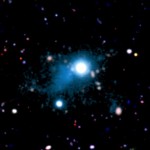
Astronomers have discovered a distant quasar illuminating a vast nebula of diffuse gas, revealing for the first time part of the network of filaments thought to connect galaxies in a cosmic web. Researchers at the University of California, Santa Cruz, led the study, published January 19 in the journal, Nature.
This deep image shows the nebula (cyan) extending across 2 million light-years that was discovered around the bright quasar UM287 (at the center of the image). Credit: S. Cantalupo, UCSCUsing the 10-meter Keck I telescope at the W. M. Keck Observatory in Hawaii, the researchers detected a very large, luminous nebula of gas extending about 2 million light-years across intergalactic space.
“This is a very exceptional object: it’s huge, at least twice as large as any nebula detected before, and it extends well beyond the galactic environment of the quasar,” said Sebastiano Cantalupo, first author of the paper and a postdoctoral fellow at UC Santa Cruz.
The standard cosmological model of structure formation in the universe predicts that galaxies are embedded in a cosmic web of matter, most of which (about 84 percent) is invisible dark matter. This web is seen in the results from computer simulations of the evolution of structure in the universe, which show the distribution of dark matter on large scales, including the dark matter halos in which galaxies form and the cosmic web of filaments that connect them. Gravity causes ordinary matter to follow the distribution of dark matter, so filaments of diffuse, ionized gas are expected to trace a pattern similar to that seen in dark matter simulations.
The Board of Directors of the W. M. Keck Observatory announced today that Taft Armandroff, executive director of the world’s premier ground-based astronomical observatory, will step down on June 1 to become a professor at the University of Texas at Austin, and director of its McDonald Observatory.
W. M. Keck Observatory Director Taft Armandroff Credit: Ethan TweedieArmandroff joined Keck Observatory in June 2006. During his tenure, the observatory continued to be a global leader in optical and infra-red astronomy. Keck Observatory serves nearly five hundred astronomers drawn not only from the United States but also from around the world, including Australia. The observatory also provides ground-based support for the National Aeronautics and Space Administration (NASA).
Before coming to Keck Observatory, Armandroff worked at the National Optical Astronomy Observatory (NOAO) in Tucson, Arizona, for 19 years, holding positions of associate director and director of the NOAO Gemini Science Center. He is a 1982 graduate in astronomy of Wesleyan University, and he earned his Master’s and Ph.D. degrees in astronomy from Yale University. His scientific research has focused dwarf spheroidal galaxies, stellar populations in the Milky Way galaxy and nearby galaxies, globular clusters, chemical evolution of galaxies, and dark matter.
As executive director of the W. M. Keck Observatory, Armandroff reports to a governing board representing the observatory’s founding partners, the California Institute of Technology (Caltech) and the University of California (UC). The governing board also has liaisons from the NASA, the W. M. Keck Foundation, and the University of Hawaii. In 2013, Keck Observatory managed a budget of $25 million to support the organization’s 120 professional staff, operations, and advanced instrument initiatives.
“Taft did an exceptional job in maintaining the high productivity of Keck Observatory,” said Tom Soifer, Caltech Professor of Physics and a member of the California Association for Astronomical Research (CARA) Board. “During his tenure federal and privately funded cutting edge instruments were built and great advances were made in adaptive optics. We wish him well in his new job.”
A team of scientists led by astronomers at the University of California, Riverside has used NASA’s Hubble Space Telescope and the W. M. Keck Observatory to uncover the long-suspected underlying population of galaxies that produced the bulk of new stars during the universe’s early years.
Galaxy Cluster Abell 1689 Credit: HST/STScI, H. Ford (JHU)The galaxies are the smallest, faintest, and most numerous galaxies ever seen in the remote universe, and were captured by Hubble deep exposures taken in ultraviolet light, and confirmed using the mighty Keck I telescope on the summit of Mauna Kea on the island of Hawaii.
University of Hawaii at Manoa astronomer Regina Jorgenson has obtained the first image that shows the structure of a normal galaxy in the early universe as captured by the W. M. Keck Observatory. The results were presented at the winter American Astronomical Society meeting being held this week near Washington, DC.
A map of the hydrogen emission from DLA2222-0946. Credit R. JorgensonThe galaxy, called DLA2222-0946, is so faint that it is virtually invisible at all but a few specific wavelengths. It is a member of a class of galaxies thought to be the progenitors of spiral galaxies like our own Milky Way.
These galaxies are known to contain most of the neutral gas that is the fuel for star formation, so they are an important tool for understanding star and galaxy formation and evolution. Discovered and classified over 30 years ago, they have been notoriously difficult to see directly.
Dr. Jorgenson, an NSF Astronomy and Astrophysics Postdoctoral Fellow at the University of Hawaii’s Institute for Astronomy, worked with Dr. Arthur Wolfe of the University of California, San Diego. They used the advanced technologies of the W. M. Keck Observatory on Mauna Kea to obtain the first-ever spatially resolved images of a galaxy of this type.
The galaxy was detected with the 10-meter, Keck I telescope fitted with OSIRIS and the Laser Guide Star Adaptive Optics system.
The Kepler team today reports on four years of observations from the W. M. Keck Observatory targeting Kepler’s exoplanet systems, announcing results this week at the American Astronomical Society meeting in Washington. These observations, from Keck Observatory on the summit of Mauna Kea, confirm that numerous Kepler discoveries are indeed planets and yield mass measurements of these enigmatic worlds that vary between Earth and Neptune in size.
Chart of Kepler planet candidates as of January 2014., credit NASA AmesMore than three-quarters of the planet candidates discovered by NASA’s Kepler spacecraft have sizes ranging from that of Earth to that of Neptune, which is nearly four times as big as Earth. Such planets dominate the galactic census but are not represented in our own solar system. Astronomers don’t know how they form or if they are made of rock, water or gas.
Using one of the two world’s largest telescopes at Keck Observatory in Hawaii, scientists confirmed 41 of the exoplanets discovered by Kepler and determined the masses of 16. With the mass and diameter in-hand, scientists could immediately determine the density of the planets, characterizing them as rocky or gaseous, or mixtures of the two.
Getting to and from the vehicles was done as quickly as possible, running from door to door. Not only were the temperatures as low as anyone could remember, the wind was adding to the issue, blowing at a steady 35mph. The temperatures reached -8°C (17°F) at night and never rose above freezing during the day. The ice is slowly sublimating in the dry air, but there is still too much on the domes for safe observing.
Now if the wind would obey the posted speed limit…
The remains of heavy ice sublimating in cold, dry air with steady 35mph winds
More than three-quarters of the planet candidates discovered by NASA’s Kepler spacecraft have sizes ranging from that of Earth to that of Neptune, which is nearly four times as big as Earth. Such planets dominate the galactic census but are not represented in our own solar system. Astronomers don’t know how they form or if they are made of rock, water or gas.
Artist’s rendition of the Kepler Spacecraft in orbit around the Sun peering at a distant solar system, press release image from the NASA Kepler websiteThe Kepler team today reports on four years of ground-based follow-up observations targeting Kepler’s exoplanet systems at the American Astronomical Society meeting in Washington. These observations confirm the numerous Kepler discoveries are indeed planets and yield mass measurements of these enigmatic worlds that vary between Earth and Neptune in size.
Included in the findings are five new rocky planets ranging in size from 10 to 80 percent larger than Earth. Two of the new rocky worlds, dubbed Kepler-99b and Kepler-406b, are both 40 percent larger in size than Earth and have a density similar to lead. The planets orbit their host stars in less than five and three days respectively, making these worlds too hot for life as we know it.
A major component of these follow-up observations was Doppler measurements of the planets’ host stars. The team measured the reflex wobble of the host star, caused by the gravitational tug on the star exerted by the orbiting planet. That measured wobble reveals the mass of the planet: the higher the mass of the planet, the greater the gravitational tug on the star and hence the greater the wobble.