
While Jupiter will leave the stage, exiting into the sunset after the end of the month, Mercury and Venus will continue the dance well into June.
When you want to see the stars, find someplace dark

While Jupiter will leave the stage, exiting into the sunset after the end of the month, Mercury and Venus will continue the dance well into June.
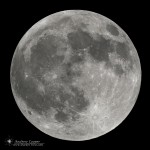
A penumbral lunar eclipse will occur, but it is so minor there is little point in trying to observe it. As the NASA eclipse site notes… “With a penumbral eclipse magnitude [6] of 0.0158, just 0.5 arc-minutes of the Moon’s southern limb will pass into Earth’s pale penumbral shadow; such a shallow eclipse is only of academic interest since it will be all but impossible to detect.”
W. M. Keck Observatory press release…
Two hungry young galaxies that collided 11 billion years ago are rapidly forming a massive galaxy about 10 times the size of the Milky Way, according to UC Irvine-led research conducted on the W. M. Keck Observatory and other research facilities around the world. The results will be published today in the journal Nature.
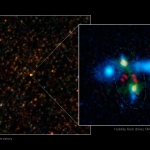
HXMM01 is fading away as fast as it forms, a victim of its own cataclysmic birth. As the two parent galaxies smashed together, they gobbled up huge amounts of hydrogen, emptying that corner of the universe of the star-making gas.
“These galaxies entered a feeding frenzy that would quickly exhaust the food supply in the following hundreds of million years and lead to the new galaxy’s slow starvation for the rest of its life,” said lead author Hai Fu, a UC Irvine postdoctoral scholar.
The discovery solves a riddle in understanding how giant elliptical galaxies developed quickly in the early universe and why they stopped producing stars soon after. Other astronomers have theorized that giant black holes in the heart of the galaxies blew strong winds that expelled the gas. But cosmologist Asantha Cooray, the UC Irvine team’s leader, said that they and colleagues across the globe found definitive proof that cosmic mergers and the resulting highly efficient consumption of gas for stars are causing the quick burnout.
Continue reading “Mega-galaxy is Missing Link in History of Cosmos”
Normally I do not snorkel around the reef, rather I prefer donning full kit including tank and regulator allowing a more immersive experience. Staying down allows me a freedom of movement, to explore well beyond the twenty five feet or so that I can reach without the gear. Scuba permits me to carry a camera with time to compose a subject and observe behavior.
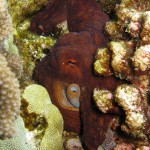
I skim along, the large fins providing effortless speed. The view is different than that of scuba, you are always looking down. I stay in the shallower water where the coral comes close to the surface. On occasion I dip down below the surface to get a closer look, weaving through the coral on long shallow dives. To go up I simply stop swimming to allow my buoyancy to lift me to the surface. A sharp breath clears the snorkel of water. With practice the actions are almost reflex, as natural as breathing on shore.
There are species that prefer the shallows, rarely seen when diving, often common in just a few feet of water. Snowflake morays, the colorful lagoon triggerfish, snorkeling allows spotting of a different reef community. I often make a point to sweep the areas just off the shore in three feet of water or less, just to see what can be found.
This evening, and the next few evenings, will find Mercury, Venus and Jupiter in a tight triangle just above the sunset. The trio will be separated by less than 3° and will be well above the setting Sun, 14° at sunset, thus will remain in the sky for almost an hour after the Sun slides below the horizon.
Tonight will see Mercury and Venus even closer, separated by only 1°48′, tomorrow that will shrink to 1°26′ and 1°22′ on the 24th. The trio will all be quite bright, with Mercury shining around -1 magnitude, Jupiter at -2, and Venus around -4 magnitude. Keep watching as this trio will continue to be quite close through the end of the month.
Tonight will see a bright Moon just a few degrees from Saturn in the constellation Virgo. The Moon will be nearing full, about 94% illuminated and 4° south of Saturn.

Tonight the Moon will rendezvous with the bright star Spica in the constellation Virgo. The Moon is approaching full, just under 90% illuminated. Evening will see the two quite close, about 2° apart. As the night progresses this separation will diminish as the Moon slides just south of the star. For viewers in Hawai’i the minimum separation will be about 40′ around 2:00 in the morning with the star just 25′ from the Moon’s pole.

I am old enough to remember when a phone book was actually useful. It was the way to locate businesses and the phone numbers of friends. That was a long time ago. At this point I can not remember when I last opened a phone book to accomplish anything useful, an internet search is faster and more informative. A search provides so much more than a phone number…. Business hours, a map to the location with directions if needed, reviews and more. Not to mention that the information is up to date, not printed once a year, a business can update their website as details change. Need to see tonight’s menu?
Phone books are an anachronism from another time, one that belongs in the past. As with any business there is a certain inertia, they will not die quickly. While it does appear that the white pages have properly died, someone needs to put a stake into the yellow pages.
For this household? It is straight into the recycle bin with the book. Unused, unlamented, existing only long enough to inspire a rant.
For the sixth year running I made the drive to Hilo to help in judging the Big Island Regional 2013 MATE Underwater ROV competition. Too much fun to miss!
As usual Keck provided much of the official staff. This is the fault of Keck software engineer Al Honey, the head official, who drafts the rest of us into being there! An engineer from Liquid Robotics and a couple folks from the observatories in Hilo rounded out the judging staff. Add teams from schools all over the island and mix with water to create an event.
