Tomorrow!!
I think we are ready. It has been a frantic scramble, it should be a good time!

When you want to see the stars, find someplace dark

Tomorrow!!
I think we are ready. It has been a frantic scramble, it should be a good time!
Broadcasting live now!
W. M. Keck Observatory press release…
A team of international scientists using the W. M. Keck Observatory has made the most detailed examination yet of the atmosphere of a Jupiter-size planet beyond our Solar System.
According to lead author Quinn Konopacky, an astronomer with the Dunlap Institute for Astronomy & Astrophysics, University of Toronto and a former Lawrence Livermore National Laboratory (LLNL) postdoc, “We have been able to observe this planet in unprecedented detail because of Keck Observatory’s advanced instrumentation, our ground-breaking observing and data processing techniques, and because of the nature of the planetary system.” The paper appears online March 14th in Science Express, and March 22nd in the journal Science.
“This is the sharpest spectrum ever obtained of an extrasolar planet,” said co-author Bruce Macintosh, an astronomer at LLNL. “This shows the power of directly imaging a planetary system—the exquisite resolution afforded by these new observations has allowed us to really begin to probe planet formation.”

The team, using the OSIRIS instrument fitted on the mighty Keck II telescope on the summit of Mauna Kea, Hawaii, has uncovered the chemical fingerprints of specific molecules, revealing a cloudy atmosphere containing water vapor and carbon monoxide. “With this level of detail,” says coauthor Travis Barman, an astronomer at the Lowell Observatory, “we can compare the amount of carbon to the amount of oxygen present in the atmosphere, and this chemical mix provides clues as to how the planetary system formed.”
There has been uncertainty about how planets in other solar systems formed, with two leading models, called core accretion and gravitational instability. When stars form, they are surrounded by a planet-forming disk. In the first scenario, planets form gradually as solid cores slowly grow big enough to start absorbing gas from the disk. In the latter, planets form almost instantly as parts of the disk collapse on themselves. Planetary properties, like the composition of a planet’s atmosphere, are clues as to whether a system formed according to one model or the other.
Continue reading “Astronomers Detect Water in Atmosphere of Distant Planet”

So, the comet is to be positioned right next to a pretty crescent moon this evening, a perfect photo opportunity. What are my chances of seeing it? Pretty much nil.
Will have to wait for the photos from my friends in Arizona.

I got pleasant surprise walking past the newspaper box on my way to lunch. The Honolulu Star-Advertiser published one of my photos across the top of the front page!

This is not actually one photo, but a panorama assembled from several shots. It was a nice night, if very cold, the first light of dawn just visible on the eastern horizon. Overhead the laser competed with the light of a bright moon. We were doing tests of the newly commissioned Keck 1 laser when I had a chance to get up on the roof and take some photos. Over the radio I begged Heather to lower the bottom shutter on Keck 1 so I could see the telescope inside the dome. I then took about 15 thirty second shots spanning the full view from our roof.
As cold as it was to shoot, it was also a pain to assemble, I worked on this one for hours to get it right. Only about 180° is shown on the newspaper, the original is a full 360°. The result was worth the effort, for your viewing pleasure I have re-posted the full version below. Click on the image to get a larger version…

Presenting the wonders of the night sky to the general public can be a rewarding experience. The smile on a child’s eyes they first time the see the rings of Saturn or the craters of The Moon is a truly a wonderful thing.
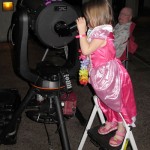
I am attempting to put down a few of the things I have learned in over a decade of hauling a telescope around. In that time I have used countless schoolyards as observatories, set my gear up at posh resorts, on the tee line of a driving range, outside the front door of Wal-Mart, across the fence from cows at a dude ranch, parking lots, city sidewalks and grassy lawns, under conditions both perfect and absolutely lousy for doing astronomy. Dealt with everything from drunks to two year olds, and I still do this regularly… It is worth every young smile!
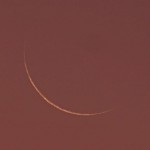
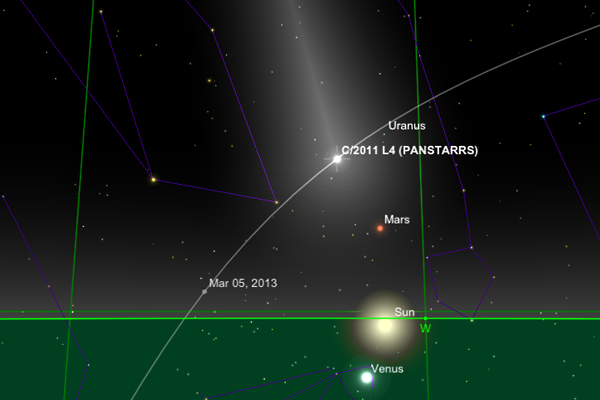
Today Comet C/2011 L4 (Pan-STARRS) will pass through perihelion, its closest approach to the Sun. Take a good look now, given the 110,000 year orbital period, the comet will not be back anytime soon.
The comet should be visible as a 1st magnitude object 13° above the horizon at sunset and directly above the glow of the setting Sun. It will climb higher each evening after passing through perihelion. It will begin to fade as well, most likely dimming below 4th magnitude by the end of March.
Now for a truly awful comet image.

It had been wonderfully clear all afternoon. It was just as the sky darkened that trouble appeared, a band of high clouds sweeping in from the west. Noooo!
The comet appeared in the STi guide camera right on schedule, my coordinates less than half a degree off! Not bad with a manual telescope mount offsetting from the Sun. The clouds swept over the comet a few minutes later, just as the tail was beginning to appear in the darkening sky.
I did grab a few images from the guide camera and snap a few frames with the DSLR. The monochrome CCD on the guider managed slightly better shots despite a fairly bright sky. I managed a few more frames as an opening appeared a few minutes after that. It is still an awful image. The only reason I could tell it was the comet is that it remained centered as the clouds swept through the image. Take my word for it, the barely there spot at the center of the photo is the comet.
At least my vehicle is fixed, a new alternator in place. Try again tomorrow?