
Tomorrow morning, on March 10th, the Moon and Mercury will form a close pair. The Moon will be a very thin crescent, only 1.75% illuminated. Mercury will be only 2° below, shining at 2.7 magnitude. The pair will rise about 05:38HST, and will be 12° above the horizon at sunrise.
Mercury Appears in the Dawn
Mercury will begin a morning apparition this week. The planet is currently about 10° above the rising Sun, climbing higher each morning. Look for a 2nd magnitude star-like object just above the glow of dawn. Mercury will reach a maximum elongation of 28° on March 31st.
Tomorrow morning, March 10th, the planet will be just 2° below a razor thin Moon. The Moon will be about 1.7% illuminated and will rise at 05:38HST, just 14° and about and hour ahead of the Sun.
200,000
Another large, arbitrary number… I have rolled the odometer on my 1995 Ford Explorer past 200,000 miles. It occurred when driving back from counting whales along the Akoni Pule highway north of Kawaihae.

I remember worrying when I bought the vehicle, $23,000 was a lot of money to me back then, would I get to use the vehicle enough to make it worthwhile. Would I end up wrecking the vehicle in the first year? Would it be stolen or experience some horrible break down? Two hundred thousand miles later I can answer that question.
Postcard from the Reef – Pebble Crab

Keck Observatory Completes $4 Million Adaptive Optics Fund
W. M. Keck Observatory press release…
The W. M. Keck Observatory has successfully completed a $4 million campaign that will give astronomers the most detailed Adaptive Optics images of the cosmos ever created by mankind. Furthermore, the campaign was funded entirely by private philanthropy.
The Gordon and Betty Moore Foundation, the W. M. Keck Foundation and The Bob & Renee Parsons Foundation awarded three grants totaling $3.7 million to significantly upgrade the Keck II Laser Guide Star Adaptive Optics (LGS AO) system. The balance of the campaign came from individual gifts from Friends of the Keck Observatory.
Continue reading “Keck Observatory Completes $4 Million Adaptive Optics Fund”
Gold Lace

Comet C/2011 L4 Pan-STARRS Closest to Earth
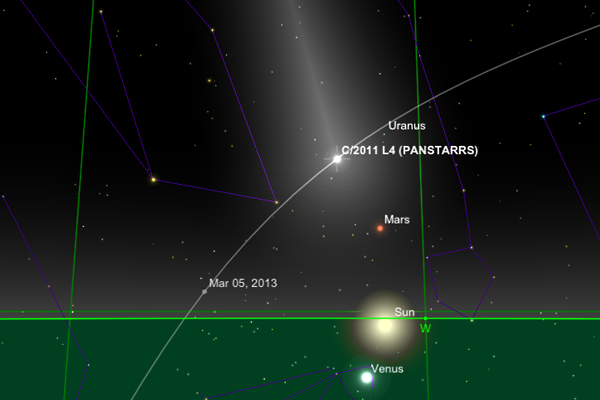
Today Comet C/2011 L4 (Pan-STARRS) will make its closest approach to Earth. Not that that is saying too much, close approach will be 1.09 AU or about 101,300,000 miles, just over the average distance from the Earth to the Sun. In contrast Comet C/2012 S1 (ISON) will approach us to closer than half that distance, about 0.42 AU or 39,000,000 miles from Earth on December 26th, 2013.
The comet should be visible as a 2nd magnitude object 7° above the horizon and a little south of the Sun at sunset. It will climb higher each evening, passing through perihelion, close approach to the Sun on March 10th.
Astronomers Open Window Into Europa’s Ocean
W. M. Keck Observatory press release…
With data collected from the W. M. Keck Observatory, California Institute of Technology (Caltech) astronomer Mike Brown — known as the Pluto killer for discovering a Kuiper-belt object that led to the demotion of Pluto from planetary status — and Kevin Hand from the Jet Propulsion Laboratory (JPL) have found the strongest evidence yet that salty water from the vast liquid ocean beneath Europa’s frozen exterior actually makes its way to the surface.
The data suggests there is a chemical exchange between the ocean and surface, making the ocean a richer chemical environment, and implies that learning more about the ocean could be as simple as analyzing the moon’s surface. The work is described in a paper that has been accepted for publication in the Astronomical Journal.
The findings were derived from spectroscopy delivered from the Keck Observatory, which operates the largest and most scientifically productive telescopes on Earth.
“We now have the best spectrum of this thing in the world,” Brown says. “Nobody knew there was this little dip in the spectrum because no one had the resolution to zoom in on it before.”
Continue reading “Astronomers Open Window Into Europa’s Ocean”
Mercury at Inferior Conjunction
Today the planet Mercury passes through inferior conjunction, passing between the Sun and the Earth. In a week or so the planet will again be visible in the dawn sky, climbing higher each day. Maximum elongation will occur March 31st.
Comet C/2011 L4 Pan-STARRS
Like so many other amateur astronomers, I am eagerly awaiting the appearance of Comet C/2011 L4 Pan-STARRS.
The comet was discovered in June of 2011, by the Pan-STARRS survey telescope atop Haleakala, Maui. The comet will pass closest to earth on March 5th, at a distance of 1.09 au. Perihelion, the comet’s closest approach to the Sun, occurs early on March 10th UT.

Initial predictions were quite optimistic with this comet, indicating a possible -1 magnitude for the comet. Reality seems to be somewhat more restrained, with a peak somewhere between magnitude one and two being more likely. Reports indicate that the comet has brightened to about 2nd magnitude, bright enough to be easily seen without optical aid.
Even more convenient, the comet will be well placed for observation this coming weekend. With new moon occurring on March 11th, this will be the prime weekend for a telescope outing. Amateur astronomers everywhere are already planing for this weekend. Our local club is no exception, expect a good crowd of telescopes to be at the Mauna Kea VIS this weekend. Myself? I will probably setup at the Substation site, just across the road from the VIS. The site offers a much better western horizon, which is blocked from the VIS by a line of pu’u, old cinder cones.
I will be taking photo gear, looking to get a decent photo of the comet. Stay tuned to Darker View to see the results if I meet with any success.
The latest orbital elements from the MPC
Another interesting opportunity will come on March 12th, when a slim crescent Moon will join the comet in the sky. A 1.4 day old moon, about 2% illuminated will be about 4° north (to the right) of the comet.