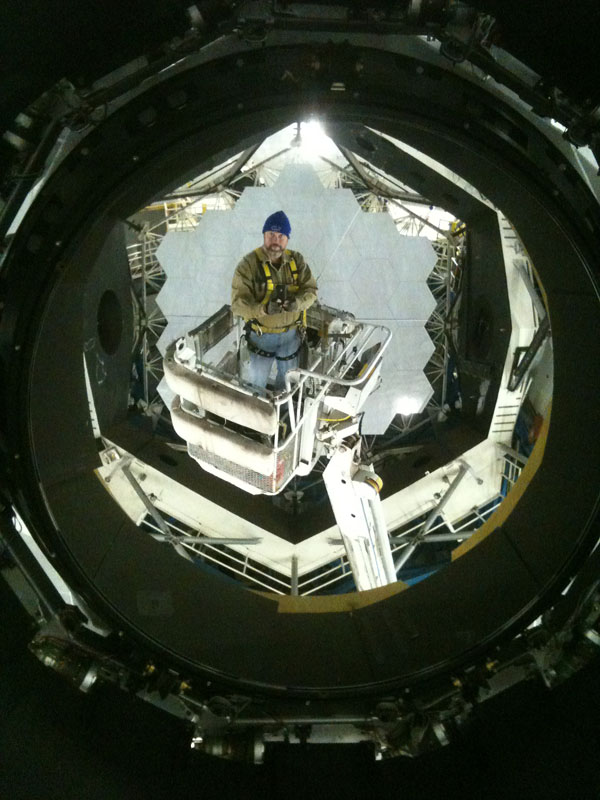
I am kicking myself that I only had the iPhone along in the basket. This has to be one of the most epic selfies. In a quick web survey of epic selfies, I find I am a distant second to one taken by Aki Hoshide.
When you want to see the stars, find someplace dark

I am kicking myself that I only had the iPhone along in the basket. This has to be one of the most epic selfies. In a quick web survey of epic selfies, I find I am a distant second to one taken by Aki Hoshide.
In the fable of the town and country mice, the country mouse visits his city-dwelling cousin to discover a world of opulence. In the early cosmos, billions of years ago, galaxies resided in the equivalent of urban or country environments. Those that dwelled in crowded areas called clusters also experienced a kind of opulence, with lots of cold gas, or fuel, for making stars.
Today, however, these galactic metropolises are ghost towns, populated by galaxies that can no longer form stars. How did they get this way and when did the fall of galactic cities occur?
A new study from NASA’s Spitzer Space Telescope finds evidence that these urban galaxies, or those that grew up in clusters, dramatically ceased their star-making ways about 9 billion years ago (our universe is 13.8 billion years old). These galactic metropolises either consumed or lost their fuel. Galaxies in the countryside, by contrast, are still actively forming stars.
“We know the cluster galaxies we see around us today are basically dead, but how did they get that way?” wondered Mark Brodwin of the University of Missouri-Kansas City, lead author of this paper, published in the Astrophysical Journal. “In this study, we addressed this question by observing the last major growth spurt of galaxy clusters, which happened billions of years ago.”


Join us for a free astronomy lecture at Waimea’s Kahilu Theater…

Andrew Howard – University of Hawai’i
Kahilu Theatre
Thursday November 21, 2013
07:00 pm – 08:00 pm
Andrew Howard, astronomer from the University of Hawaii’s Institute for Astronomy, will give an illuminating talk about the hunt for exoplanets and the quest for another Earth. Since 1995, more than 3,000 exoplanets have been discovered. Many of these planets look nothing like the planets of our Solar System — strange orbits, unusual compositions, and unknown beginnings. Dr. Howard will tour this diverse landscape of exoplanets, including the recent discoveries of planets the size of Earth.

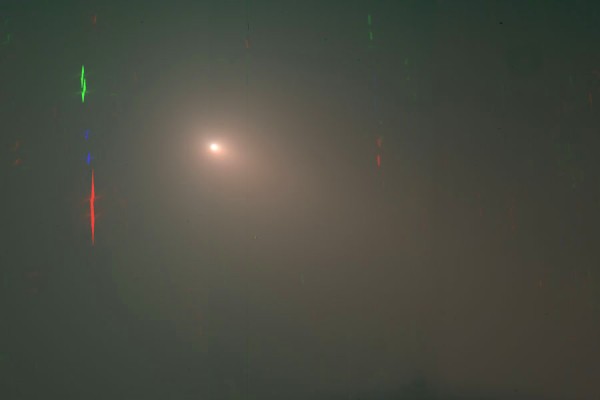
After our comet ISON observing session I have been asked what it is like to take a comet photograph with Keck. An apt question as all of the recent observers were taking spectra, not photos.
The answer? Not very pretty.
A few years back Greg Wirth and I took some frames of comet Hartley 2 with Keck 2. When I processed the frames into a color photo the results were less than impressive.
Comets are big. While the nucleus is quite small, we do not see the nucleus even with the enormous power of a 10 meter telescope. It is hidden in the coma and quite dark, the average nucleus is a shade of dark gray equivalent to charcoal.
The coma and tail are very extended, much larger than the field of view of the telescope, thus the entire frame is inside the coma. The photo of Hartley 2 Greg and I took was no exception.. The image is notable for its complete lack of any interesting structure. There are no jets, shells or other inner coma detail visible. The tail is simply a general brightening to the southwest (lower right in this image).
Small telescopes, in the hands of amateurs, are going to produce the prettiest images of comets. With fields of view measured in degrees, not arcminutes, the comet is going to be seen in all its glory.
W. M. Keck Observatory press release…
A team of astronomers has found the first Earth-sized planet outside the solar system that has a rocky composition like that of Earth. This exoplanet, known as Kepler-78b, orbits its star very closely every 8.5 hours, making it much too hot to support life. The results are being published in the journal Nature.

Every 8.5 hours the planet passes in front of its host star, blocking a small fraction of the starlight. These telltale dimmings were picked up by researchers analyzing the Kepler data.
The team led by Dr. Andrew Howard (Institute for Astronomy, University of Hawaii at Manoa) then measured the mass of the planet with the Keck Observatory on Mauna Kea, in Hawaii. Using the ten-meter Keck I telescope fitted with the HIRES instrument, the team employed the radial velocity method to measure how much an orbiting planet causes its star to wobble, to determine the planet’s mass. This is another excellent example of the synergy between the Kepler survey, which has identified more than 3,000 potential exoplanet candidates, and Keck Observatory, which plays a leading role in conducting precise Doppler measurements of the exoplanet candidates.
We put it together in very short notice. Fortunately a webcast is pretty easy to put together.
Keck is hosting a sizable team of folks who are here to observe comet ISON. Astronomers from several institutions are participating in the NASA Comet ISON Observing Campaign. They have a total of 6½ nights, but only the last few hours of each night as the comet rises in the dawn. Comet C/2012 S1 ISON is starting to encounter significant publicity, we may as well take advantage of this.
It was a lot of fun. I particularly like the spot (41:00) where I made the mistake of saying spectra were not very pretty to look at in a room full of spectroscopists. These folks love spectra and quickly corrected me, leading to a nice discussion on why spectra are so valuable to astronomy, often more valuable than photos.
The video is embedded below. A lot of good information about comet ISON, indeed about comets in general. Nothing like having a room full of comet experts…
Supposedly twins, each of our two telescopes has its own peculiar personality. Anyone who works on the crew can tell the telescopes apart at a glance. I do not need the caption to know this is Keck 1. Each telescope has a unique configuration, a unique set of instruments, plus many little differences that take time to appreciate and come to love…
