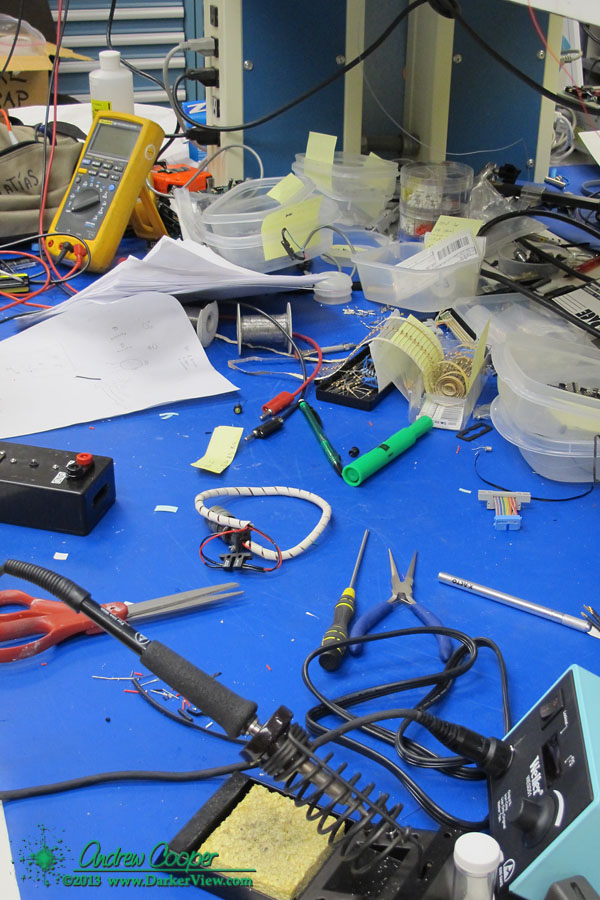
Postcard from the Summit – The Usual Mess
When you want to see the stars, find someplace dark


It is just two weeks away!
All the planning does seem to be coming together thanks to the hard work of some of our Keck staff. It should be a great event for all!
For information just go to the W. M. Keck Observatory website.

With an upcoming open house, everyone around the observatory is frantically trying to get everything in place. There will be all manner of science exhibits throughout the observatory headquarters complex. Exhibits about our research, controlling the telescopes, an IR camera display (Get your portrait in IR!), liquid nitrogen ice-cream, just a lot of fun.
When attempting to teach something, a little eye-candy is helpful to catch the attention of the audience, particularly kids. Our group includes a laser engineer and a laser tech, so the use of lasers was obvious. There is little that catches the eyes of a kid faster than a bright laser beam. One of the first ideas they tossed on the table was a laser spirograph. After a few moments thought the answer was clear… I can build that!

The moorish idol (Zanclus cornutus) is one of the most memorable fish on a Hawaiian reef. They are commonly seen grazing along the open reef in shallow water. I often find these fish in caves as well, which seems quite odd as few daytime fish venture into the dark. The sponge and algae covered walls apparently provide good grazing.

Mercury will exit the evening sky this week. Currently about 10° above the setting Sun, it will quickly orbit back into the Sun’s glare. It will pass through inferior conjunction on March 4th to reappear in the dawn around March 10th.

At some points there were half a dozen different groups of whales in sight at the same time. The spotters called whale activity in a confusing chorus of activity and locations. The annual Hawaiian Islands Humpback Whale National Marine Sanctuary Ocean Count picked a pretty good day. Given the recent winter storm I had half expected to be rained out, some of the east Hawai’i sites were, but we had perfect conditions.
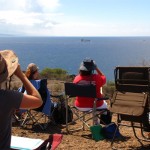
Not that we always needed to look that far, often enough the whales were at the base of the bluff, just a few hundred yards below us. In one half hour data interval we counted 24 breaches. Just a few whales around.
No argument, it was a good morning to be counting whales. From the looks of the preliminary results, our site counted far more whales than any other site across the islands. No surprise, this stretch of coast is always thick with whales. The only sites that challenge MM7 are the sites just north and south, Lapakahi and Pu’ukohola Heiau, from the data those folks had a good day as well.