Caltech Scientists Detects First Progenitor of Type 1b Supernova

W. M. Keck Observatory press release

Powerful new survey telescopes led by the California Institute of Technology (Caltech) are being combined with the W. M. Keck Observatory to provide insight into rare, exotic cosmic explosions. Caltech’s intermediate Palomar Transient Factory (iPTF) recently described the first direct detection of the progenitor of a rare type of supernova in a nearby galaxy. The findings were published n the September 20 issue of Astrophysical Journal Letters [http://dx.doi.org/10.1088/2041-8205/775/1/L7].

The paper describes the detection of a Type Ib supernova, a rare explosion in which the progenitor star lacks an outer layer of hydrogen, the most abundant element in the universe. It has proven difficult to pin down which kinds of stars give rise to Type Ib supernovae. One of the most promising ideas, according to graduate student and lead author Yi Cao, is they originate from Wolf-Rayet stars. These objects are 10 times more massive and thousands of times brighter than the Sun and have lost their hydrogen envelope by means of very strong stellar winds. Until recently, no solid evidence existed to support this theory. Cao and colleagues believe that the young supernova they discovered, iPTF13bvn, occurred at a location formerly occupied by a likely Wolf-Rayet star.

Supernova iPTF13bvn was spotted on June 16, less than a day after the onset of its explosion. With the aid of the world-leading adaptive optics system installed on the Keck II telescope, one of Keck Observatory’s two 10-meter telescopes in Hawaii, the team obtained a high-resolution image of this supernova to determine its precise position. Then they compared the Keck Observatory image to a series of pictures of the same galaxy (NGC 5806) taken by the Hubble Space Telescope in 2005, and found one starlike source spatially coincident to the supernova. Its intrinsic brightness, color, and size — as well as its mass-loss history, inferred from supernova radio emissions — were characteristic of a Wolf-Rayet star.

“All evidence is consistent with the theoretical expectation that the progenitor of this Type Ib supernova is a Wolf-Rayet star,” said Cao. “Our next step is to check for the disappearance of this progenitor star after the supernova fades away. We expect that it will have been destroyed in the supernova explosion.”

Though Wolf-Rayet progenitors have long been predicted for Type Ib supernova, the new work represents the first time researchers have been able to fill the gap between theory and observation, according to study coauthor and Mansi Kasliwal from the Carnegie Institution for Science. “This is a big step in our understanding of the evolution of massive stars and their relation to supernovae,” she said.

The iPTF builds on the legacy of the Caltech-led Palomar Transient Factory (PTF), designed in 2008 to systematically chart the transient sky by using a robotic observing system mounted on the 48-inch Samuel Oschin Telescope on Palomar Mountain near San Diego, California. This state-of-the-art, robotic telescope scans the sky rapidly over a thousand square degrees each night to search for transients.
Astronomers Discover Most Distant Known Galaxy

W. M. Keck Observatory press release

University of Texas at Austin astronomer Steven Finkelstein has led a team that has discovered and measured the distance to the most distant galaxy ever found, using the W. M. Keck Observatory on the summit of Mauna Kea, Hawaii. The galaxy is seen as it was at a time just 700 million years after the Big Bang. The result will be published in the Oct. 24 issue of the journal Nature.

Initial observations from NASA’s Hubble Space Telescope identified many candidates for galaxies in the early universe, but this galaxy is the earliest and most distant definitively confirmed, using the 10-meter, Keck I telescope fitted with Keck Observatory’s newest instrument, MOSFIRE.

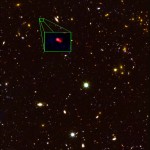
Hubble Galaxy z8_GND_5296
This image from the Hubble Space Telescope CANDELS survey highlights the most distant galaxy in the universe with a measured distance, dubbed z8_GND_5296. Credit: V. Tilvi, S.L. Finkelstein, C. Papovich, A. Koekemoer, CANDELS, and STScI/NASA
What makes this distance so exciting, is “we get a glimpse of conditions when the universe was only about 5 percent of its current age of 13.8 billion years,” said Casey Papovich of Texas A&M University, second author of the study.

Astronomers can study how galaxies evolve because light travels at a finite speed, about 186,000 miles per second. Thus when we look at distant objects, we see them as they appeared in the past. The farther astronomers can push their observations, the farther into the past they can see.

“We want to study very distant galaxies to learn how they change with time,” Finkelstein said. “This helps us understand how the Milky Way came to be.”

The devil is in the details, however, when it comes to making conclusions about galaxy evolution, which means astronomers must employ the most rigorous methods and utilize the most powerful instruments to measure the distances to these galaxies in order to understand at what epoch of the universe they are seen.

The Hubble CANDELS survey uses colors from HST images to identify potentially distant galaxies. Finkelstein’s team selected z8_GND_5296, and dozens of others, for follow-up spectroscopy from the approximately 100,000 CANDELS galaxies. This method is good, but not foolproof, Finkelstein says. Using colors to sort galaxies is tricky because more nearby objects can masquerade as distant galaxies.

In order to accurately determine the distance to these galaxies, astronomers use spectroscopy to measure how much a galaxy’s light wavelengths have shifted toward the red end of the spectrum over their travels from the galaxy to Earth. This phenomenon is called “redshift”, and is due the expansion of the universe.

The team used Keck Observatory’s Keck I telescope in Hawaii, one of the two largest optical/infrared telescopes in the world, to measure the redshift of z8_GND_5296 at 7.51, the highest galaxy redshift ever confirmed. The redshift means this galaxy hails from a time only 700 million years after the Big Bang.

MOSFIRE
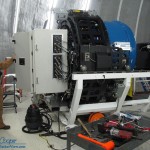
Mark Kassis stands beside the MOSFIRE spectrograph
Keck I was fitted with the new MOSFIRE instrument, which made the measurement possible, Finkelstein said. “The instrument is great. Not only is it sensitive, it can look at multiple objects at a time,” he said, which allowed his team to observe 43 galaxies in only two nights at Keck Observatory, and obtain the highest quality observations possible.

In addition to its great distance, the team’s observations showed that the galaxy z8_GND_5296 is forming stars extremely rapidly — producing stars at a rate 150 times faster than our own Milky Way galaxy. This new distance record-holder lies in the same part of sky as the previous record-holder (redshift 7.2), which also happens to have a very high rate of star-formation.

“So we’re learning something about the distant universe,” Finkelstein said. “There are way more regions of very high star formation than we previously thought. … There must be a decent number of them if we happen to find two in the same area of the sky.”

In addition to their studies with Keck, the team also observed z8_GND_5296 in the infrared with NASA’s Spitzer Space Telescope. Spitzer measured how much ionized oxygen the galaxy contains, which helps pin down the rate of star formation. The Spitzer observations also helped rule out other types of objects that could masquerade as an extremely distant galaxy, such as a more nearby galaxy that is particularly dusty.

Other team members include Bahram Mobasher of the University of California, Riverside; Mark Dickinson of the National Optical Astronomy Observatory; Vithal Tilvi of Texas A&M; and Keely Finkelstein and Mimi Song of UT-Austin.

Telescopes Large and Small Team Up to Study Triple Asteroid

W. M. Keck Observatory press release

Combining observations from the world’s largest telescopes with small telescopes used by amateur astronomers, a team of scientists discovered that the large main-belt asteroid (87) Sylvia has a complex interior, thanks to the presence of two moons orbiting the main asteroid, and probably linked to the way the multiple system was formed. The findings are being revealed today, October 7, at the 45th annual Division of Planetary Sciences meeting in Denver, Colorado.

Sylvia Artist Impression
Artistic representation of the triple asteroid system showing the large 270-km asteroid Sylvia surrounded by its two moons, Romulus and Remus. Credit: Danielle Futselaar/SETI Institute
This work illustrates a new trend in astronomy in which backyard amateur astronomers team up with professional astronomers to expand our knowledge of our solar system. The study of multiple asteroids such as (87) Sylvia gives astronomers an opportunity to peek through the past history of our solar system and constrain the internal composition of asteroids. The two moons of (87) Sylvia were discovered in 2005.

The team, led by Franck Marchis, senior research scientist at the Carl Sagan Center of the SETI Institute, has continued to observe this triple asteroid system by gathering 66 adaptive optics observations from 8-10m class telescopes including those at the W. M. Keck Observatory, the European Southern Observatory, and Gemini North.

“Because (87) Sylvia is a large, bright asteroid located in the main belt, it is a great target for the first generation of adaptive optics systems available on these large telescopes. We have combined data from our team with archival data to get a good understanding of the orbits of these moons,” Marchis said.

Continue reading “Telescopes Large and Small Team Up to Study Triple Asteroid”

Watery Asteroid Discovered in Dying Star Points to Habitable Exoplanets

W. M. Keck Observatory press release

Astronomers have found the shattered remains of an asteroid that contained huge amounts of water orbiting an exhausted star, or white dwarf. This suggests that the star GD 61 and its planetary system – located about 150 light years away and at the end of its life – had the potential to contain Earth-like exoplanets.

The new research findings used data collected from NASA’s Hubble Space Telescope, both of W. M. Keck Observatory’s Keck I and Keck II telescopes, as well NASA’s FUSE telescope, and are reported today in the journal Science.

Watery Asteroid
Artist impression of a rocky and water-rich asteroid being torn apart by the strong gravity of the white dwarf star GD 61. Credit: Copyright Mark A. Garlick, space-art.co.uk, University of Warwick and University of Cambridge.
This is the first time both water and a rocky surface – two key ingredients for habitable planets – have been found together beyond our solar system.

Earth is essentially a “dry” planet, with only 0.02% of its mass as surface water, meaning oceans came long after it had formed; most likely when water-rich asteroids in the solar system crashed into our planet.

The asteroid analyzed is composed of 26% water mass, very similar to Ceres, the largest asteroid in the main belt of our solar system. Both are vastly more water-rich compared with Earth.

The new discovery shows the same water delivery system could have occurred in this distant, dying star’s solar system – as latest evidence points to it containing a similar type of water-rich asteroid that would have first brought water to Earth.

Astronomers at the Universities of Cambridge and Warwick say this is the first “reliable evidence” for water-rich, rocky planetary material in any extrasolar planetary system.

Continue reading “Watery Asteroid Discovered in Dying Star Points to Habitable Exoplanets”

Night Logs

Keck tracks every night with a custom, in-house database. These form a complete log of what occurred every night… The routine, the problems, the small disasters of operating a complex facility on top of a mountain. Reading these logs every morning is a ritual for many of the staff. A synopsis arrives in our e-mail each day, to be read on an iPad over breakfast, or as soon as you sit down at your desk.

Keck 1 Operator's Station
The Keck 1 telescope operator’s consoles in the night during laser AO observing
For many in the operations department the contents of the logs set the pattern of the day. Was this a quiet night with no issues? Or is this a day when you need to drop everything to address some serious problem on the mountain?

Below is a typical night log from a quiet night. Reading through the logs each morning reveals much about the inner workings of the observatory. Who was working the night, the visiting astronomers and their subject of study. The logs also contain a number of statistics that are used to monitor the performance of the observatory.

Continue reading “Night Logs”

Snow on the Mountain

Winter might just be starting in Hawai’i. A fall storm dropped the season’s first snow on the summit of Mauna Kea this afternoon. Not much, just enough to turn the summit white. I had to scrape the frozen snow from the windshield to free the wipers before I could drive down.

We got 1.2″ of rain at the house, quite a bit when you consider we get 10″ a year in the shadow of the mountain. I am headed back to the summit tomorrow morning, wondering what we will find, this storm is just starting.

Snow on Mauna Kea
A light snowfall marks the start of winter on Mauna Kea.

Warped

Warping is not much fun. Warping is now on my list of responsibilities. At least I know I am accomplishing something critical to the operation of the telescope.

Segment
A Keck mirror segment after stripping and cleaning, ready to place in the chamber to receive a new reflective coating
Warping is a process of tuning the performance of a mirror segment after a segment exchange. A segmented mirror offers large advantages over a monolithic mirror, not least of which is the ability to swap a few segments out for re-coating and refurbishment without the weeks of downtime needed to re-coat a monolithic mirror. Throughout the summer Keck schedules a couple days of SegEx each month, so that at the end of the summer we have a completely clean and re-coated mirror.

Exchanging segments does require some interesting procedures to realign each new segment, each must be warped and the edge sensors tuned. The first few hours of the night after a SegEx is used to evaluate the performance of the newly replaced segments. Using a special alignment camera system the optical figure of each segment can be evaluated and a set of corrections generated to be applied the next day… Warping.

Keck Segment Types
A map of the segment types in the Keck primary mirror
There are six segment types that make up the primary mirror, each with the slightly different curve needed to make up the correct part of the hyperbolic curve. In theory the segments are interchangeable, any type four can be swapped with any other type four. This works… With a little help. It is necessary to adjust the figure of each segment, just slightly, to tune the figure of each segment for its place in the array.

To apply the correct pressure there are small knobs and screws at specific points in the whiffle tree. Each adjustment point also contains a strain gauge, allowing the applied pressure to be measured precisely. A computer and analog interface allows all of the points to be read out and checked against the calculated values.

Warping Computer
the warping computer set up in the subcell
There are thirty adjusters and strain gauges on the back of each mirror segment. The problem is that you can not simply adjust each one. Adjustment of one point affects all of the nearby points, particularly if the adjustment is large. Typically it is necessary to go around three times before the segment is properly warped. Thirty adjustments becomes ninety. Three segments in a day becomes 270 knobs to turn, 540 over two days, a lot of knobs.

After setup, it takes about an hour to do each segment, an hour of painstaking frustration. the mirror cell is just the right height, too high to sit down and reach the knobs, too low to stand up fully. Working in a jungle gym of frigid steel just makes it worse. A day in the mirror cell is a nice recipe for a tired and sore body.

How careful was I? Did I get all of the points set correctly? The computer is displaying all of the correct numbers. I will not know until the next day, when the night’s performance data is reduced, when we can see the figure of the primary mirror and check the errors.

My first warp is a success, most of the segments show less than 20nm rms error. Next SegEx there are only two segments being exchanged, but Sergey is threatening to have two others re-warped to address some lingering issues. Four? Better than six. Only 360 adjustments to make, more or less.