Halloween Sidewalk Astronomy

For many years it has been my tradition to setup a telescope on Halloween. A tradition I have inherited from other amateur astronomers, a tradition I intend to continue.
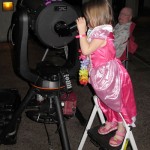
Princess at the Telescope
A Halloween princess looking through the telescope while we were set up at the King’s Shops
Unfortunately there are few trick-or-treaters in my own neighborhood. We are somewhat at the end of the street and at the top of the hill.

Looking for an alternative to setting up in the driveway, as I have in the past, I instead arranged to setup at the King’s Shops in the resort at the bottom of the hill. The shops make an evening of it, with various entertainment and activities arranged for children and adults. Contacting the Kings Shops management I was able to arrange permission to set up a few telescopes for the evening.

Cliff and Maureen volunteered to join me, bringing more gear. We had a few other club folks drop by. Also helping out were Dean and Melinda Ketelsen, fellow Tucsonans who share the Halloween telescope tradition and happen to be visiting for the week.

Unfortunately clouds hampered us in the early evening. As usual these cleared as the night progressed so that by 8:30pm we had a mostly clear sky. Moonrise provided a beautiful view, followed by Jupiter. There was a steady flow of folks checking out the telescopes. Princesses, Batman, ninjas and more had views of Alberio, Andromeda and other celestial objects. A fun evening for everyone, mixing in just a bit of science education, just what sidewalk astronomy is all about.
Database Work

I have spent quite a few hours lately revamping my observation database. The whole thing had been quite neglected as of late, never being properly updated since I changed over to WordPress on the main blog. The appearance had been left in a halfway state that didn’t match anything, never mind some serious bugs.

HCG88
Overlayed DSS image of HCG88. These overlays are generated on-the-fly using the object data.
In addition to adding all of my recent observations at the telescope, I have redone the style sheets. You can now select white-on-black, black-on-white, or night vision red, just look for the pull-down menu on the object page.

The printable version is still there, a clean black-on-white layout including inverted DSS images for printing. I took a cue from that printed version and kept the other new layouts very clean and uncluttered in appearance.

There is a nearby object section that picks up any close by objects for quick reference. Some attention has been paid to the search routines for better usability.

Those are just the visible changes, much of the work has gone into the back end to improve the quality of the underlying data. The whole thing uses Python and Tk on my local machine, this gets converted to SQL and PHP for the webserver. Most of the tools are automated at this point, and getting less buggy as I hunt down the little issues that I find with use.

I put the whole thing together for my own use, a place to organize my observing notes. But as it is online, anyone can use it. Let me know if you ever find it useful.

Employment Opportunity at Keck – Senior Mechanical Engineer

W. M. Keck Position Announcement

The W. M. Keck Observatory seeks a Senior Mechanical Engineer to work under the direction of the TSD Senior Engineer to provide mechanical engineering and project management support, to develop new observatory capabilities and to upgrade existing observatory systems. This position is responsible for design, analysis, specification, and construction of high technology mechanical and opto-mechanical systems for precision telescope operations.

Segment Crane
the segment crane being lowered into place to remove a segment from a primary mirror
Qualifications for this position are:

  • B. S. Mechanical Engineering or equivalent.
  • >8 years of Mechanical Engineering experience, some experience with opto-mechanical devices, 3 years of which are in project/subcontract management and reporting.
  • Track record of precision designs of small and large scale mechanical components.
  • Competence with 3D computer aided design, finite element analysis, design for assembly and maintainability, product life cycle management, and reliability engineering.
  • Engineering process and configuration management experience.
  • Experienced use of modern manufacturing techniques.

To learn more and to apply please go to: http://keckobservatory.iapplicants.com/ViewJob-359943.html

Galaxies: some assembly required

Swinburne Observatory press release

New research using the world’s largest telescope at the Keck Observatory in Hawaii has revealed two distinct populations of star clusters surrounding galaxies that have radically different chemical compositions.

NGC6656
M22 or NGC6656 in Sagittarius, a classic globular cluster
An international team, led by Swinburne astronomers Christopher Usher and Professor Duncan Forbes, has measured the chemical composition of more than 900 star clusters in a dozen galaxies.

“This is ten times the number of star clusters previously examined, allowing us to confirm the existence of two chemically-distinct star clusters,” Mr Usher said.

Continue reading “Galaxies: some assembly required”

Large Binocular Telescope

A friend of mine, Dean Ketelsen is visiting the island with his wonderful wife, Melinda and a few family members. Dean grinds big glass for a living, as in 8.4m telescope mirrors for Steward Observatory. You can read about his various adventures at his personal blog.

Posted below is Dean’s latest time-lapse video of the LBT opening for a night of observing. I suspect he will be posting something similar of Keck in the near future. We toured the telescopes today and he had a chance to setup the camera while the guys swung the ‘scope around a bit.

I have visited the LBT, many years ago before it was completed. Even without the dual 8.4 meter primary mirrors it was an impressive facility.

Mercury at Maximum Elongation

Today Mercury reaches maximum elongation, the furthest point it will reach from the Sun in the sky and the highest it will be above the sunset this apparition. The planet is easily visible as a bright, starlike object about 15° above the setting Sun as the sky grows dark. Over the next couple weeks Mercury will slide back into the sunset, heading for inferior conjunction on November 17th.

Continue reading “Mercury at Maximum Elongation”

Reminder Keck Lecture Tonight

Keck Astronomy Lecture

Dr. Ben Zuckerman
University of California at Los Angeles
Violent Events in Rocky Planetary Systems: Implications for the fate of technological civilizations

Keck 2
Looking into the optics of the Keck 2 telescope
Thursday, October 25, 2012
7:00 PM
Gates Performing Arts Center Auditorium
Hawaii Preparatory Academy
65-1692 Kohala Mtn. Rd., Waimea

This evening, Dr. Ben Zuckerman of UCLA, will take us on a journey describing Earth’s formation 4.6 billion years ago to its possible demise 4-5 billion years from now. Along the way, we will consider a few tumultuous eras suffered by Earth’s biosphere, including the present. Such eras, from origins to final resting places, can be explored by understanding astronomical studies of other planetary systems. These systems also provide clues for the long-term fate of our technological civilization and the likelihood, or lack thereof, of civilizations beyond our own.

Seating is limited to first come, first served.
Doors Open at 6:30 PM
Free and Open to the Public