
Tomorrow morning, November 12th, Saturn will join a very thin Moon in the dawn. The pair will be at about the same elevation, 15° above the horizon at sunrise and about 4.5° apart. The Moon will be very thin, only 2.3% illuminated. Above the pair a brilliant Venus will shine at about 30° elevation at sunrise.
The Moon and Venus
A thin crescent Moon will rise in accompaniment with Venus tomorrow morning. A brilliant Venus, shining at -4.0 magnitude, will rise about 5.5° from a 7% illuminated Moon. The pair will rise about 04:10HST and be about 30° above the horizon at sunrise.
Mercury Exits the Evening Sky
Mercury is ending it’s last evening apparition of 2012. Over the next few days the planet will slide into the sunset heading for inferior conjunction on November 17th and begin a morning apparition beginning in waning days of November.
A Cometary Breakup
While Comet 168P Hergenrother may be a bit of a mouthful, it is the proper designation for an interesting comet. Discovered in 1998, the comet is one of dozens that orbit in the inner solar system. Normally inconspicuous objects, these comets orbit quietly, objects that only astronomers love, or even know about. You would normally have needed a substantial telescope to see 168P, shining very dimly at magnitude 15.5 at it’s brightest. A community of amateur astronomers keeps tabs on these comets, occasionally photographing them, updating the orbits.
As the comet approached perihelion during the beginning of October, it became apparent that something had happened. Several observers were reporting that the comet had brightened. Suddenly the comet was far brighter, eventually reaching near 8th magnitude, over 500 times brighter than expected. We have seen this sort of thing before, a cometary breakup. Observations from several large telescopes, including Gemini North here on Mauna Kea, showed that the comet has split into at least four pieces.
When a breakup occurs it exposes a great deal of fresh material and debris, dramatically adding to the supply of dust and gas in the coma and creating a far brighter object. It is not the comet itself we see, that is fairly small. It is the coma and tail, the cloud of dust and gas that reflects the sunlight and gives a comet the synonymous appearance.
Comet 168P Hergenrother currently sports a small fan shaped tail, easily visible in the telescope. We enjoyed this classic comet shape in the telescopes last new moon at the Mauna Kea VIS. Setting up a telescope and CCD camera last night allowed me to photograph the comet, appearing much the same as it did a few weeks ago.

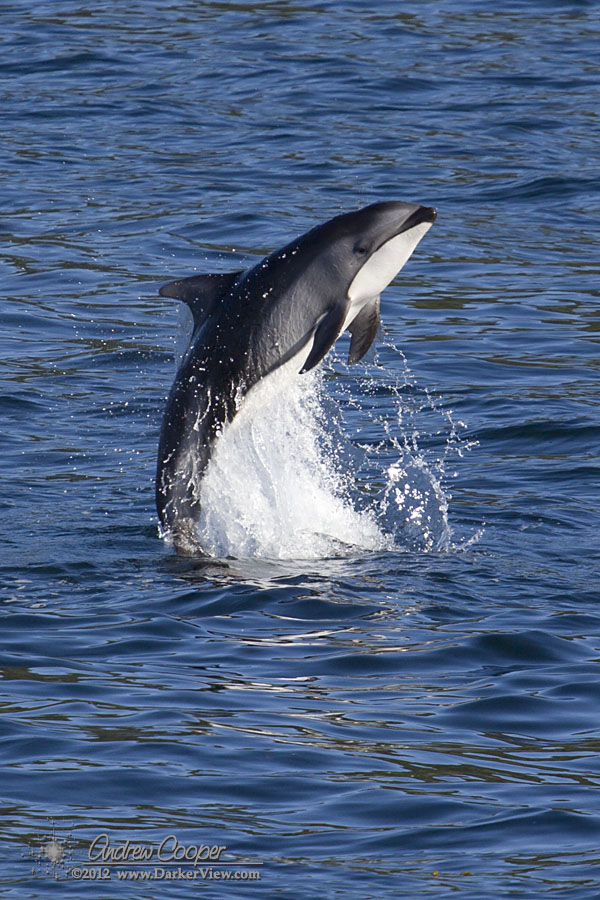
White-sided Dolphin
Postcard from the Summit – Walking to the True Summit
It has been many years since I last stood atop the summit of Mauna Kea, the true summit that is. A couple decades ago, while on vacation I walked to the summit as a tourist. All these years of driving past on the way to work, I have not stopped and taken the short walk to the summit of Mauna Kea from the road, until now.
Broken gear on a weekend, driving up the mountain by myself. Once the gear was fixed I was free to head back down. Without a vehicle full of guys just wanting to go home after a full day at work, I was free to stop and take a walk with the camera…

Saturn Appears in the Dawn
As Saturn emerges from solar conjunction it will appear in the dawn sky. This week the planet will become visible to alert skywatchers low in the sunrise sky. Saturn will dance with Mercury and Venus in the dawn during late November and early December. On November 26th, Venus and Saturn will be less than a degree from each other.
Postcard from the Summit – Island Volcano

Swinburne Team on Keck Discovers Farthest Supernova Ever
W. M Keck Observatory press release…
Two ‘super-luminous’ supernovae — stellar explosions 10–100 times brighter than other supernova types — have been detected in the distant Universe, using the W.M. Keck Observatory on the top of Mauna Kea in Hawaii. The discovery, reported online in Nature this week, sets a record for the most distant supernova yet detected, and offers the rare possibility of observing the explosions of the first stars to form after the Big Bang.

Super-luminous supernovae were discovered only a few years ago, and are rare in the nearby Universe. Their origins are not well understood, but a small subset of them is thought to occur when extremely massive stars undergo a nuclear explosion triggered by the conversion of photons into electron–positron pairs. Such events are expected to have occurred more frequently in the early Universe (at high redshift), when massive stars were more common. This, and the extreme brightness of these events, encouraged Cooke and colleagues to search for super-luminous supernovae at redshifts, z, greater than 2, when the Universe was less than one-quarter of its present age.
Continue reading “Swinburne Team on Keck Discovers Farthest Supernova Ever”
Comment Spam
Comment spam is always a problem when maintaining a blog, a constant battle. Generally one my readers do not see, as I have to manually approve any comment from a new commenter. As I have it setup now, once I approve a comment from a particular reader, any further comments they make get posted immediately. I do try to make it easy for my loyal readers.
But this does leave a list of messages in the approval que each day, until recently this was anywhere from a few to a dozen. In the last week the number has soared, to 30-50 spam comments each day. It becomes a real chore to delete them all.
Time to take the next step in the armaments race. I had two choices, disallow anything using an @gmail.com address as verification, or install a more sophisticated filtering software.
Just about every spam comment in the que is using a Gmail address for verification. So are a few of my loyal readers, folks I really do not want to cut off from commenting. These mail accounts are really convenient, for regular folks and the spammers.
Take the other choice? I will attempt to use a spam detection plugin for WordPress called Askimet. As of today it is installed and active, a test.
I do worry that legitimate comments will be lost. Please look to see your comment posts properly, if it does not, drop me a line and I will see if I can add you to the whitelist.