The W. M. Keck Observatory seeks a Senior Electronics Engineer to provide electronics engineering and project management support to develop new observatory capabilities and upgrades to our existing observatory infrastructure. Desired competencies include: sound electronics engineering and design skills, and demonstrated ability to plan and manage electronics and electro-mechanical systems projects. Ideal candidate should have excellent electronics engineering, design and project management skills, and should be a motivated self-starter who can manage multiple projects and priorities within a fast paced environment.
Working on the Keck 1 AO benchThe observatory operates two of the largest and most scientifically productive optical/infrared telescopes in the world. The twin 10-meter telescopes are located amidst several other world class observatories on the summit of Mauna Kea, at 13,796 feet above sea level on the Big Island of Hawaii, one of the premier sites for astronomy. The successful candidate will have the opportunity to join a skilled and deeply committed team of technical professionals who enable exciting and important astronomical discoveries.
Qualifications for this position include a Bachelor of Science in Electrical Engineering or equivalent and eight years of work experience performing design and documentation, analysis, fabrication, test, and troubleshooting of electronic and electromechanical systems.
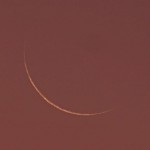
This one will be a challenge. This evening a very thin Moon may be visible just below Mercury as the Sun sets. The Moon will be a mere 1.3% illuminated and only 7° above the horizon at sunset. Mercury may provide a bit of a signpost that can be used to find the Moon. It will be located 2.5° directly above the Moon, shining at 2.8 magnitude. As Mercury is heading for inferior conjunction, it too is a thin crescent. The pair will be 10° south from the point at which the Sun slips below the horizon.
A very young moon over Waikoloa, this is only 26 hours after new, visible to the unaided eye as a sliver in the fading glow of sunsetNew Moon will occur today at 18:24HST.
It hits you as soon as you step through the front door. There is only one thought that describes it… tourist trap.
The Dole Plantation in Wahiawa, OahuThe signs are classic, you enter and exit through the gift shop. It isn’t a little gift shop either, but a large operation with every type of tacky tourist wares. This is a place where the tour buses stop. A place designed to extract as much money as possible in the short time available before the bus moves on to the next stop around the island.
I have been to tourist traps so kitschy they actually become fun. Between Benson and Wilcox, Arizona, along I-10 is The Thing. The place make no pretense about being a pure tourist trap. Admission to the museum that includes the namesake mummy/artifact/side-show-exhibit is actually quite cheap, $1 per person last time I was there. They obviously make the money in the gift shop. Beside The Thing itself, the little museum is surprisingly decent, with western memorabilia, wagons and old cars. If you take the place for what it is you can simply enjoy the experience, with some ice cream on the way out.
Pineapples in the demonstration garden at the Dole PlantationThe Dole Plantation is simply a tourist trap, without many redeeming features. They charge for most everything, the maze is $6/person, the train is $8, the garden tour is $5. Visit a couple spots and it quickly adds up. The prices in the gift shop are not much better. I had to laugh when I saw the prices for the small packages of macadamia nuts. You could buy twice as much of the same brand in any local supermarket.
There were a few simple signs in the garden that explained the history of the Dole pineapple empire and it’s founder, James Dole. The story is a fascinating example of a determined businessman who took a quiet local market and turned it into a global industry. It is a classic example of the plantation history of Hawai’i, with all of the good and ugly bits mixed in. Likely you will not learn much visiting the place. There was supposed to be something more of a museum here, if it still existed I could not find it behind all the tasteless merchandise. A bit of history, something real, anything would have created a more worthwhile stop. I guess it would just take up space that could be used for another rack of hula skirts.
I must admit it was not all bad… Walking through the garden Deb and I discovered the best part. There were cute little Carolina anoles all through the bromeliads. We must have spent half an hour chasing anoles trying to get good photos, with some success. The pineapple ice-cream float wasn’t so bad either.
Mercury is ending it’s second evening apparition of 2012. Over the next few days the planet will slide into the sunset heading for inferior conjunction on July 28th and a morning apparition beginning in the first days of August.
Mauna Kea is simply a great place to shoot astrophotos from. Dark, clear skies with typically good seeing. Unlike some mainland locations there is a distinct lack of aircraft overhead. I am not sure how many shots I have had ruined by the bright anti-collision strobes crossing through the frame when shooting from locations in Arizona.
There are hazards to shooting photos here that do not commonly exist elsewhere. I was unpleasantly surprised when reviewing the take the next morning to find brilliant yellow lines through a hour and a half of exposures taken of the Cygnus region. The material is otherwise great, the makings of a nice shot, except for this one little issue. There are ways of suppressing artifacts like this when processing, but the beam is so bright I am not certain they will work all that well.
Worse, I checked the schedule, the offending laser is coming from Keck 2 AO, a system I work on.
The observatories have a system in place to deal with this issue. There are four operational lasers on the mountain, Keck 1 and Keck 2, Subaru and Gemini. Each optical observatory using a laser maintains a server that posts their laser location, status, and calculates the position of each beam in the sky. This can be queried by the other observatories to check if the beam crosses the field of view. A set of rules has been negotiated to determine who has right of way, usually who is on target first.
Obviously this computer system does not take into account my little telescope shooting photos from Hale Pohaku. If I had known I could have called Heather and asked her to shutter her laser, I was on target first. Being the kind soul she is, she would probably laugh with me.
Rough processing of a single frame, Cygnus region, with the Keck 2 Adaptive Optics laser crossing through the frame
A morning conjunction of the three brightest objects in the night sky, the Moon, Venus and Jupiter on the morning of July 15, 2012, the Pleiades star cluster can be seen at the top
From a distance it looked like another common P. varicosa, a nudibranch I see all the time on the reef. Getting closer something was different. No protuberances, no yellow, what was it? Simply a juvenile that has not developed the full colors and pattern? Not knowing what it was I proceed to take a few photos of the critter.
Hitting the books it quickly becomes apparent, it was a P. sphingus I found and photographed. A new species for me! I carefully read through the descriptions of the various dorid nudibranch found in Hawai’i again. I need to look closer, there are some lookalikes to be aware of.
Sphinx Nudibranch (Phyllidiopsis sphingis) at 25′ depth, Puako
Five days, a quick island hop to Oahu, our first time exploring the island. A major feature of the plan was a bit of diving. Oahu features a number of unique dives we can not experience on the Big Island, particularly the wrecks. Based on conversations on ScubaBoard I chose to book with Gabe and Kaimana Divers. The reviews and comments of this dive op have been uniformly positive. After some experience I can second that opinion.
Along with a few changes of clothes and the cameras, we packed two full sets of dive gear. There would be five full days, including two days of diving. The basic plan each day was a two tank morning dive trip, a deeper wreck dive, followed by a shallower reef dive. The YO-257, the Corsair, there are several sites to choose from. On the Big Island we do have the SS Kauai at Mahukona, but scattered bits and pieces are not the same as a large intact ship.
Walking across the posh lobby of a luxury hotel with full dive gear over your shoulder is fun. Everyone looks in your direction, you can only guess at what they are thinking. It was 7am, meeting our ride to the marina. We were looking for our ride from Kaimana Divers in a big black pickup truck. Already in the truck were a couple from Texas and another fellow, five divers total, a nice small group.
We met Drew, our divemaster for the day. Like all divers we introduced ourselves, Jeannie and Charles lived near the gulf coast, but traveled regularly to dive under better conditions than local waters offered. Our fifth diver was somewhat less experienced, with a dozen dives behind him. We were all looking forward to this dive.
Surf and Surfers along the famous Waikiki breaks with Diamond Head in the backgroundHeading of of the marina we saw the first sign that perhaps not all was well… The surfers were out.
Dramatic breakers rolled across the famous Waikiki reefs, stretching from the marina to Diamond Head. There is an adage in the local dive community, if the surfers are happy, the divers are not.
Arriving over the wreck for the YO-257 there was a notable swell, while it was going to be a problem, it was diveable. Drew hopped in to secure the mooring line. Upon returning to the boat he reported a moderate current. We geared up and readied for the water.