Venus Transit

This is your last chance this lifetime to witness a Venus transit! On June 5th the Earth, Venus and the Sun will line up correctly so that earthbound observers will see Venus cross the disk of the Sun.

Mercury Transit
Mercury transiting the face of the Sun, 6 Nov 2006
Venus transits are relatively rare events, that occur in pairs1, with the paired events separated by eight years. Each pair is separated from the next pair in a predictable pattern, alternating 105.5 or 120.5 year gaps. The first transit of the current pair was in June 2004, with the 2012 event completing the pair. The next pair of events will begin in December 2117. Given the century long separation between events Venus transits have only occurred seven times since the invention of the telescope (1631, 1639, 1761, 1769, 1874, 1882 and 2004)2.

To witness this event you only need to be on the daylight side of our planet when it occurs. The 2012 event favors the Pacific, Australia, Japan and eastern Asia.

For Hawai’i the event will begin at about 12:10pm with the Sun high in the sky, mid-point will be about 3:26pm and will end about 6:44pm, just before sunset. These times are only approximate, exact times will depend on the observer’s location and can vary by several minutes across the islands.

As always the single best source on the web (or anywhere) for eclipse and transit information is Fred Espenak’s eclipse website at NASA. Stop by whenever you have a question on upcoming events as well as viewing and photography tips.

Keck Observatory will be making an extra effort for this transit as Mauna Kea is perfectly positioned to observe the event. We will be webcasting the transit from a small telescope located at the summit. The webcast can be seen on your computer, or come over to our headquaters in Waimea to see the webcast and a live view in a solar telescope if the weather cooperates. there will be extra staff on hand to answer your questions.

Stay tuned to DarkerView for further details as the transit draws near.

1) Transit of Venus, Wikipedia Article, retrieved 8 Feb 2009

2) 2004 and 2012 Transits of Venus, Fred Espenak, NASA/GSFC, NASA Eclipse Website, retrieved 8 Feb 2009

Employment Opportunity at Keck – Software Engineer

W. M. Keck Observatory position announcement…

Keck 1 Laser
Testing the Keck 1 laser under the light of a nearly full Moon
The W. M. Keck Observatory operates two of the world’s largest optical/infrared telescopes located on the summit of Mauna Kea on the Big Island of Hawaii. Each telescope is equipped with a full suite of instruments designed to perform exciting, cutting edge astronomical research.

The Observatory seeks a Software Engineer responsible for a variety of duties related to developing, deploying and optimizing software for control solutions used at the observatory and integration of partner developed science instruments. The successful candidate will enjoy a comprehensive benefits package while residing in one of the world’s most uniquely beautiful and diverse locations.

The candidate is expected to have a minimum of 5 years’ proven experience developing and integrating distributed control software solutions for engineering or scientific applications with involvement in all aspects of the software life cycle from specification through deployment.

The candidate is expected to have sound knowledge of modern software engineering practices. Practical experience in the following is required: strong C/C++ with significant O-O design and development; UNIX platform development environment using the gnu tool chain under Linux or Solaris; working with communication middleware such as RPC, RMI, ICE or messaging systems; working with real-time OS like VxWorks or RT Linux; User Interface development with Tcl/Tk, Java, Qt, Python or other toolkits.

The ideal candidate should be a motivated, self-starter who can collaborate effectively across disciplines in a fast paced environment. Experience working with EPICS at an astronomical observatory or high energy physics experiment facility and experience with driver development and motion control are highly desirable.

This position requires you to submit your resume on-line at: http://keckobservatory.iapplicants.com/ViewJob-304399.html with your cover letter that states why you are uniquely qualified for the position.

Additional information about WMKO and this position may be found on our web site at www.keckobservatory.org. EEO Employer

Postcard from the Universe – Telescopes

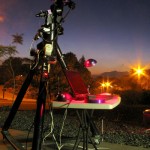
Two telescopes set up on the side of Mauna Kea. Olivier’s 12″ and my 18″ Deep Violet. A full night of deep sky observing under very nice conditions.

The photo was taken with a red LED light swept over the area during the 20 seconds of exposure. The camera had other ideas, set for automatic white balance it attempted to correct the color, fairly successfully. Surprising given the monochromatic nature of the light source.

As usual, click on the image for a larger version…

Mauna Kea Observing
Two telescopes set up under dark Mauna Kea skies

The Moon and Saturn

Saturn, the Moon and Spica will rise together in the east after sunset this evening. The three will be within 10° of each other. The Moon will be just short of full, over 94% illuminated as it rises. Saturn will be shining at 0.4 magnitude while Spica is very close to 1.0 magnitude.

Tomorrow night will see the Moon east of Saturn, but still close, just over 10°.

Student Engineering

It is always gratifying to see. Tangles of wire, zip ties, plastic and metal bent and warped into odd shapes, contraptions that occasionally come apart. They may not be pretty, buy they usually work. This is engineering!

Piloting an ROV
Students from Hawai'i Preparatory Academy pilot an ROV in the Big Island Regional MATE ROV Competition
The goal? To build and pilot and underwater ROV through a simulated mission. Not an easy task, actually downright difficult. That the engineers and pilots are elementary, middle and high school students makes the results that much more impressive.

This is the fourth year I have helped to judge the 2012 Big Island Regional MATE ROV Challenge. Back again, it is just too much fun to see what the students come up with. Last year I helped judge the technical presentations and posters. While that is OK, the action is in the pool. This year it was poolside judging, getting a first hand view of the event. I was not alone, Keck provided many of the judges for the 2012 event. An investment in the next generation of engineers and techs that will follow our path.

ROV
A student built ROV attempting a mission in the Hilo regional 2012 MATE ROV Competition
Most of the ROV’s followed the usual pattern we have seen each year. A box frame built of PVC pipe with bilge pump motors attached to provide maneuvering capability. Cameras provide the vehicles eyes. Indeed, the operators must control the craft with only the visuals on the display screen, no looking around into the pool.

The mission this year was to survey a shipwreck, a victim of war, an oil tanker lying on the bottom with the potential to create an environmental disaster. The students must survey the wreck, then attempt to remove a sample of the “oil” trapped within. No matter that the “oil tanker” is a frame of PVC pipes at the bottom of a swimming pool, this was a challenging mission.

There were a number of rookie teams this year. It showed, a rough day in the pool for several of the teams. Experience showed, those teams with a couple years of competitions behind them performed much better. It was Kealakehe that won the Ranger class title… again. Give the new guys another chance next year, and I think the competition will be much closer.

‘Ridiculously’ Dim Bevy of Stars Found Beyond Milky Way

W. M. Keck Observatory press release…

A team of American, Canadian and Chilean astronomers have stumbled onto a remarkably faint cluster of stars orbiting the Milky Way that puts out as much light as only 120 modest Sun-like stars. The tiny cluster, called Muñoz 1, was discovered near a dwarf galaxy in a survey of satellites around the Milky Way using the Canada-France-Hawaii Telescope (CFHT) and confirmed using the Keck II telescope, both of which are on Mauna Kea, Hawaii.

“What’s neat about this is it’s the dimmest globular cluster ever found,” said Ricardo Muñoz, an astronomer at the University of Chile and the discoverer of the cluster. A globular cluster is a spherical group of stars bound to each other by gravity so that they orbit around a galaxy as a unit.

“While I was working on the Ursa Minor dwarf galaxy I noticed there was this tiny little object close by,” Muñoz recalled. He made the discovery while he was a postdoctoral associate at Yale University. Most globular clusters have in the range of 100,000 stars. Muñoz 1 has something like 500 stars. “This is very surprising,” he said.

Muñoz 1
The Muñoz 1 globular cluster is seen to the right of the Ursa Minor dwarf galaxy in this image from the Canada-France-Hawaii Telescope MegaCam imager.

“It’s ridiculously dim,” agreed Yale astronomer Marla Geha. “There are individual stars that would far outshine this entire globular cluster.” That puts Muñoz 1 head-to-head with the Segue 3 globular cluster (also orbiting the Milky Way) as the dimmest troupe of old stars ever found.

Muñoz 1’s discovery was the result of a survey done with the CFHT MegaCam imager in 2009 and 2010. It was then confirmed by spectroscopic study using the Deep Extragalactic Imaging Multi-Object Spectrograph (DEIMOS) on the Keck II telescope. The researchers will be publishing their results soon in The Astrophysical Journal Letters.

The Keck data was critical for the study, said Geha, because it sorted out whether or not Muñoz 1 and the Ursa Minor dwarf galaxy were moving together.

“Nearly every galaxy has an entourage of globular clusters,” said Geha, “so we first thought that Muñoz 1 might be associated with the nearby Ursa Minor dwarf galaxy.” By using spectroscopic data to measure the relative velocities of the cluster and the dwarf galaxy, they discovered quite the opposite was the case.

“The velocities turned out to be wildly different,” said Geha. So the fact that they are near each other is just a coincidence, she said. What has been seen is more like a single snapshot of two cars traveling near each other and apparently together, but they really have different destinations and are traveling at very different speeds. Analysis of the brightness and colors of the stars belonging to Muñoz 1 and Ursa Minor also suggests that the tiny cluster is actually located about 100,000 light years in front of the dwarf galaxy.

As for how Muñoz 1 came to be so dim, a likely scenario is that it has gradually lost stars over the eons, said Geha. It’s also possible it was stripped of stars by passing through the Milky Way. But the direction of the cluster’s movement is not yet known, so it’s not known whether it has passed through the Milky Way.

Perhaps the most intriguing aspect of the discovery is the possibility that Muñoz 1 may be hinting that there are many more such globular clusters in the Galactic halo. After all, the CFHT survey covered only 40 square degrees of sky out of 40,000 square degrees in the entire sky.

“Assuming that we’re not just lucky to have found something very rare, there could be many others out there,” said Geha.

“To truly understand its nature, we will need to measure its mass,” added Munoz. To do that, astronomers would need to measure the velocities of individual stars in the cluster and see how they move with relation to each other. That, in turn, reveals the overall mass of the cluster. A lot of mass would suggest there is a lot of dark matter holding the cluster together, and maybe even qualify the cluster as the smallest, darkest galaxy ever discovered. Right now the Segue 1 dwarf galaxy holds that record. Geha was also involved in measurements with the Keck DEIMOS instrument that confirmed the nature of Segue 1.

“The goal of this survey was to understand the difference between dwarf galaxies and globular clusters,” said Geha. Muñoz 1 suggests there may be plenty of borderline objects out there waiting to be found, which could help sort that matter out.

A pdf of the paper is available at http://www.cfht.hawaii.edu/en/news/Munoz1/munoz12.pdf.

Diving South of Kona

I have not done much diving south of Kona, usually diving the shores close to home, the reefs of North and South Kohala. I have done a couple dives at Two Step, at Hōnaunau. The terrain is different further south, there are different species to see. Last weekend I got a chance to do some more diving down south.

This was made possible through a friend and fellow Keck engineer. Dennis owns a boat. Not just any boat… The Aqua Safari… A big boat, a fast boat, a dive boat, equipped for scuba, actually a pretty nice boat. I was invited to join the guys for a dive outing. I didn’t even ask where we were going, it really didn’t matter, I just wanted to dive.

Dropoff
Mark Devenot exploring the reef drop-off at Tanks
We headed south of Kona to a dive site I had never explored before, a place called Amphitheater. Just around the corner from the famous Kealakekua Bay, the site features some large sea caves carved into the cliffs by the winter waves. An excellent site, featuring good fish, numerous lava tubes, and good coral cover. Visibility was great, allowing good photographic conditions.

A find of the dive was a Bearded Cusk Eel hiding in a crevice at the base of a rock wall. I managed one half-decent photograph before it disappeared further into the crevice, out of sight. I guess it did not like the strobe, cusk eels are notoriously shy.

Mark, Patti and I shared the meal preparations. They had brought sandwich makings, I brought tuna mac, drinks and chips. Deb even sent a long a batch of home-made chocolate chip cookies. We ate well indeed.

The second dive site was Tanks, a site just north of the old Kona Airport and south of Honokohau. A fair amount of surge made mooring quite a challenge, we actually gave up on one mooring buoy, too close to the rocks where we were getting bounced around. There was quite a bit of surge underneath as well, and visibility was poor. At least poor by Kona standards, fairly good for most anywhere else. The surge and vis did not preclude a decent dive, we descended to the edge of the dropoff, where the slope plunges into the deep blue abyss. A few good photos, including a Undulated Moray. We spent the last part of the dive exploring a number of small caves just under the shoreline, where we found several white tip reef sharks, including one of the largest I had ever seen. This shark was a bit more than six feet, and quite rotund. He lived up to the scientific name for the species Triaenodon obesus.

A great day and a couple good dives. That was the goal, and that was what we achieved. Thanks Dennis!