Just testing how some HTML works within a WordPress post…
Yeah, this may look ugly!
When you want to see the stars, find someplace dark

Just testing how some HTML works within a WordPress post…
Yeah, this may look ugly!
They are everywhere in the tide zone, an extraordinarily common species. So common I usually forget to take a picture. A closer look shows a cool animal. The spines are modified, no sharp needles here, armor plates instead. An excellent arrangement for resisting the fury of the waves and still giving protection from would be predators.

Public awareness of a unique astronomical event, the Transit of Venus, is appearing. While avid sky-watchers have been anticipating this event for years, the general public is mostly unaware of the event.
This seems to be changing… A number of articles have appeared in the mainstream press this last week, from MSNBC to Fox News, providing information about the transit.
Yes, it is the same article on all of the sites, all apparently picked up from the Space.com site. There is some lesson here on the nature of corporate news today. In any case it is nice to see an astronomical event getting coverage. Any opportunity to get more astronomy onto the public stage is to be taken advantage of.
A transit is a less spectacular event, not exactly a total solar eclipse. It is quite interesting from an astronomical and historical standpoint. There are other articles, the transit is getting more press as the date approaches. In the run up to June 5th it will be interesting to see just what the public response to this event will be.
W. M. Keck Observatory press release…
Engineers and astronomers are celebrating the much anticipated first light and first two nights commissioning of the MOSFIRE instrument, now installed on the Keck I telescope at W. M. Keck Observatory. MOSFIRE (Multi-Object Spectrometer For Infra-Red Exploration) will vastly increase the data gathering power of what is already the world’s most productive ground-based observatory.
“This is a near-infrared multi-object spectrograph, similar to our popular LRIS and DEIMOS instruments, only at longer wavelengths,” explained Keck Observatory Observing Support Manager Bob Goodrich. “The dedicated MOSFIRE project team members at Keck Observatory, Caltech, UCLA, and UC Santa Cruz are to be congratulated, as are the dedicated observatory operations staff who worked hard to get MOSFIRE integrated into the Keck I telescope and infrastructure. A lot of people have put in long hours getting ready for this momentous First Light.”

The first unprocessed image from MOSFIRE was made on the night of April 4, despite thick cirrus clouds over Mauna Kea. The subject was two interacting galaxies known as The Antennae. Additional images adn spectra were gathered on the night of April 5, as part of the continuing commissioning of the instrument.
MOSFIRE gathers spectra, which contain chemical signatures in the light of everything from stars to galaxies, at near-infrared wavelengths (that is, 0.97-2.45 microns, or millionths of a meter). Infrared is light which is beyond red in a rainbow—just beyond what human eyes can detect. Observing in the infrared allows researchers to penetrate cosmic dust clouds and see objects that are otherwise invisible, like the stars circling the supermassive black hole at the center of the Milky Way. It also allows for the study of the most distant objects, the light of which has been stretched beyond the red end of the spectrum by the expansion of the universe.
Continue reading “First Light of Powerful New MOSFIRE Instrument”
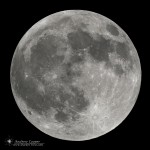
A bright trio can be seen tonight as Saturn, the Moon and Spica rise together after sunset. The three will be within 6° of each other. The Moon will be just short of full, over 99% illuminated as it rises. Saturn will be shining at 0.4 magnitude while Spica is very close to 1.0 magnitude.
Poli’ahu is the goddess of snows who calls Mauna Kea her home. Poli’ahu i ke kapu, recently released by Hāwane, is a tribute to Poli’ahu, the divine snow goddess of Mauna Kea.
True, the sales of the song on iTunes go to KAHEA’s Hawaiian-Environmental Alliance Mauna Kea Legal Defense Fund. This is the same group that opposes telescopes on the mountain. The Enemy? Not really. In this case I respect those who stand up for what they believe, even if I disagree. KAHEA does needed work on other fronts across the islands.
Besides, it is a good song…
Here is the stream for tonight’s Keck lecture. Nothing to see if you stop by early (or late). Come by at 7:00pm HST to see Dr. Richard Wainscoat of the University of Hawai’i Institute for Astronomy, “City Dark: Search for Night on a Sleepless Planet.”
Better yet… drop by the Kahilu Theater in Waimea to see the talk in person.
You are invited to attend a free Keck Observatory lecture…

Dr. Richard Wainscoat
University of Hawai’i Institute for Astronomy
Kahilu Theater
Thursday, April 5th, 2012
7:00pm
The advent and spread of electrical lighting has made it ever harder to find the dark skies valued by professional and amateur astronomers, not to mention lovers of starry skies in general. Dr. Wainscoat tells the story about light pollution and astronomy, with special emphasis on light pollution’s effects on the world’s best astronomical observing site: Mauna Kea on the Big Island of Hawai’i. Dr. Wainscoast is an astronomer as well as an accomplished photographer.
There is no charge for admission to any events in the Makana series.
Presented by W.M. Keck Observatory.
